
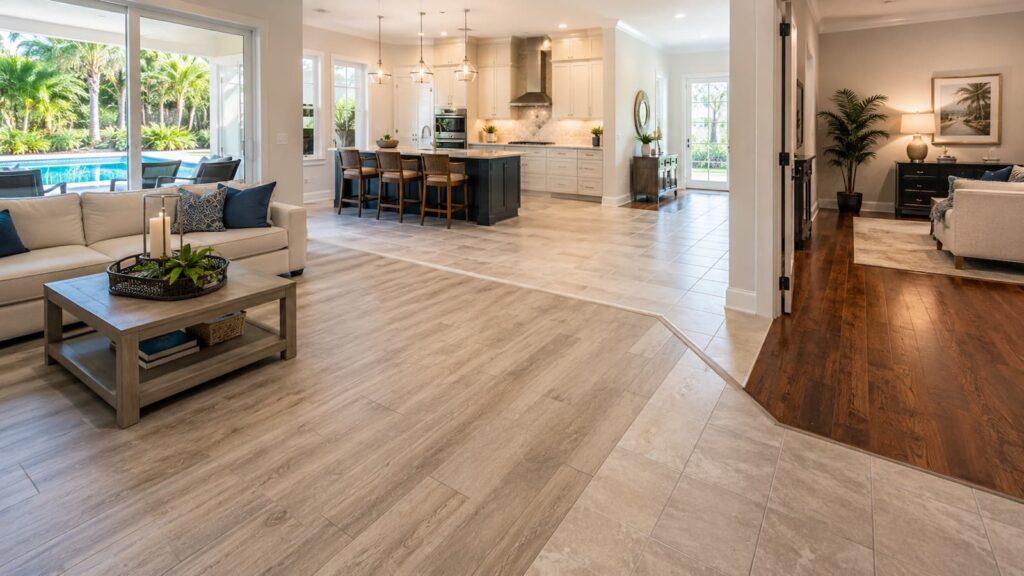
Choosing flooring for a Florida home is different from choosing flooring in a cooler, drier part of the country. In many places, homeowners can focus mostly on appearance, price, and general durability. In Florida, those things still matter, but they are only part of the decision. A floor here also needs to handle humidity, heat, sudden rain, sandy shoes, wet pets, air conditioning cycles, concrete slab foundations, and the occasional plumbing or appliance leak.
A floor that works well in a dry bedroom may be the wrong choice for a bathroom, laundry room, or entryway where water exposure is part of everyday life. The same material can also perform differently depending on whether it is installed over a flat concrete slab, an older subfloor, or a surface with previous moisture damage. That is why choosing flooring for a Florida home should start with the room, the conditions underneath the floor, and the way the home is actually used — not just with a color sample or a product label.
Luxury vinyl plank, tile, laminate, and hardwood can all make sense in the right situation. They can also become frustrating if they are installed in the wrong room, over the wrong surface, or without enough attention to moisture and floor preparation.
For many Florida homeowners, the best overall choice will be luxury vinyl plank, often called LVP, because it offers a strong balance of water resistance, comfort, style, and everyday practicality. For wet areas and long-term durability, tile is still one of the strongest materials available. Laminate can be a smart budget-friendly option in dry spaces, especially bedrooms and offices. Hardwood remains the premium natural flooring choice, but in Florida it requires more careful product selection, climate control, and installation planning.
The right answer depends on the home. A family with kids and pets may need a different floor than a retired couple living in a condo. A rental property near the coast may need a more durable and forgiving material than a formal living room in a carefully climate-controlled home. A house built on a concrete slab may require different preparation than a home with a wood subfloor. A room with past water damage should be approached differently than a dry bedroom that rarely sees spills.
This guide compares LVP, tile, laminate, and hardwood from a Florida homeowner’s point of view. We will look at moisture resistance, comfort, maintenance, cost, installation requirements, slab conditions, pet performance, room-by-room recommendations, and the mistakes homeowners should avoid before investing in new flooring.
Why Flooring Choice Matters So Much in Florida
Florida is hard on floors in ways that are easy to underestimate. Even if a home is clean, air-conditioned, and well maintained, the flooring is still exposed to conditions that influence long-term performance. Humidity is the obvious factor, but it is not the only one. Homes in Largo, Clearwater, St. Petersburg, Palm Harbor, Tampa Bay, and other coastal or near-coastal areas often experience a combination of moisture, sand, sun exposure, and heavy indoor-outdoor traffic.
Many Florida homes are also built on concrete slabs. A concrete slab can be an excellent base for flooring, but only when it is clean, flat, dry enough, and properly prepared. A slab that looks acceptable at first glance may still have dips, high spots, old adhesive residue, cracks, moisture vapor concerns, or uneven transitions between rooms. Those issues can affect every flooring material differently.
A floating LVP floor can flex or separate if the slab has too much variation. Large-format tile can crack or show lippage if the substrate is not flat enough. Laminate can be affected by moisture if the correct underlayment and installation details are ignored. Hardwood over concrete requires special care because wood is naturally sensitive to moisture movement.
Florida homes also deal with water in small but common ways. Not every water problem is a flood or storm event. Sometimes the issue is a slow refrigerator line leak, a dishwasher drip, a washing machine overflow, an AC condensate problem, a water heater leak, or rainwater near an entry door. The flooring material you choose can determine whether that event is a quick cleanup or a replacement project.
Before choosing flooring, homeowners should think through several practical questions:
- Is the room dry, damp, or regularly exposed to water?
- Is the existing slab or subfloor flat enough for the new material?
- Has the home had any previous water damage?
- Will pets, kids, tenants, or frequent guests use the space heavily?
- Is comfort underfoot important?
- Is low maintenance a priority?
- Does the floor need to continue through multiple connected rooms?
- Will direct sunlight hit the floor for long periods?
- Is the goal budget-friendly replacement, long-term durability, or premium appearance?
These questions matter because the “best” flooring is not simply the product with the best marketing claim. It is the product that fits the real conditions of the home.
Quick Comparison: LVP, Tile, Laminate, and Hardwood
Before going deep into each material, it helps to compare the four major options at a high level. This does not replace a room-by-room decision, but it gives a useful starting point.
| Flooring Type | Best For | Main Strength | Main Weakness |
|---|---|---|---|
| Luxury Vinyl Plank | Living rooms, bedrooms, kitchens, rentals, pet-friendly homes | Strong balance of water resistance, comfort, and style | Needs a flat surface; quality varies by product |
| Tile | Bathrooms, kitchens, laundry rooms, entries, high-traffic areas | Excellent moisture resistance and long-term durability | Hard underfoot; grout requires maintenance |
| Laminate | Bedrooms, offices, dry living areas, budget-conscious updates | Good appearance and scratch resistance for the price | More vulnerable to moisture than LVP or tile |
| Hardwood | Bedrooms, formal rooms, premium living spaces | Natural beauty and upscale feel | Sensitive to humidity, water, and scratches |
A high-quality LVP installed over a properly prepared slab can outperform a cheaper product installed poorly. Tile can last for decades, but only when the substrate, layout, and installation are handled correctly. Laminate can be a smart choice in a dry bedroom but a poor choice in a laundry room. Hardwood can be beautiful in the right space and troublesome in the wrong one.
The material matters, but the room and installation matter just as much.
Luxury Vinyl Plank Flooring in Florida Homes
Luxury vinyl plank has become one of the most popular flooring choices in Florida because it fits the way many people actually live. It offers the appearance of wood, but with better moisture resistance and less maintenance than traditional hardwood. It feels softer than tile, works well in many rooms, and can create a clean continuous look across open floor plans.
For homeowners who want one practical flooring material for living areas, bedrooms, hallways, and sometimes kitchens, LVP is often the first option worth considering. It is not perfect for every situation, but it is one of the most balanced choices for Florida homes.
What LVP Is and Why It Works Well in Florida
Luxury vinyl plank is a layered synthetic flooring product designed to look like wood planks. Most LVP products include a protective wear layer, a printed design layer, a core, and a backing layer. Some products are flexible glue-down planks, while others are rigid click-lock planks installed as floating floors.
You may also see terms such as SPC and WPC. SPC stands for stone plastic composite, and these products usually have a dense rigid core. WPC stands for wood plastic composite, and these floors often feel slightly softer or more cushioned. Both can work well, but the best choice depends on the room, subfloor, product quality, and installation method.
LVP works especially well in Florida because it addresses several major concerns at once. It is more moisture-friendly than laminate and hardwood, more comfortable than tile, easier to maintain than natural wood, and available in styles that fit Florida interiors. Many homeowners want a bright, coastal, natural, or modern wood-look floor, and LVP gives them that appearance without the same level of risk associated with real wood in a humid climate.
Another reason LVP is attractive in Florida is that it can often be installed over concrete slabs when the slab is properly prepared. Since many local homes are built on slab foundations, this matters. However, “can be installed over concrete” does not mean “can be installed over any concrete in any condition.” Flatness, moisture, surface cleanliness, and old flooring residue still need to be evaluated.
That is why proper surface preparation matters so much before installing vinyl plank flooring. LVP can perform very well in Florida homes, but it needs a flat, stable base to support the locking system and prevent movement over time.
Main Advantages of LVP
LVP’s biggest advantage is its practical moisture resistance. In many cases, the planks themselves can tolerate surface spills and everyday wet traffic better than wood-based products. This is valuable in homes where pets drink from water bowls, kids come in from the yard, guests arrive during a rainstorm, or kitchen spills happen during normal use.
LVP is also comfortable. Tile can be extremely durable, but it is hard and unforgiving underfoot. LVP has more resilience, which makes it easier to live with in bedrooms, family rooms, and kitchens where people stand for longer periods. For homeowners who want a floor that feels warmer and less rigid than tile, LVP is often a better everyday experience.
Maintenance is another major advantage. LVP generally does not require sealing, refinishing, or grout care. Regular sweeping and damp mopping are usually enough, as long as the homeowner follows the manufacturer’s cleaning instructions and avoids harsh products that can damage the finish.
LVP also works well aesthetically. It can imitate oak, maple, walnut, driftwood, weathered wood, and modern wide-plank styles. In open Florida homes where the kitchen, living room, dining area, and hallway connect visually, LVP can create a consistent look without switching materials every few feet.
Key benefits of LVP include:
- Strong resistance to everyday surface moisture
- Comfortable feel compared with tile
- Wide range of wood-look styles
- Good option for open floor plans
- Lower maintenance than hardwood
- No grout lines to clean
- Practical for pets and families
- Often suitable for concrete slab homes when properly installed
For many homeowners, the biggest appeal is not one single feature. It is the combination. LVP looks good, performs well, and does not demand the same level of caution as hardwood or the same comfort trade-off as tile.
Potential Drawbacks of LVP
LVP is not perfect. The biggest issue is that it requires a suitable surface underneath. Floating LVP systems in particular need a flat floor. If the slab has low spots, high spots, waves, or uneven transitions, the planks may move, flex, click, separate, or wear prematurely. Some homeowners blame the flooring product when the real problem was an uneven surface.
This is why floor preparation matters. If the existing concrete or subfloor is not flat enough, floor leveling may be needed before installation. This is not just a cosmetic step. It is often the difference between a floor that performs well and a floor that develops problems.
Another limitation is that waterproof planks do not make the entire room waterproof. If a major leak sends water underneath the floor, moisture can still become trapped. The LVP itself may survive, but the subfloor, underlayment, baseboards, or surrounding materials may not. Homeowners should still treat leaks seriously.
LVP can also dent or gouge under heavy concentrated weight, especially lower-quality products. Dragging furniture, moving appliances without protection, or using sharp furniture legs can cause damage. Direct sunlight and heat can also be an issue for some products, especially near large glass doors or sunrooms, so manufacturer specifications should be reviewed.
Best Rooms for LVP in Florida Homes
LVP is often one of the best choices for living rooms, bedrooms, hallways, family rooms, dining areas, home offices, and many kitchens. It can also work well in rental properties because it provides a good balance of cost, appearance, durability, and maintenance.
It is especially useful for homeowners who want the look of wood but do not want the humidity sensitivity of hardwood or the hardness of tile. In a typical Florida home, LVP may be the most practical “whole-home” flooring option, especially when paired with tile in bathrooms or laundry rooms.
LVP is usually a strong choice for:
- Living rooms
- Bedrooms
- Hallways
- Family rooms
- Home offices
- Dining areas
- Many kitchens
- Rental homes
- Pet-friendly homes
- Open floor plans
- Some laundry rooms, depending on installation details
It may be less ideal in rooms with frequent standing water, extreme direct heat, or major slab irregularities that cannot be corrected. In those cases, tile or a different installation method may be the better choice.
Tile Flooring in Florida Homes
Tile has been one of the most common flooring choices in Florida for decades, and it is easy to understand why. In a warm, humid state where homes often deal with wet shoes, sandy entryways, pets, frequent cleaning, and occasional plumbing leaks, tile offers something many other flooring materials cannot match: long-term stability in moisture-prone conditions.
For homeowners who want a floor that feels solid, cleans easily, and can handle heavy daily use, tile remains one of the strongest options available. It is especially useful in bathrooms, kitchens, laundry rooms, entryways, pool-adjacent areas, and homes where durability matters more than softness underfoot. Tile is not always the most comfortable flooring material, and it does require proper installation, but when it is installed over a well-prepared surface, it can perform well for many years.
Another reason tile works so well in Florida is that it fits the local style of living. Many homes have open layouts, sliding glass doors, patios, and direct access to outdoor areas. Floors in these homes often need to handle more than normal indoor foot traffic. They also need to tolerate sand, moisture, and frequent mopping without becoming damaged or difficult to maintain.
Porcelain vs. Ceramic Tile: Which One Makes More Sense?
Most homeowners choosing tile flooring will compare porcelain and ceramic tile. Both are made from clay-based materials and fired at high temperatures, but they are not identical. Porcelain tile is usually denser, harder, and less porous than standard ceramic tile. That makes it especially useful for flooring in high-traffic and moisture-prone areas.
Ceramic tile can still be a good choice in certain residential settings. It is often more affordable and available in many styles. However, for Florida floors, porcelain is usually the more durable and practical option, especially in kitchens, bathrooms, laundry rooms, and main living areas where the floor needs to handle daily wear.
The choice is not only about strength. Tile also has a major design advantage. Homeowners can choose from:
- Wood-look porcelain tile
- Stone-look tile
- Marble-look tile
- Concrete-look tile
- Large-format tile
- Patterned tile
- Matte or textured finishes
- Light coastal tones
- Warmer Mediterranean-style designs
This flexibility makes tile useful in both modern and traditional Florida homes. It can feel clean and minimal, warm and natural, or more refined depending on the color, size, finish, and layout.
Why Tile Performs So Well in Florida’s Climate
Tile performs well in Florida because it does not react to humidity the way wood-based flooring materials can. It does not swell like traditional laminate, it does not cup like hardwood, and it does not soften or dent the way some resilient floors can under concentrated weight. For rooms where moisture is expected rather than unusual, that stability is a major advantage.
This is especially important in areas such as bathrooms, kitchens, laundry rooms, and entries. In these rooms, water exposure is not hypothetical. Wet feet, splashes, spills, cleaning water, appliance leaks, and humidity are all part of normal use. Tile gives homeowners a surface that can handle those conditions without requiring delicate care.
Tile also works well in warm climates because it stays cool underfoot. Some homeowners love this, especially in living areas, sunlit rooms, and homes with lots of natural light. In Florida, where the cooling effect can feel pleasant for much of the year, this can be a real benefit.
At the same time, that cool, hard feeling is not for everyone. Some homeowners prefer LVP in bedrooms or family rooms because it feels warmer and softer. That is why tile is often best used strategically: in wet zones, high-traffic areas, and spaces where durability matters most.
Main Advantages of Tile Flooring
Tile’s biggest advantage is moisture resistance. When installed properly, tile is one of the safest flooring choices for rooms where water exposure is common. This makes it a natural fit for bathrooms, kitchens, laundry rooms, mudroom-style entries, and pool bath areas.
Durability is another major benefit. Tile can handle pets, heavy foot traffic, sandy shoes, furniture movement, and frequent cleaning. It is also resistant to most surface scratches, which makes it appealing for homeowners who want a floor that does not require constant worry.
Tile is also easy to clean on the surface. Sand, dirt, pet hair, and spills can usually be swept, vacuumed, or mopped without much effort. In Florida homes, where outdoor living often brings more debris indoors, this is a practical advantage.
The strongest benefits of tile include:
- Excellent resistance to moisture
- Strong long-term durability
- Good performance in humid rooms
- Easy surface cleaning
- Resistance to scratches and pet wear
- Cool feel underfoot
- Wide design variety
- Strong performance in kitchens, bathrooms, and laundry rooms
For homeowners who are already planning a bathroom, kitchen, or high-traffic flooring project, proper tile installation is especially important because tile depends heavily on surface preparation, layout, mortar coverage, spacing, and clean transitions.
Potential Drawbacks of Tile Flooring
Tile is durable, but it is not perfect for every room or every homeowner. Its biggest drawback is hardness. A tile floor can feel uncomfortable if you stand on it for long periods, especially in kitchens. It is also less forgiving if a child falls or if a glass, dish, or phone is dropped.
Grout is another consideration. The tile itself may be easy to clean, but grout lines can collect dirt, discolor, crack, or stain over time if they are not installed and maintained properly. Choosing the right grout color, grout type, and tile layout can reduce maintenance, but grout care is still part of owning a tile floor.
Installation quality also matters more with tile than with many other materials. Tile does not hide uneven surfaces well. If the slab or subfloor is not properly prepared, tile can crack, sound hollow, or show uneven edges between pieces. Large-format tile is especially demanding because larger pieces require a flatter surface.
This is why tile should not be chosen only by appearance. Homeowners should also think about the condition of the existing floor, the room’s layout, the tile size, the grout width, and whether the substrate is ready for installation.
Best Rooms for Tile in a Florida Home
Tile is usually one of the best choices for rooms where moisture, traffic, and easy cleaning matter most. It is especially strong in bathrooms because it handles steam, splashes, wet feet, and frequent cleaning better than most flooring materials.
It is also a very good option for kitchens. Kitchen floors deal with spills, dropped utensils, chairs, pets, and heavy daily use. Tile handles those conditions well, although some homeowners prefer LVP in kitchens because it feels softer underfoot.
In laundry rooms, tile is often the safest choice because washing machines, utility sinks, and water heaters can leak. Entryways are another strong use case, especially in Florida homes where rain, sand, and outdoor traffic are common.
Tile is usually best for:
- Bathrooms
- Kitchens
- Laundry rooms
- Entryways
- Pool-adjacent spaces
- High-traffic hallways
- Homes with large pets
- Coastal homes with sand and wet traffic
- Rental properties where long-term durability matters
Tile may be less ideal for bedrooms or rooms where comfort is the main priority. In those spaces, LVP, laminate, or engineered hardwood may feel more comfortable and visually warmer.
Laminate Flooring in Florida Homes
Laminate flooring has improved significantly, and it should not be dismissed automatically. Modern laminate can look attractive, resist scratches well, and offer good value in the right rooms. However, in Florida, laminate needs to be used thoughtfully because moisture is its main weakness.
A lot of homeowners consider laminate because they want the look of wood at a lower price than hardwood. That can be a reasonable goal, especially for bedrooms, guest rooms, offices, and other lower-moisture spaces. The problem comes when laminate is treated as if it performs the same way as LVP or tile. It does not.
Laminate can be a smart choice, but only when the room conditions match the material.
What Laminate Flooring Is
Laminate is a layered flooring product made with a core, a printed design layer, and a protective wear layer. Most laminate is designed to look like hardwood, though some products imitate stone or tile.
The core is what separates laminate from LVP. Many laminate products have fiberboard-based cores. That construction can give laminate a firm feel, but it also makes the product more vulnerable to moisture than vinyl plank. When water reaches the seams or edges, the core can swell, and that damage is usually not reversible.
Some newer laminate products are marketed as water-resistant or waterproof, and they may perform better than older laminate. Still, homeowners should read the product specifications carefully and avoid assuming laminate can be used exactly like tile or LVP.
Why Laminate Can Still Be a Good Choice
Laminate can make sense when the room is dry, the budget matters, and the homeowner wants an attractive wood-look floor. Bedrooms, guest rooms, home offices, and low-moisture living spaces can be good candidates.
Laminate can also offer strong scratch resistance. In some cases, it resists surface scratches better than certain softer vinyl products. This makes it appealing for homeowners with pets or kids, as long as moisture exposure is limited.
Another benefit is appearance. High-quality laminate can have realistic texture, detailed wood visuals, and a more rigid feel than some vinyl floors. In a bedroom or office, where water exposure is unlikely, laminate can provide a polished look without the cost of hardwood.
Main Advantages of Laminate
Laminate’s strongest advantage is value. It can provide a clean, updated wood-look floor at a lower cost than hardwood and sometimes at a lower cost than premium LVP. For homeowners improving bedrooms or dry secondary spaces, that value can be attractive.
Laminate is also relatively comfortable underfoot compared with tile. With the right underlayment, it can feel warmer and quieter than a hard tile surface. That makes it more pleasant in bedrooms, offices, and guest rooms.
It is also available in a wide range of styles, including light oak, gray-brown, natural wood tones, rustic textures, and modern wide-plank visuals. For homeowners trying to update the look of a room without making a premium investment, laminate can be a practical middle-ground option.
Key benefits of laminate include:
- Attractive wood-look appearance
- Often budget-friendly
- Good scratch resistance in many products
- Comfortable compared with tile
- Good option for dry rooms
- Wide range of design choices
- Useful for bedrooms, offices, and guest rooms
Laminate works best when homeowners respect its limitations. It is not a bad material. It is simply not the best answer for every room in a Florida home.
Limitations of Laminate in Florida
Moisture is the main limitation. Laminate is generally not the best choice for bathrooms, laundry rooms, pool-adjacent spaces, or any area where standing water or frequent spills are likely. Even in kitchens, homeowners should be careful. Some water-resistant laminate products may be suitable for certain kitchens, but tile and LVP are usually safer choices in Florida.
Laminate also requires proper acclimation and installation. Expansion gaps, underlayment selection, slab moisture protection, and room conditions matter. If the product is installed too tightly or in the wrong environment, it can buckle, peak, or separate.
Another issue is repairability. If laminate swells or is damaged, it usually cannot be sanded or refinished. Individual plank replacement may be possible, but it depends on the floor layout and installation method.
For homeowners considering installing laminate flooring, the most important step is choosing the right rooms. Laminate can be a strong choice in dry spaces, but it should not be forced into areas where moisture risk is high.
Best Rooms for Laminate in Florida Homes
Laminate is best for bedrooms, guest rooms, home offices, and dry living spaces where moisture exposure is low. It is not usually the best choice for bathrooms, laundry rooms, or rooms with a history of leaks.
It can be especially useful in a home where the owner wants to update several dry rooms on a controlled budget. For example, laminate may make sense in secondary bedrooms while LVP or tile is used in more demanding areas.
Laminate is usually best for:
- Bedrooms
- Guest rooms
- Home offices
- Low-moisture living rooms
- Second-floor dry spaces
- Budget-conscious updates
- Rooms without plumbing fixtures or exterior wet traffic
Laminate is usually not the best choice for bathrooms, laundry rooms, pool entries, or any area where water may sit on the floor. In those spaces, LVP or tile is usually a safer long-term choice.
Hardwood Flooring in Florida Homes
Hardwood has a special appeal that synthetic flooring materials cannot fully duplicate. Real wood has natural grain, warmth, variation, and character. It can make a room feel more refined, more permanent, and more upscale. For many homeowners, hardwood is still the flooring material they love most.
In Florida, however, hardwood requires more caution than LVP, tile, or laminate. Wood is a natural material, and it reacts to moisture. It expands and contracts. It can cup, gap, crown, buckle, or stain if humidity and water exposure are not controlled. That does not mean hardwood is a bad choice for Florida homes. It means it should be used in the right rooms, with the right product, and with realistic expectations.
Solid Hardwood vs. Engineered Hardwood
The difference between solid hardwood and engineered hardwood is especially important in Florida.
Solid hardwood is made from one piece of wood from top to bottom. It can often be sanded and refinished multiple times, which is one of its biggest advantages. However, it is more sensitive to moisture movement. In many Florida homes, especially homes built on concrete slabs, solid hardwood can be more complicated.
Engineered hardwood has a real wood top layer over a layered core. This construction usually makes it more dimensionally stable than solid hardwood. For many Florida homes, engineered hardwood is often the more practical option.
That does not mean every engineered hardwood product is automatically a good choice. Quality varies widely. The thickness of the wear layer, the stability of the core, the finish system, the installation method, and the manufacturer’s moisture requirements all matter.
Why Homeowners Still Choose Hardwood
Hardwood offers a premium feeling that is hard to replace. It works beautifully in bedrooms, dining rooms, offices, formal living spaces, and homes where natural materials are part of the design. For homeowners who care deeply about authenticity, hardwood may be worth the extra cost and maintenance.
Hardwood can also age in a way that some homeowners appreciate. While vinyl and laminate are usually replaced when they wear out, some hardwood floors can be refinished, depending on the product. That gives hardwood a different kind of long-term value.
Main benefits of hardwood include:
- Natural beauty and authentic wood grain
- Premium appearance
- Warm feel underfoot
- Strong design appeal
- Potential refinishing options depending on product
- Good fit for bedrooms, offices, and formal rooms
- Timeless look that does not rely on printed visuals
Hardwood is rarely chosen because it is the easiest floor to maintain. It is chosen because homeowners want the real material and are willing to care for it properly.
Limitations of Hardwood in Florida
Humidity is the biggest concern. Wood naturally expands and contracts as moisture levels change. If indoor humidity is not controlled, hardwood can move. This is why air conditioning, acclimation, product choice, and installation method matter.
Water exposure is another concern. Hardwood is not ideal for bathrooms, laundry rooms, or areas with frequent spills. Even in kitchens, it requires careful use and quick cleanup. A small spill is not usually a disaster if cleaned quickly, but repeated moisture exposure or a hidden leak can cause serious damage.
Hardwood is also more vulnerable to scratches and dents than tile. Pets, furniture, high heels, and dragged objects can leave marks depending on the wood species and finish.
Cost is another factor. Hardwood is usually more expensive than LVP, laminate, and many tile options. For homeowners who want low maintenance above all else, hardwood may not be the best fit.
Best Rooms for Hardwood in Florida Homes
Hardwood works best in dry, climate-controlled spaces where appearance and warmth matter more than moisture resistance. Bedrooms, formal living rooms, dining rooms, and offices are usually better candidates than bathrooms or laundry rooms.
In Florida, engineered hardwood is often the better choice than solid hardwood, especially in homes built on concrete slabs. Before installing hardwood flooring, homeowners should think carefully about the room, the slab or subfloor, the home’s humidity control, and the product’s installation requirements.
Hardwood is usually best for:
- Primary bedrooms
- Guest bedrooms
- Formal living rooms
- Dining rooms
- Home offices
- Dry, climate-controlled spaces
- Rooms where premium appearance is the main priority
Hardwood is usually not ideal for bathrooms, laundry rooms, pool-adjacent areas, or homes with recurring water issues.
Best Flooring for Florida Humidity and Moisture
Humidity and water exposure are related, but they are not the same thing. A humid room has moisture in the air. A water-exposed room has spills, wet feet, leaks, splashes, or standing water risk. Florida homes often deal with both, so it is important to think about them separately.
Tile performs best in humid environments because it does not absorb moisture or expand like wood-based products. LVP is also a strong performer because vinyl is not as moisture-sensitive as laminate or hardwood. Laminate can work in dry, controlled spaces, but it is more vulnerable if moisture reaches the core. Hardwood is the most sensitive and requires the most attention to indoor climate control.
A practical ranking for humidity resistance looks like this:
- Tile — most stable in humid and wet environments
- LVP — very good for everyday humidity and surface moisture
- Laminate — acceptable in dry rooms with proper installation
- Hardwood — beautiful but most sensitive to humidity changes
For true water exposure, tile usually wins. A properly installed tile floor is the safest option for bathrooms, laundry rooms, and wet entries. LVP is also strong for everyday spills and wet traffic, although water should not be allowed to remain trapped underneath the floor. Laminate is more risky because water can enter seams and cause swelling. Hardwood should be protected from standing water.
For wet rooms, the most practical choices are usually:
- Bathrooms: tile first, LVP in some cases
- Laundry rooms: tile first, LVP as a possible alternative
- Kitchens: tile or LVP
- Entryways: tile or LVP
- Pool-adjacent spaces: tile is usually the strongest choice
If a room has already had a leak or moisture problem, the existing flooring should be inspected carefully before a new floor is installed. Covering a moisture issue with new material can create bigger problems later.
Flooring Over Concrete Slabs in Florida
Concrete slab foundations are common in Florida, and they influence flooring decisions more than many homeowners realize. The slab is the foundation of the flooring system. If it is uneven, contaminated, cracked, or moisture-prone, the finished floor may not perform correctly.
Tile, LVP, laminate, and engineered hardwood can all be installed over concrete in the right conditions, but they each have different requirements. Tile needs a stable, properly prepared surface. If the slab has cracks, movement, or uneven areas, those issues may affect the tile. Large-format tile requires especially careful flatness.
LVP can work very well over concrete, but floating floors require a flat surface. If the slab has dips or humps, the locking system can be stressed over time. Laminate can be installed over concrete with proper underlayment and moisture precautions, but it is less forgiving if moisture is present. Engineered hardwood over concrete requires the most careful planning. Moisture testing, approved adhesives or underlayment systems, and product specifications are critical.
Common slab issues include:
- Low spots or dips
- High spots or ridges
- Hairline cracks
- Old adhesive residue
- Moisture vapor concerns
- Uneven room transitions
- Surface contamination
- Previous flooring damage
If those problems are ignored, the new flooring may look good at first but fail earlier than expected.
Why Floor Leveling Can Be a Critical Step
Floor leveling is one of the least glamorous parts of a flooring project, but it can be one of the most important. Homeowners often want to spend the budget on the visible floor, but the surface underneath determines how that floor behaves.
An uneven floor can cause different problems depending on the material. LVP may flex, click, separate, or feel hollow. Laminate may move or develop gaps. Tile may crack or show lippage. Hardwood may not sit properly or may develop movement.
Floor leveling is especially important when:
- The old floor was removed and revealed uneven concrete
- There are visible dips or high spots
- Doors and transitions show height differences
- Large-format tile is being installed
- Floating LVP or laminate is being installed
- Previous flooring failed because of movement
- The home has an older slab
In some homes, leveling the surface is not an optional upgrade. It is the step that allows the new flooring to perform the way it is supposed to.
Subfloor Problems Homeowners Should Not Ignore
Not every flooring issue starts with the finish material. Sometimes the real problem is underneath. A damaged or unstable subfloor can make any new floor fail, no matter how good the product is.
Subfloor issues are especially important in rooms with previous leaks, older flooring, soft spots, or visible movement. If the surface feels spongy, bouncy, uneven, or unstable, installing new flooring over it may only hide the problem temporarily.
Warning signs of subfloor trouble include:
- Soft spots underfoot
- Squeaking or movement
- Musty smells
- Uneven or sagging areas
- Old water stains
- Loose or cracked tile
- Flooring that lifts or separates
- Previous leak history
- Visible damage after old flooring is removed
If these signs are present, repairing the subfloor may be needed before the new floor is installed. This is especially true with tile and hardwood, where stability is critical, but it also matters for LVP and laminate.
A good flooring project should not simply cover problems. It should correct the conditions that would cause the next floor to fail.
Water-Damaged Flooring in Florida Homes
Water damage is one of the most common reasons homeowners replace flooring in Florida. It does not always come from severe weather. Many flooring failures begin with ordinary household leaks.
A refrigerator supply line may drip slowly behind the appliance. A dishwasher may leak under the cabinets. A washing machine may overflow. A toilet seal may fail. A water heater may leak. An AC condensate line may back up. Rainwater may enter near a door. In each case, the visible floor may be only part of the problem.
Different flooring materials react differently to water:
- Tile may survive surface water, but the substrate or surrounding areas can still be affected.
- LVP may not swell from surface water, but moisture trapped underneath can create odor or hidden damage.
- Laminate can swell at seams and edges if water reaches the core.
- Hardwood can cup, buckle, stain, or warp.
The key question after water exposure is not only whether the floor still looks acceptable. The real question is whether moisture reached underneath and stayed there. If water was trapped below the floor, replacement may be safer than trying to preserve a compromised installation.
When moisture has affected the flooring system, replacing water-damaged flooring is often about more than appearance. It is about removing damaged material, checking the underlying surface, and installing a floor that makes sense for the room’s future risk.
Best Flooring by Room in a Florida Home
Choosing flooring room by room is usually smarter than choosing one material in the abstract. Each room has different moisture exposure, comfort expectations, traffic levels, and maintenance needs.
Living Rooms and Family Rooms
Living rooms and family rooms need a balance of style, comfort, and durability. These are often the spaces where homeowners want the floor to look warm and inviting, but they also need it to handle daily traffic, furniture, pets, kids, and guests.
LVP is often the best all-around choice for Florida living rooms because it gives a wood-look appearance without the moisture sensitivity of hardwood. It is more comfortable than tile and easier to maintain than real wood. Tile can also be a strong choice, especially in homes where durability and easy cleaning matter more than softness. Hardwood can work beautifully in formal or carefully controlled living spaces, while laminate can be a budget-friendly option in lower-moisture rooms.
Kitchens
Kitchens need flooring that can handle spills, dropped utensils, chair movement, food messes, pets, and frequent cleaning. In Florida, kitchens are often connected to living areas, so visual continuity also matters.
Tile and LVP are usually the strongest choices. Tile offers excellent water resistance and long-term durability. LVP feels softer underfoot and can continue smoothly into nearby living spaces. Laminate may work in some kitchens if the product is water-resistant and the homeowner is careful, but it is generally riskier than LVP or tile. Hardwood can look beautiful in kitchens, but it requires quick cleanup and more caution.
Bathrooms
Bathrooms are true wet zones. They involve steam, splashes, wet feet, toilet overflows, cleaning products, and sometimes poor ventilation. Because of that, tile is usually the best bathroom flooring choice.
Porcelain tile is especially strong because of its density and moisture resistance. Proper installation, waterproofing details where needed, and good grout selection all matter. LVP may be suitable in some bathrooms, especially powder rooms or lower-risk residential bathrooms, but installation details are important. Laminate and hardwood are generally not the best choices for Florida bathrooms.
Bedrooms
Bedrooms are usually lower-risk spaces, so homeowners have more flexibility. Comfort, warmth, quietness, and appearance often matter more than maximum water resistance.
LVP is a strong bedroom choice because it is comfortable, easy to maintain, and works well if the same flooring continues from the hallway or living area. Laminate can also be a good bedroom option, especially for budget-conscious projects. Hardwood is beautiful in bedrooms and can create a premium, warm atmosphere. Tile is less common in bedrooms because of its hardness, although some Florida homeowners like tile throughout the home for durability and cooling benefits.
Laundry Rooms
Laundry rooms are high-risk areas because washing machines, utility sinks, water heaters, and plumbing connections can leak. The floor should be selected with water exposure in mind.
Tile is usually the strongest laundry room flooring choice. It can handle moisture, cleaning, and appliance movement better than most materials. LVP can also work if installed correctly and if leaks are handled quickly. Laminate and hardwood are usually not ideal for laundry rooms because water risk is too high.
Entryways and Hallways
Entryways and hallways deal with sandy shoes, wet feet, pets, packages, furniture movement, and frequent traffic. In Florida homes, these areas often connect directly to outdoor spaces, garages, patios, or driveways.
Tile is excellent for entryways because it handles sand and moisture well. LVP is also a strong choice because it is comfortable, easy to clean, and visually consistent with living areas. Hardwood and laminate can work in some hallways, but they are less ideal near exterior doors where wet traffic is common.
Best Flooring for Different Florida Homeowners
The best flooring choice often depends on lifestyle. A material that works perfectly for one homeowner may be wrong for another.
Busy Families
Families need floors that are forgiving. Kids spill drinks, drop toys, drag chairs, run through the house, and track in dirt. The best family flooring is not necessarily the hardest material; it is the material that handles daily chaos without constant worry.
LVP is often the strongest all-around family option in Florida. It is more comfortable than tile, easier to maintain than hardwood, and more water-resistant than laminate. For living rooms, bedrooms, hallways, and many kitchens, it gives families a practical balance of durability and comfort.
Tile is also excellent for families in wet or high-traffic spaces. It handles spills, sandy shoes, pets, and heavy use extremely well. The trade-off is hardness. In rooms where children sit, play, or fall, tile may feel less comfortable than LVP.
For most busy Florida families, the strongest combination is often LVP in main living areas and bedrooms, with tile in bathrooms, laundry rooms, and possibly kitchens.
Pet Owners
Pets change the flooring decision in practical ways. A floor must handle claws, water bowls, accidents, shedding, dirt from outside, and frequent cleaning. It should also provide enough traction and comfort for the animal, especially for older dogs.
LVP is often one of the best choices for pet owners because it balances moisture resistance, easy cleaning, and comfort. It is softer than tile, which can be easier on paws and joints, and it does not have grout lines that collect dirt. A textured LVP surface can also provide better traction than slick tile.
Tile is another excellent pet-friendly option from a durability perspective. It resists scratches and is very easy to clean. However, it can be hard and slippery, especially for older pets. Area rugs or runners can help in main pathways.
Laminate can resist scratches well, but pet accidents are a concern. If urine or water reaches seams and sits too long, swelling can occur. Hardwood is the most sensitive option for pets because claws can scratch the finish and accidents can damage the wood if not cleaned quickly.
Rental Property Owners
Rental properties need flooring that looks good, photographs well, handles turnover, and does not require delicate maintenance. Owners also need to think about repairability and long-term cost, not only initial installation price.
LVP is often the best flooring for Florida rental properties because it gives tenants an updated wood-look surface while offering good resistance to moisture and daily wear. It is easier to live with than hardwood, more comfortable than tile, and generally more forgiving than laminate.
Tile can be an excellent choice in bathrooms, kitchens, and entries. In some rental properties, tile throughout the home may make sense, especially if durability is more important than comfort. However, grout maintenance and installation cost should be considered.
Laminate can be tempting because of price, but it is riskier in rentals because tenants may not clean spills quickly or report leaks early. Hardwood is usually best reserved for higher-end rentals where the owner is comfortable with maintenance and possible refinishing.
Coastal Homes
Coastal Florida homes face sand, humidity, wet feet, salt air, and frequent outdoor traffic. Even if the home is not directly on the beach, coastal living often means more abrasive particles and more moisture entering the home.
Tile and LVP are usually the strongest options. Tile handles sand and moisture extremely well and is easy to clean. LVP offers similar everyday practicality with a softer feel and a warmer visual style.
Hardwood can be used in coastal homes, but it requires more control and maintenance. Sand can scratch finishes, and humidity must be managed. Laminate should be used carefully and mostly in dry spaces.
For coastal homes, the best flooring is usually easy to clean, moisture-resistant, and not overly delicate. Matte finishes, textured surfaces, and medium-tone colors can help hide everyday dust and sand better than very dark or very glossy floors.
Homeowners Focused on Resale
Homeowners who are thinking about resale should avoid choosing flooring based only on personal taste. The safest choices are usually durable, neutral, and appropriate for the home’s price point.
In many Florida homes, high-quality LVP and tile are well accepted because buyers understand their practical benefits. LVP can make a home feel updated and cohesive, especially when it runs through connected living areas. Tile can signal durability in kitchens, bathrooms, and high-traffic zones. Engineered hardwood can add premium appeal in bedrooms, dining rooms, and formal spaces.
Very trendy colors, low-quality products, poor transitions, and visible installation issues can hurt the impression of a home even if the material itself is popular. For resale, the quality of the installation and the suitability of the flooring often matter as much as the material choice.
Cost and Long-Term Value
Flooring cost is not only the price of the material. The final cost depends on removal of old flooring, disposal, preparation, leveling, repairs, underlayment, transitions, baseboards, layout complexity, and labor.
LVP often offers excellent value because it combines attractive design, water resistance, and manageable maintenance. It is not always the cheapest, but it often delivers one of the best performance-to-cost ratios for Florida homes.
Tile may cost more to install because the process is more labor-intensive, but it can last for decades. In bathrooms, kitchens, laundry rooms, and high-traffic areas, tile can be a very smart long-term investment.
Laminate can be cost-effective in dry rooms. The risk is using it in the wrong location. If moisture damages the floor, the initial savings can disappear quickly.
Hardwood is usually the premium option. It can be worth the investment in the right rooms, especially when natural beauty and resale appeal matter. But it is not the most forgiving or lowest-maintenance choice for Florida conditions.
When comparing value, homeowners should consider:
- Expected lifespan
- Maintenance requirements
- Water risk
- Repair difficulty
- Room suitability
- Comfort
- Product quality
- Installation preparation
- Long-term appearance
A cheap floor installed over an unprepared surface is rarely a good value. A well-selected floor installed properly is usually the better investment.
Common Flooring Mistakes Florida Homeowners Should Avoid
Many flooring problems can be prevented before installation begins. The most common mistakes are not always dramatic; they are simple decisions that overlook Florida-specific conditions.
One common mistake is assuming “waterproof” means the whole flooring system is immune to water. Waterproof LVP can resist surface moisture, but water trapped underneath can still cause problems. Another mistake is using laminate in areas where water exposure is likely. Laminate can be a good material, but bathrooms, laundry rooms, and leak-prone kitchens are not usually its best environment.
Homeowners also often ignore slab flatness. This is a major issue with LVP, laminate, and tile. If the floor underneath is uneven, the finished floor may move, crack, separate, or wear poorly.
Another mistake is choosing flooring based only on color. Color matters, but so do wear layer, core construction, finish, slip resistance, texture, installation method, and room conditions.
Some homeowners also choose hardwood without fully considering humidity. Hardwood can be beautiful in Florida, but it needs the right product, the right room, and consistent indoor conditions.
The most important mistakes to avoid are:
- Choosing flooring by appearance alone
- Ignoring slab flatness or subfloor movement
- Assuming waterproof flooring solves every moisture problem
- Installing laminate in wet areas
- Choosing hardwood for rooms with high water exposure
- Skipping preparation to reduce upfront cost
- Forgetting about transitions, door clearances, and baseboards
- Using the same material everywhere without thinking room by room
A good flooring decision should reduce future problems, not simply improve the way the room looks on installation day.
How to Choose the Right Flooring for Your Florida Home
The best way to choose flooring is to start with the room, not the material. A floor that is perfect for a bedroom may be wrong for a bathroom. A product that works beautifully in a climate-controlled living room may be risky in a laundry area.
Start by dividing your home into zones:
- Wet zones: bathrooms, laundry rooms, pool bath areas
- Semi-wet zones: kitchens, entries, mudroom-style spaces
- Dry comfort zones: bedrooms, offices, guest rooms
- High-traffic zones: living rooms, hallways, rentals, family rooms
- Premium appearance zones: dining rooms, formal living rooms, primary bedrooms
Then match the flooring to the zone. Tile is usually best for wet zones. LVP is excellent for high-traffic and whole-home areas. Laminate can work in dry comfort zones. Hardwood belongs in premium dry spaces where the homeowner is ready to maintain it.
The second step is evaluating the surface underneath. If the slab or subfloor is uneven, damaged, or moisture-prone, preparation must be part of the plan. The third step is choosing a product quality level that matches the room. A main living area deserves better flooring than a rarely used guest room. The fourth step is thinking honestly about maintenance. A homeowner who wants low maintenance should be careful with hardwood. A homeowner who dislikes grout cleaning may prefer LVP over tile in some areas.
Final Recommendation: What Is the Best Flooring for Florida Homes?
For most Florida homes, luxury vinyl plank is the best all-around flooring option. It handles everyday moisture well, feels more comfortable than tile, offers attractive wood-look designs, and works in many rooms. It is especially strong for living rooms, bedrooms, hallways, family spaces, pet-friendly homes, and rental properties.
Tile is the best choice where water resistance and maximum durability matter most. Bathrooms, laundry rooms, kitchens, entries, and pool-adjacent spaces are natural places for tile. It is hard underfoot, but its long-term performance in wet areas is excellent.
Laminate is a good option for dry rooms when budget and appearance matter. It can work well in bedrooms, offices, and guest rooms, but it should be used carefully in Florida because of moisture concerns.
Hardwood is the best choice for homeowners who want natural beauty and a premium feel. In Florida, engineered hardwood is often more practical than solid hardwood, especially in slab homes. Hardwood is best reserved for dry, climate-controlled spaces where the homeowner is comfortable with more care.
A smart Florida flooring plan might look like this:
- LVP in living areas, bedrooms, hallways, and family rooms
- Tile in bathrooms, laundry rooms, and wet entries
- Laminate in budget-conscious dry rooms
- Engineered hardwood in selected premium spaces
The best flooring is not the one that wins every category on paper. It is the one that fits your actual home, your climate, your subfloor, your lifestyle, and your long-term expectations.
For homeowners in Largo and nearby areas, working with an experienced flooring contractor can help prevent expensive mistakes before they happen. A good flooring decision starts with the material, but it also depends on the condition of the slab or subfloor, the moisture risk in each room, and the quality of the installation. When those pieces work together, the result is a floor that looks good on day one and continues performing well through Florida’s humidity, rain, sand, pets, traffic, and everyday living.