
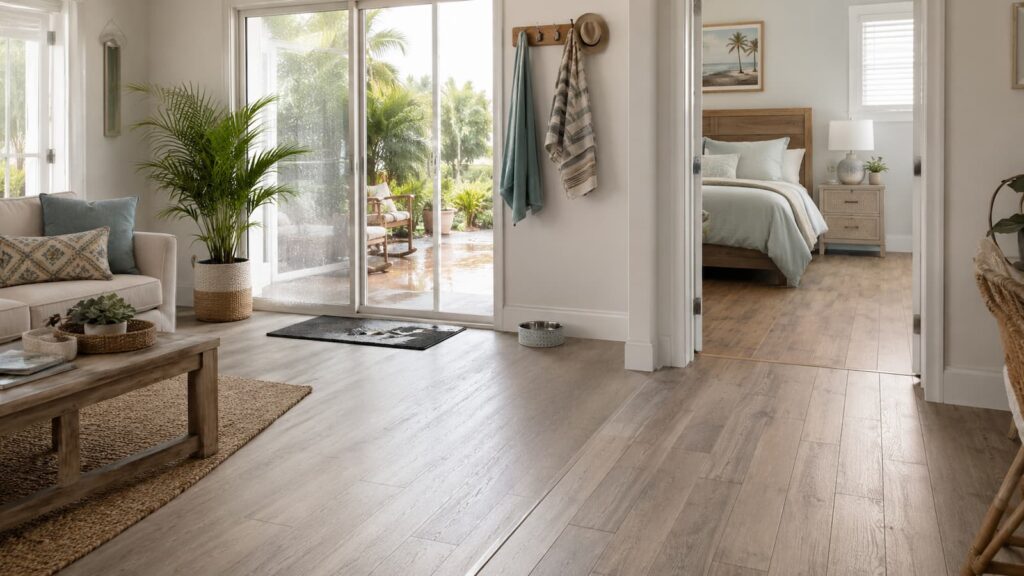
Luxury vinyl plank and laminate flooring are often compared because they can look similar at first glance. Both are popular wood-look flooring options. Both are available in a wide range of colors, textures, and plank sizes. Both can update a home without the cost of real hardwood. But when humidity becomes part of the conversation, the difference between LVP and laminate becomes much more important.
For Florida homeowners, this comparison is not just theoretical. Humidity, concrete slab foundations, wet shoes, pet accidents, kitchen spills, air conditioning cycles, rainy afternoons, and occasional plumbing leaks can all affect how a floor performs over time. A material that looks beautiful in a showroom may behave differently in a humid home near the coast, in a laundry room, or over an older concrete slab that was not properly prepared.
So which one is better for humidity: LVP or laminate? In most humid environments, LVP is the safer and more moisture-resistant choice. Luxury vinyl plank is usually less vulnerable to swelling, edge damage, and moisture-related failure because it is not built around the same type of wood-fiber core found in many laminate products. That does not mean laminate is a bad floor. It can still be a smart choice in dry bedrooms, offices, guest rooms, and low-moisture living spaces. But if humidity, surface moisture, or water exposure are major concerns, LVP usually has the advantage.
The best answer still depends on the room, the subfloor, the product quality, and the installation. A high-quality laminate in a dry bedroom may perform better than a cheap LVP installed over an uneven slab. A waterproof LVP plank can still become part of a failed floor system if water gets trapped underneath it. A water-resistant laminate can handle minor spills better than older laminate, but it should not be treated like tile or vinyl plank in wet areas.
This guide explains the real differences between LVP and laminate flooring in humid homes. We will look at how each material is made, how each one reacts to humidity and water, where each floor works best, what Florida homeowners should consider before installation, and how to avoid common mistakes that lead to swelling, gaps, movement, or premature replacement.
The Short Answer: LVP Is Usually Better for Humidity
If your main concern is humidity, moisture, or occasional water exposure, LVP is usually the better choice than laminate. The reason is simple: most luxury vinyl plank products are made from materials that do not absorb moisture the way wood-fiber-based laminate cores can. When humid air, spills, or damp conditions are part of daily life, that difference matters.
Laminate flooring has improved a lot over the years. Many modern laminate products are more water-resistant than older versions, and some are marketed for better spill protection. But water-resistant laminate is not the same thing as vinyl plank. Laminate can still be vulnerable at the seams, edges, and core if moisture gets inside the floor system. Once swelling happens, it is usually difficult or impossible to reverse.
LVP is more forgiving in humid climates because the plank itself is typically more moisture-stable. It can handle everyday spills, damp mopping, pet bowls, and wet shoes better than many laminate floors. That is one reason LVP has become so popular in Florida homes, especially in living rooms, kitchens, hallways, rental properties, and homes with pets or children.
Still, the answer is not as simple as “LVP good, laminate bad.” A floor is a system, not just a surface. The product, underlayment, slab condition, installation method, expansion space, indoor humidity control, and room use all affect the final result. Choosing the right material is only the first step.
As a practical rule, homeowners can think about it this way:
- Choose LVP for humid rooms, active households, kitchens, hallways, pet-friendly spaces, and areas where water exposure is possible.
- Choose laminate for dry bedrooms, offices, guest rooms, and spaces where budget and scratch resistance matter more than moisture resistance.
- Avoid laminate in bathrooms, laundry rooms, pool-adjacent areas, and rooms with a history of leaks or trapped moisture.
- Prepare the subfloor carefully no matter which product you choose, especially over concrete slabs.
This is the foundation of the LVP vs laminate decision. Now let’s look at why these materials behave so differently.
What Is LVP Flooring?
LVP stands for luxury vinyl plank. It is a multi-layer flooring product designed to look like hardwood planks while offering better resistance to moisture than natural wood or many wood-based floors. The surface usually has a printed design layer that imitates wood grain, a clear wear layer that protects the design, a core layer, and sometimes an attached backing for comfort or sound reduction.
There are different types of LVP, and the construction matters. Some products are flexible glue-down vinyl planks. Others are rigid-core floating floors that click together. Many homeowners also see terms like SPC and WPC when shopping for vinyl plank flooring.
SPC stands for stone plastic composite. SPC floors usually have a dense, rigid core that provides stability and impact resistance. WPC stands for wood plastic composite. WPC floors are often slightly softer and more cushioned underfoot, although quality varies by brand and product line. Both can be good options, but they do not feel or perform exactly the same.
In humid climates, the main advantage of LVP is that the plank itself is generally not made with a moisture-sensitive fiberboard core. That makes it less likely to swell when exposed to humidity or surface moisture. This is especially valuable in homes where floors need to handle wet shoes, pets, spills, and regular cleaning.
However, LVP is not automatically problem-free. A waterproof plank does not make an entire floor waterproof in every situation. If water gets underneath the floor and stays trapped, moisture can still affect the slab, underlayment, baseboards, adhesive, or surrounding materials. LVP is very useful in humid homes, but it still needs correct installation and proper surface preparation.
For homeowners comparing products for a Florida home, the quality of the LVP matters. Important details include:
- Wear layer thickness and durability
- Core type and dimensional stability
- Locking system strength
- Manufacturer moisture requirements
- Texture and slip resistance
- Compatibility with concrete slabs
- Direct sunlight and heat limitations
- Whether the product needs an underlayment or already has one attached
Good LVP can be an excellent flooring choice for Florida homes, but it should still be selected and installed with the actual room conditions in mind.
What Is Laminate Flooring?
Laminate flooring is also a multi-layer product, but it is built differently from LVP. Most laminate floors have a fiberboard-based core, a printed design layer, and a protective wear layer. Like LVP, laminate often imitates hardwood. Some laminate products can look very realistic, especially higher-quality options with textured surfaces and better plank variation.
The core is the key difference. Many laminate floors use high-density fiberboard or similar wood-based material. This gives laminate a firm, solid feel underfoot and can help with scratch resistance, but it also creates the main moisture concern. If water reaches the core through seams, edges, or damaged areas, the material can swell.
This is why older laminate flooring developed a reputation for bubbling, swelling, or peaking after water exposure. Modern products are often better. Some have improved edge sealing, tighter locking systems, water-resistant coatings, and better installation guidelines. But even with those improvements, laminate generally remains more moisture-sensitive than LVP.
Laminate can still be a good flooring material. It can be attractive, affordable, comfortable, and scratch-resistant. It often works well in bedrooms, offices, guest rooms, and dry living areas. The mistake is using laminate in rooms where moisture exposure is likely or assuming that “water-resistant” means “safe anywhere.”
Before choosing laminate, homeowners should look carefully at:
- Whether the product is standard, water-resistant, or marketed as waterproof
- How long spills can sit before cleanup is required
- Whether the seams or edges have additional moisture protection
- What underlayment is required over concrete
- How much expansion space is needed
- Whether the room has plumbing, exterior doors, or past water damage
- Whether the manufacturer allows installation in kitchens or other semi-wet spaces
Laminate is not automatically wrong for Florida homes. It simply needs to be used in the right places. In humid homes, that usually means dry rooms with stable indoor conditions and low water risk.
LVP vs Laminate: How They Handle Humidity
Humidity affects flooring differently than a spill or flood. A spill is liquid water on the surface. Humidity is moisture in the air. In Florida homes, both can matter. Air conditioning usually keeps indoor humidity under control, but doors open, storms roll through, seasonal conditions change, and some homes have rooms that stay more humid than others.
LVP generally handles humidity better because vinyl-based materials are less likely to absorb airborne moisture. The plank itself is typically more dimensionally stable in humid conditions. That makes LVP a safer choice in rooms where the air may occasionally feel damp or where the floor may be exposed to wet traffic.
Laminate is more sensitive because many products rely on wood-fiber cores. Wood-based materials can react to moisture by expanding. Even if the surface wear layer resists moisture, the seams and edges remain important. If humid conditions combine with poor installation, insufficient expansion space, or moisture from the slab, laminate may begin to peak, swell, or gap.
This does not mean laminate will fail just because it is installed in Florida. Many laminate floors perform well in dry, air-conditioned rooms. But laminate has less room for error. The more humidity and moisture risk a room has, the more careful the homeowner needs to be.
A useful way to compare the two materials is to separate three types of moisture exposure:
- Normal indoor humidity: LVP usually performs very well; laminate can perform well in controlled spaces.
- Everyday surface moisture: LVP usually handles wet shoes, pet bowls, and small spills better; laminate needs faster cleanup.
- Water intrusion or trapped moisture: both floors can become part of a bigger problem, but laminate is more likely to swell or show visible damage.
The key difference is not that LVP is invincible. It is not. The key difference is that LVP usually gives homeowners more protection against the type of moisture exposure that happens in real life.
What Happens When LVP Gets Wet?
When LVP gets wet on the surface, the plank itself usually handles the moisture well. This is one of the main reasons homeowners choose it. A spill, wet shoes, or a pet water bowl is less likely to cause swelling or edge damage than it would with many traditional laminate floors.
That said, homeowners should not ignore water just because the product is marketed as waterproof. Water can move between planks, under baseboards, around transitions, or beneath the floor. If it gets trapped underneath, the problem shifts from the plank surface to the floor system below it.
For example, if a refrigerator line leaks and water travels under a floating LVP floor, the planks may not swell, but moisture can remain beneath them. That trapped moisture can cause odor, affect underlayment, damage baseboards, or create conditions that require the floor to be lifted. In a glue-down installation, excessive moisture may also affect adhesive performance depending on the product and conditions.
This is why homeowners should treat water events seriously even with LVP. Quick cleanup is still important. Leaks should be fixed immediately. Areas near appliances, sliding doors, laundry equipment, and exterior entries should be monitored. Waterproof flooring reduces risk, but it does not eliminate common-sense maintenance.
In a humid Florida home, LVP’s biggest strength is that ordinary moisture exposure is less likely to damage the plank itself. This makes it practical for active households, but it still depends on proper installation, good transitions, and a suitable surface underneath.
What Happens When Laminate Gets Wet?
Laminate reacts differently because of its core construction. The surface wear layer may resist moisture for a period of time, but the edges and seams are more vulnerable. If water gets into the core, the material can swell. Once swelling happens, the plank often does not return to its original shape.
This is why laminate damage often appears as raised seams, swollen edges, bubbling, cupping, peaking, or uneven plank joints. The damage may start small, especially near a kitchen sink, pet bowl, exterior door, bathroom doorway, or laundry area. Over time, it can become more noticeable.
Water-resistant laminate improves the situation, but it does not remove all risk. Many products can handle spills for a limited time if the water is cleaned quickly. Some may have edge treatments that reduce moisture penetration. But homeowners still need to follow the manufacturer’s instructions carefully. If the product says spills should be cleaned within a specific time window, that matters.
Humidity can also contribute to problems when laminate is installed without enough expansion space or over a slab with moisture concerns. Laminate needs room to expand and contract. If it is pinned under trim, installed too tightly against walls, or placed in a room with fluctuating moisture conditions, it may buckle or peak.
This does not make laminate a poor product. It means laminate should be used with realistic expectations. In dry rooms, it can perform well and look excellent. In humid or moisture-prone spaces, LVP is usually the safer choice.
LVP vs Laminate Over Concrete Slabs
Concrete slab foundations are common in Florida, so the LVP vs laminate decision often depends on what is happening underneath the floor. Concrete may look solid, but it can still have moisture vapor, surface irregularities, old adhesive residue, low spots, high spots, cracks, and uneven transitions between rooms.
LVP can work very well over concrete, but the slab must be suitable for the product. Floating LVP generally needs a flat surface because the locking system depends on stable support. If the floor has dips or high points, the planks may flex, click, separate, or feel hollow. Glue-down LVP has different requirements, but it still needs a clean, properly prepared surface.
Laminate can also be installed over concrete in the right conditions, but moisture precautions are especially important. A proper underlayment or vapor barrier may be required depending on the product. If slab moisture is ignored, laminate can be affected from below, even if the surface looks dry.
Both LVP and laminate can fail if the slab is not flat enough. This is one of the most common problems homeowners overlook. A flooring sample may look perfect in the store, but once installed over an uneven slab, the finished floor may move or wear unevenly.
Common concrete slab issues include:
- Low areas that create movement under floating planks
- High spots that stress locking systems
- Old adhesive or residue from previous flooring
- Hairline cracks or surface damage
- Moisture vapor coming through the slab
- Uneven transitions between rooms
- Previous water damage hidden under old flooring
If the slab is uneven, leveling the surface may be necessary before either LVP or laminate is installed. This is especially important for floating floors because they rely on consistent support across the room.
In general, LVP is more forgiving than laminate when it comes to humidity, but neither material should be installed over a problem slab without preparation. The best flooring choice still needs the right foundation.
Room-by-Room: Where LVP or Laminate Makes More Sense
The best way to compare LVP and laminate is not just by product category. It is by room. Humidity and moisture exposure change from one space to another, even inside the same home. A bedroom may be dry and stable, while a kitchen, entryway, or laundry room may deal with regular moisture and traffic.
Living Rooms and Family Rooms
Living rooms and family rooms are often good candidates for both LVP and laminate, but LVP usually has the advantage in busy Florida homes. These spaces often connect to kitchens, patios, hallways, and exterior doors. They may see pets, guests, kids, sandy shoes, and occasional spills. LVP’s moisture resistance and easy maintenance make it a practical choice.
Laminate can still work well in a living room if the space is dry, climate-controlled, and not exposed to frequent wet traffic. It may be appealing when budget matters or when the homeowner prefers the feel of a rigid laminate plank. But if the living area connects directly to a patio, pool area, or kitchen, LVP is usually safer.
Bedrooms
Bedrooms are usually lower-moisture spaces, which makes laminate more reasonable. A good laminate floor can look attractive, resist scratches, and provide a comfortable feel underfoot. If the bedroom does not have exterior wet traffic, plumbing fixtures, or a history of moisture problems, laminate can be a smart budget-friendly option.
LVP is also excellent in bedrooms, especially when homeowners want the same flooring to continue through hallways and living areas. It is easier to maintain and more moisture-resistant than laminate, but it may cost more depending on the product. For bedrooms, the decision often comes down to budget, comfort preference, and whether the homeowner wants one continuous flooring type throughout the home.
Kitchens
Kitchens are where the difference between LVP and laminate becomes more important. Kitchens have spills, sinks, dishwashers, refrigerator lines, dropped food, chair movement, and frequent cleaning. Even careful homeowners cannot completely avoid moisture in a kitchen.
LVP is usually the better choice for kitchens because it handles everyday surface moisture more confidently. It also allows homeowners to create a continuous wood-look floor between the kitchen and living area. Laminate may be possible if the product is specifically designed for water resistance and installed carefully, but it carries more risk. A dishwasher leak or slow refrigerator line drip can damage laminate quickly if moisture reaches the core.
Bathrooms
Bathrooms are not ideal for laminate. Even water-resistant laminate is usually not the best choice in a room with steam, splashes, wet feet, toilet overflows, and frequent cleaning. The risk of water reaching seams and edges is simply too high.
LVP may be used in some bathrooms, especially powder rooms or lower-risk bathrooms, but tile is often the strongest bathroom flooring choice overall. If the decision is only between LVP and laminate, LVP is clearly the safer option. Installation details still matter, especially around edges, toilets, tubs, showers, and transitions.
Laundry Rooms
Laundry rooms are high-risk areas because washing machines, utility sinks, and nearby water heaters can leak. Laminate is usually not a good choice here. Even if the floor looks fine at first, one overflow or slow leak can cause swelling and replacement.
LVP is a better option than laminate in laundry rooms, but tile is often even stronger if water risk is a major concern. If LVP is used, homeowners should still respond quickly to leaks and avoid allowing water to remain under appliances or near walls.
Entryways and Hallways
Entryways and hallways in Florida homes often deal with sandy shoes, rainwater, pets, and heavy foot traffic. LVP generally performs better in these areas because it is easier to clean and less vulnerable to moisture at the surface.
Laminate can work in interior hallways that stay dry, but it is less ideal near exterior doors, garage entries, patio doors, or pool access. If wet traffic is common, LVP is the more practical choice.
LVP vs Laminate for Pets, Kids, and Busy Homes
Humidity is important, but most homeowners are not choosing flooring for humidity alone. They also need to think about how the floor will handle daily life. Pets, children, guests, furniture, toys, water bowls, sandy shoes, and cleaning habits all affect flooring performance.
For pets, LVP is often the better all-around choice. It handles water bowls, minor accidents, damp paws, and frequent cleaning better than laminate. It also feels softer than tile, which can be helpful for older dogs. A textured LVP surface can provide better traction than a slick, glossy floor.
Laminate can be good for scratch resistance, and some high-quality laminate products handle pet claws well. But moisture from pet accidents is the concern. If urine or water gets into the seams, swelling can occur. For pet owners who are choosing between LVP and laminate, LVP is usually safer.
For families with children, the logic is similar. LVP is more forgiving around spills, dropped drinks, wet shoes, and regular cleaning. Laminate can work well in bedrooms or playrooms if water exposure is limited, but it is not as low-stress in kitchens, entries, or shared living areas.
In busy homes, LVP usually has the stronger practical profile:
- Better resistance to surface moisture
- Easier cleanup after spills
- Good comfort underfoot
- Useful for open layouts
- More forgiving in rooms with mixed use
Laminate is still worth considering in dry rooms where scratch resistance, appearance, and budget matter. But if the home is active, humid, and moisture-prone, LVP is usually the easier floor to live with.
Installation Matters More Than Many Homeowners Realize
Product choice matters, but installation can determine whether the floor performs well or fails early. This is especially true in humid climates and slab homes. Even the better material can develop problems if it is installed over an uneven surface, trapped moisture, old adhesive residue, or a damaged subfloor.
For LVP, the most common installation-related problems include movement, clicking, plank separation, hollow spots, and edge stress caused by an uneven slab. A floating LVP floor needs support. If the subfloor has dips or high spots, the locking system can be stressed every time someone walks across the room.
For laminate, installation details are even more sensitive to moisture and expansion. Laminate needs proper acclimation, expansion gaps, underlayment, and moisture protection over concrete. If the floor is installed too tightly or moisture is not controlled, it may peak, buckle, or swell.
Before installing either material, the existing floor should be evaluated for:
- Flatness and level changes
- Moisture concerns
- Soft or unstable areas
- Old adhesive, residue, or debris
- Cracks or slab damage
- Transition heights between rooms
- Door clearance
- Baseboard and trim requirements
If soft spots, previous water damage, or structural movement are present, simply covering the problem with a new floor is not a good solution. In some cases, repairing the subfloor is necessary before either LVP or laminate can be installed properly.
When the subfloor is stable, flat, and dry, both materials have a much better chance of performing as expected. When the base is ignored, even a high-quality product can disappoint.
What About Water-Resistant Laminate?
Water-resistant laminate deserves a fair discussion because it is much better than older laminate in many cases. Some modern laminate products have improved seam protection, better locking systems, coated edges, and warranties that allow limited exposure to spills. For the right room, this can make laminate a more practical choice than it used to be.
However, water-resistant laminate should not be confused with a flooring material that can handle ongoing moisture, standing water, or hidden leaks. Most water-resistant laminate still depends on quick cleanup and proper installation. If moisture reaches the core and remains there, swelling can still happen.
Water-resistant laminate may make sense in a bedroom, office, hallway, or low-moisture living area where occasional small spills are possible but not frequent. It is less ideal in bathrooms, laundry rooms, and areas near exterior doors where wet traffic is routine.
Before choosing water-resistant laminate, homeowners should read the product details carefully. Pay attention to:
- How long spills can remain before cleanup
- Whether wet mopping is allowed
- Whether the product is approved for kitchens
- Whether bathrooms or laundry rooms are excluded
- What underlayment or vapor barrier is required
- What installation steps are required to maintain warranty coverage
The improvement in laminate technology is real, but for humidity and water exposure, LVP still usually has the advantage.
Maintenance in Humid Homes
Maintenance is another area where LVP and laminate differ. Both are generally easy to clean, but they do not tolerate the same habits. In a humid home, cleaning methods can either protect the floor or create avoidable problems.
LVP is usually easier to maintain because it is more tolerant of damp cleaning. That does not mean homeowners should flood the floor with water, but a lightly damp mop is usually acceptable when used with the right cleaner. Spills should still be wiped up promptly, especially near seams, walls, and transitions.
Laminate requires more caution. Excess water during cleaning can enter seams and cause swelling. Steam mops are often not recommended, and wet mopping may void some warranties. Laminate should usually be cleaned with a dry or slightly damp method, using products approved by the manufacturer.
For humid homes, good maintenance habits include:
- Wiping spills quickly, even on moisture-resistant floors
- Using mats near exterior doors, kitchens, and pet bowls
- Avoiding excessive water during mopping
- Keeping indoor humidity reasonably controlled
- Checking appliance lines and plumbing fixtures regularly
- Using furniture pads to prevent scratches and dents
- Following the manufacturer’s cleaning instructions
Good maintenance will not turn laminate into LVP, and it will not make LVP immune to every water problem. But it can help either floor last longer and look better.
Cost and Long-Term Value
Laminate is often chosen because it can be more affordable than premium LVP. For dry rooms, this can make sense. If a homeowner wants to update bedrooms or a home office on a controlled budget, laminate may provide an attractive result without overspending.
LVP may cost more depending on the product, but it often provides better long-term value in humid homes because it can be used in more rooms with less moisture concern. If the floor will run through living areas, kitchens, hallways, or pet-friendly spaces, the additional investment may be worthwhile.
The true cost of flooring is not only material price. It also includes removal of old flooring, subfloor preparation, leveling, underlayment, transitions, baseboards, layout complexity, and future replacement risk. A cheaper floor that fails in the wrong room can become more expensive than a better floor installed correctly the first time.
When comparing LVP and laminate, homeowners should think about value in four ways:
- Initial cost: laminate may be less expensive in some cases.
- Room flexibility: LVP usually works in more areas of the home.
- Moisture risk: LVP usually reduces risk in humid or active spaces.
- Replacement risk: laminate can become costly if it swells or fails due to moisture.
For dry rooms, laminate can be a good value. For humid rooms or whole-home flooring projects, LVP often provides better long-term confidence.
Common Mistakes When Choosing Between LVP and Laminate
Many flooring problems start before installation, when the wrong product is chosen for the room. LVP and laminate can both perform well, but they need to be matched to the conditions of the home.
One common mistake is choosing laminate for a room that regularly sees moisture. A homeowner may like the price or appearance, but if the room has exterior wet traffic, pet accidents, plumbing fixtures, or appliance leak risk, laminate may not be the safest choice.
Another mistake is assuming all LVP is equal. Cheap vinyl plank with a weak locking system, thin wear layer, or poor dimensional stability can still create problems. LVP is generally better for humidity than laminate, but quality still matters.
Homeowners also sometimes ignore floor flatness. This can affect both materials. A floating floor installed over dips or high spots may move, click, separate, or feel unstable. This is especially common in homes with older concrete slabs or after old tile has been removed.
The most important mistakes to avoid include:
- Choosing based only on color or price
- Using laminate in bathrooms or laundry rooms
- Assuming water-resistant laminate is the same as LVP
- Ignoring slab moisture or uneven concrete
- Skipping needed surface preparation
- Using excessive water when cleaning laminate
- Ignoring manufacturer installation requirements
- Installing flooring over soft, damaged, or unstable areas
A good flooring decision should reduce future problems. The right material in the right room, installed over the right surface, will usually perform better than a popular product chosen without context.
What If Your Current Floor Already Has Moisture Damage?
If your existing floor is swollen, soft, musty, buckling, separating, or stained, the decision between LVP and laminate should wait until the underlying problem is understood. Installing new flooring over moisture damage can trap the problem and lead to another failure.
Moisture damage can come from many sources: refrigerator lines, dishwashers, washing machines, water heaters, toilets, AC condensate lines, exterior doors, or past leaks that were never fully addressed. Sometimes the surface floor looks like the main problem, but the subfloor or slab conditions matter more.
Warning signs that moisture may have affected the flooring system include:
- Swollen laminate edges
- Soft or spongy areas underfoot
- Musty odors
- Dark staining near walls or appliances
- Flooring that lifts or separates
- Baseboard swelling or discoloration
- Repeated moisture near the same area
When water has already affected the floor, replacing water-damaged flooring may involve more than removing the visible material. The damaged flooring needs to come out, the surface underneath should be checked, and the replacement material should be chosen based on the room’s future moisture risk.
In a room with a previous moisture problem, LVP is often a better replacement choice than laminate. But if the source of moisture is not fixed, even LVP may not solve the bigger issue.
LVP vs Laminate: Quick Comparison Table
For homeowners who want a simple side-by-side view, here is the practical difference between LVP and laminate in humid homes.
| Category | LVP | Laminate |
|---|---|---|
| Humidity resistance | Usually very good | Good in dry, controlled rooms; more sensitive overall |
| Surface water | Handles everyday spills better | Needs faster cleanup; seams and edges are vulnerable |
| Core material | Typically vinyl or rigid composite | Often wood-fiber based |
| Best rooms | Living rooms, kitchens, hallways, bedrooms, rentals, pet-friendly homes | Bedrooms, offices, guest rooms, dry living spaces |
| Bathrooms | Possible in some cases, though tile may be stronger | Usually not recommended |
| Laundry rooms | Better than laminate, but leaks still matter | Usually not recommended |
| Scratch resistance | Good, varies by product | Often strong, especially quality products |
| Comfort | Comfortable and resilient | Comfortable, firmer feel |
| Concrete slab use | Good when slab is flat and properly prepared | Possible with proper underlayment and moisture protection |
| Best overall for humidity | Usually the better choice | Better for dry spaces than moisture-prone areas |
This table does not mean LVP is always the best floor for every room. It means LVP is usually more reliable when humidity and moisture are important parts of the decision.
Final Recommendation: Which One Should You Choose?
If you are choosing flooring specifically for humidity, LVP is usually the better choice. It is more moisture-resistant, more forgiving around everyday spills, and better suited for the way many Florida homes are used. It works well in living areas, hallways, many kitchens, bedrooms, pet-friendly homes, rental properties, and open layouts where homeowners want one continuous wood-look floor.
Laminate is still a good option in the right setting. It can be attractive, scratch-resistant, comfortable, and budget-friendly. It makes the most sense in dry bedrooms, offices, guest rooms, and spaces where water exposure is unlikely. If the room is controlled, the product is high quality, and the installation is done properly, laminate can be a smart choice.
The decision becomes clearer when you think room by room:
- Choose LVP for kitchens, hallways, living areas, pet-friendly spaces, and rooms with possible moisture exposure.
- Choose laminate for dry bedrooms, offices, guest rooms, and budget-conscious updates.
- Avoid laminate in bathrooms, laundry rooms, and rooms with exterior wet traffic or past leaks.
- Check the slab or subfloor before installing either material.
For homeowners in Florida, the safest all-around answer is usually LVP. But the best result comes from choosing a quality product, preparing the surface correctly, and installing the floor in a room where it makes sense. If you are comparing materials for a real project, working with an experienced flooring contractor can help you avoid the most common mistakes: choosing the wrong material for the room, ignoring slab conditions, or installing over moisture issues that should be fixed first.
Humidity does not have to ruin a beautiful floor. It just needs to be part of the decision from the beginning. When the material, room, and installation all work together, your flooring is much more likely to stay stable, attractive, and comfortable through Florida’s humid seasons and everyday home life.