
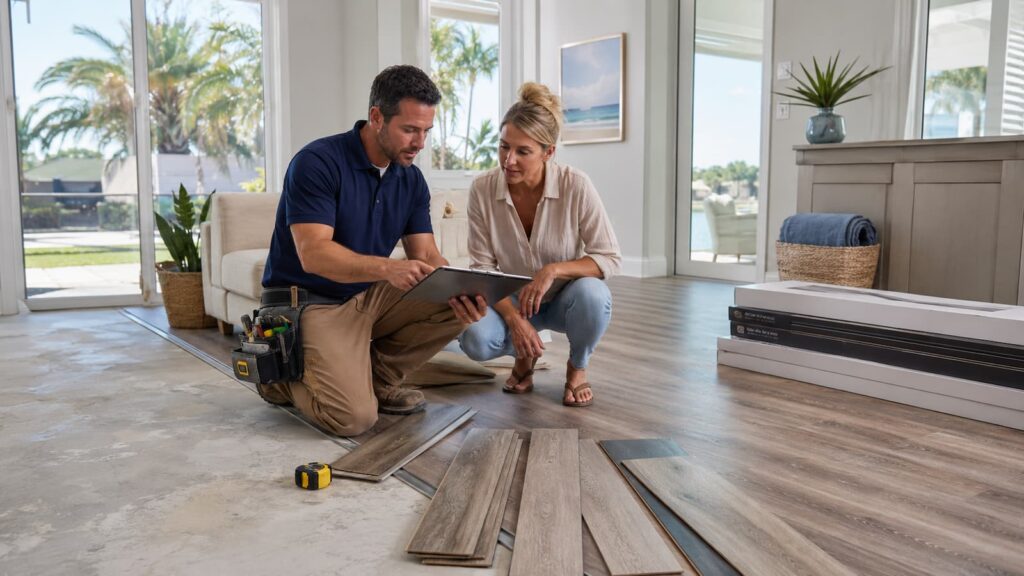
Vinyl plank flooring is popular because it gives homeowners a practical wood-look floor without the cost, moisture sensitivity, or maintenance expectations of real hardwood. It works well in many Florida homes, especially where homeowners want a surface that feels modern, handles everyday spills, and can run through living rooms, bedrooms, hallways, and kitchens with a clean, consistent look. But before choosing a product or scheduling installation, most homeowners want to know the same thing: how much does vinyl plank flooring installation cost?
The honest answer is that vinyl plank flooring installation cost depends on much more than the price of the planks. Square footage matters, but it is only the starting point. The final budget can change based on product quality, labor, old flooring removal, floor leveling, subfloor repairs, moisture issues, trim work, transitions, room layout, stairs, furniture moving, and whether the installation is click-lock, glue-down, or another method.
For many residential projects, homeowners can expect a broad installed cost range somewhere around $4 to $16 per square foot for luxury vinyl plank flooring, depending on materials, labor, and project conditions. Some simple installations may fall toward the lower end, especially if the subfloor is already clean, flat, and ready. More involved projects can cost more when old tile must be removed, the concrete slab needs correction, rooms have complicated cuts, or water damage has affected the floor system.
This guide breaks down vinyl plank flooring cost in a practical way. Instead of giving one vague number, we will look at material costs, labor costs, preparation costs, room-size examples, what increases the price, what may be included in an estimate, and what homeowners should ask before approving the job. The goal is not just to understand what LVP costs, but to understand what you are actually paying for.
If you are planning vinyl plank flooring installation, the most important thing to remember is this: a good floor is not just about the visible plank. It is also about the surface underneath, the installation method, the transitions, the finishing details, and whether the material is appropriate for the room.
The Short Answer: Average Vinyl Plank Flooring Installation Cost
Vinyl plank flooring installation is usually priced by the square foot, but the total cost depends on whether the estimate includes materials, labor, prep work, removal, disposal, trim, and transitions. For a realistic homeowner budget, it is better to think in ranges rather than one fixed price.
In many projects, luxury vinyl plank flooring can fall into these general ranges:
| Cost Category | Typical Range | What It Usually Means |
|---|---|---|
| Basic vinyl plank material | $2–$4 per sq. ft. | Budget or standard products, usually thinner or less premium |
| Mid-range LVP material | $4–$7 per sq. ft. | Better wear layer, more realistic design, stronger core options |
| Premium LVP material | $7–$10+ per sq. ft. | Higher-end design, thicker wear layer, stronger construction, better texture |
| Basic installation labor | $2–$5 per sq. ft. | Installation when the floor is already prepared and layout is straightforward |
| Installed LVP project | $4–$16 per sq. ft. | Material plus labor, with price depending heavily on prep and project complexity |
These ranges are useful, but they are not a substitute for a real estimate. A 600-square-foot project over a clean, flat concrete slab may be fairly straightforward. A 600-square-foot project that requires tile removal, slab grinding, leveling compound, baseboard work, transitions, and moisture-related repairs can cost much more.
For a simple budget estimate, multiply your room’s square footage by the expected installed cost range. Then add a buffer for waste, prep work, and finishing details. Most vinyl plank projects need extra material for cuts, layout, damaged pieces, closets, doorways, and future repairs. A common planning allowance is around 5% to 10% extra material, depending on the room layout and plank direction.
For example, if you are installing LVP in a 500-square-foot area and the installed cost is estimated at $7 to $12 per square foot, the project could land somewhere around $3,500 to $6,000 before unusual repairs or special conditions. A smaller bedroom may cost much less in total, while a whole-home installation can quickly become a larger investment.
What Is Included in Vinyl Plank Flooring Installation Cost?
One reason flooring estimates can be confusing is that different contractors include different items in the price. One estimate may include only labor to install planks over a ready surface. Another may include material delivery, minor prep, underlayment, transitions, baseboard handling, and cleanup. Before comparing prices, homeowners need to understand what each estimate actually covers.
A complete vinyl plank flooring estimate may include several parts:
- Measurement of the installation area
- Material quantity and waste allowance
- LVP product cost
- Installation labor
- Old flooring removal
- Disposal of old material
- Basic subfloor cleaning and preparation
- Underlayment or vapor barrier, if required
- Transition strips between rooms
- Baseboard or quarter-round work
- Doorway cuts and detailed trimming
- Furniture moving, if included
- Final cleanup
Some of these items may be included in the main price, while others may be listed separately. That does not automatically mean one contractor is more expensive than another. A lower estimate may simply exclude work that will be needed later. A higher estimate may be more complete and realistic from the beginning.
The best estimate is clear. It should show what is included, what is not included, what conditions could change the price, and whether the existing floor or slab has been evaluated. Flooring costs become frustrating when homeowners approve a price without knowing whether prep work, transitions, or old flooring removal were part of the plan.
Material Cost: Why Vinyl Plank Prices Vary So Much
Vinyl plank flooring material can vary widely in price because not all LVP products are built the same way. Two planks may look similar in a sample display but perform very differently once installed in a busy home. Product quality affects not only appearance but also comfort, durability, water resistance, scratch resistance, dent resistance, and long-term stability.
Budget vinyl plank may be attractive because of the low price, but it can have a thinner wear layer, less realistic design, weaker locking system, lower dent resistance, or less dimensional stability. Mid-range LVP often gives homeowners a better balance of cost and performance. Premium LVP usually has better texture, stronger surface protection, thicker construction, and more realistic wood visuals.
When comparing LVP materials, homeowners should look at more than the color. Important product details include:
- Wear layer: the protective surface that helps resist scratches and wear
- Total plank thickness: affects feel, stability, and sometimes installation requirements
- Core type: SPC, WPC, flexible vinyl, or another construction
- Locking system: especially important for floating floors
- Texture: helps with realism and traction
- Attached pad: may improve comfort and sound, depending on the product
- Waterproof or water-resistant rating: should be read carefully, not assumed
- Warranty terms: including installation and maintenance requirements
- Sunlight and heat limitations: especially near large windows or sliding doors
In Florida homes, material selection matters because flooring often has to deal with humidity, sandy traffic, pets, and concrete slab conditions. A slightly better product may be worth the difference if it performs better in the rooms where it will be installed.
It is also important to think about the size of the project. For a small bedroom, the difference between a budget and mid-range product may not be huge in total dollars. For a whole-home installation, the same per-square-foot difference can become significant. That is why homeowners should balance product quality with the room’s importance, traffic level, and moisture risk.
Labor Cost: What You Are Paying the Installer to Do
Labor is not only the act of clicking planks together or gluing them down. A good vinyl plank installation requires layout planning, accurate cuts, attention to transitions, surface evaluation, expansion spacing, trim details, and careful handling around walls, doorways, cabinets, closets, and appliances.
Labor cost depends on the installation method. Floating click-lock LVP may be faster in some rooms, but it still requires a flat surface and careful layout. Glue-down LVP can be a good choice in some settings, especially commercial or high-traffic areas, but it demands a smooth, properly prepared surface and more attention to adhesive requirements.
Labor also increases when the room layout is more complex. A large rectangular room is easier to install than a space with many closets, angled walls, built-ins, islands, doorways, vents, or transitions. Kitchens can be more involved because installers must work around cabinets, appliances, islands, and tight cuts. Hallways often require careful alignment because long narrow areas can make small layout mistakes more noticeable.
Labor pricing may be affected by:
- Total square footage
- Number of rooms
- Room shape and layout complexity
- Installation method
- Amount of cutting around obstacles
- Transitions between different flooring types
- Baseboard or quarter-round details
- Stairs or step-down areas
- Furniture and appliance movement
- Condition of the existing surface
When comparing installation quotes, homeowners should not assume the lowest labor price is automatically the best deal. Vinyl plank flooring can look simple, but mistakes in layout, cuts, expansion space, or subfloor prep can cause visible problems later. A clean professional installation often depends on work that happens before the first plank is placed.
Old Flooring Removal and Disposal
Old flooring removal can be one of the biggest cost variables in a vinyl plank project. Installing over an existing surface may be possible in some cases, but it is not always recommended. The old floor must be clean, stable, flat, and compatible with the new product. If the old floor is loose, damaged, uneven, too thick, moisture-affected, or poorly bonded, it may need to be removed.
Removing carpet is usually less complicated than removing tile. Carpet removal may involve pulling carpet, padding, tack strips, staples, and debris. Tile removal can be much more labor-intensive because ceramic or porcelain tile is bonded to the substrate. Removing tile may also reveal uneven mortar, slab damage, cracks, or height issues that must be corrected before LVP can be installed.
Old vinyl, laminate, or glue-down flooring can also create preparation issues. Adhesive residue, underlayment layers, uneven patches, and moisture-damaged material may need to be removed or corrected. If the previous floor failed because of moisture or movement, simply covering it with LVP can lead to another problem.
Removal costs may depend on:
- Type of existing flooring
- How strongly the old flooring is attached
- Whether old adhesive must be scraped or ground
- Whether the floor underneath is damaged
- Disposal fees and hauling requirements
- Dust control and cleanup needs
- Whether appliances or furniture must be moved
Removal is not the most exciting part of the project, but it can be essential. LVP performs best over a properly prepared surface. If old flooring is hiding damage or unevenness, the project cost may increase once the surface is exposed.
Subfloor Preparation and Floor Leveling Costs
Subfloor preparation is one of the biggest reasons two vinyl plank flooring projects with the same square footage can cost very different amounts. A clean, flat, dry concrete slab is much easier to work with than a slab with dips, high spots, cracks, old mortar, adhesive residue, or moisture concerns.
Luxury vinyl plank is often described as an easy flooring material, but it still needs proper support. Floating click-lock LVP can move, click, separate, or feel hollow if the floor underneath is not flat enough. Glue-down LVP can telegraph imperfections or bond poorly if the surface is not smooth and clean.
In Florida homes, concrete slab conditions are especially important. Many homes are built on slabs, and those slabs may have slight waves, low spots, high spots, cracks, or remnants from previous flooring. These problems are not always obvious until the old floor is removed.
Common preparation items include:
- Sweeping and cleaning the slab
- Removing old adhesive or residue
- Grinding down high spots
- Filling low spots
- Applying leveling compound
- Addressing cracks or damaged areas
- Checking moisture conditions
- Preparing transitions between rooms
If the existing surface is uneven, floor leveling may be necessary before installation. This can add cost, but it protects the finished floor. Skipping this step to save money can lead to movement, separation, noise, and premature wear.
Homeowners should treat floor prep as part of the flooring system, not as an optional extra. The surface underneath the LVP determines how stable the finished floor feels and how well it performs over time.
Subfloor Repair and Water Damage Can Change the Price
Not every floor is ready for new vinyl plank installation after the old material is removed. Sometimes the issue is not just uneven concrete or minor surface prep. The floor system itself may be damaged, soft, unstable, or affected by moisture. In those cases, the project cost can increase because the problem must be corrected before the new floor is installed.
Warning signs that subfloor or moisture repairs may be needed include soft spots, musty smells, visible staining, swollen old flooring, loose sections, cracked tile, movement underfoot, or baseboard discoloration. These signs should not be ignored. Installing new LVP over a damaged surface may make the room look better temporarily, but the underlying problem can continue.
In rooms with previous leaks, appliance failures, or water intrusion, the existing flooring may need to be removed so the area underneath can be evaluated. Moisture can affect wood subfloors, underlayment, adhesives, baseboards, and even the surface of concrete depending on the situation.
If the floor feels unstable or damaged, repairing the subfloor may be necessary before installing new planks. If the existing flooring has already been affected by moisture, replacing water-damaged flooring may involve removal, inspection, correction, and then installation of the new material.
This is one of the most important budget points for homeowners: water damage and subfloor repair are not cosmetic upgrades. They are the work that allows the new floor to have a stable foundation. Without that foundation, even a good LVP product can fail or feel wrong underfoot.
Click-Lock vs Glue-Down Vinyl Plank Cost
Installation method can affect vinyl plank flooring cost. The two most common options are floating click-lock LVP and glue-down vinyl plank. Each method has advantages, and the right choice depends on the room, slab condition, product type, and long-term performance goals.
Click-lock LVP is installed as a floating floor. The planks lock together and sit over the surface underneath. This method is popular in residential projects because it can be efficient, comfortable, and visually clean. It may also be easier to replace sections in some situations. However, floating floors require proper expansion space and a flat surface. If the slab has dips or high spots, the floor may move or separate.
Glue-down LVP is attached directly to the prepared surface with adhesive. It can be useful in some high-traffic areas or spaces where a lower profile is needed. Glue-down installation requires a very clean, smooth, and suitable surface because imperfections can show through and adhesive performance depends on preparation. Moisture conditions also matter.
Click-lock installation may be more common in residential whole-home projects, while glue-down may make sense in certain kitchens, commercial-style spaces, or areas where the product and substrate are well matched. Neither method is automatically cheaper in every situation because preparation requirements can change the cost.
| Installation Type | Best For | Cost Consideration |
|---|---|---|
| Click-lock floating LVP | Living areas, bedrooms, hallways, many residential spaces | Often efficient, but needs a flat surface and correct expansion space |
| Glue-down LVP | Some high-traffic areas, lower-profile installations, specific project needs | Surface prep is critical; adhesive and smoothness requirements can add work |
The best installation method should be chosen after looking at the room and the existing floor conditions. Choosing the wrong method just to reduce upfront cost can create problems later.
Room Size Examples: What Different Projects May Cost
Square footage is the easiest part of flooring cost to understand, but it can still be misleading. A small bathroom may cost more per square foot because there are many cuts and details. A large open room may cost less per square foot because installation is more efficient. Still, room-size examples can help homeowners create a starting budget.
The following examples use broad installed ranges and are meant for planning, not as fixed quotes. Actual pricing depends on material, labor, prep, removal, transitions, and local project conditions.
| Project Size | Example Area | Estimated Installed Range |
|---|---|---|
| 100 sq. ft. | Small bedroom, office, or closet area | $400–$1,600 |
| 250 sq. ft. | Bedroom, small living room, or dining room | $1,000–$4,000 |
| 500 sq. ft. | Living room plus hallway or several rooms | $2,000–$8,000 |
| 1,000 sq. ft. | Large area or partial home installation | $4,000–$16,000 |
| 1,500 sq. ft. | Whole-home or major flooring project | $6,000–$24,000 |
These numbers show why project conditions matter so much. A simple 1,000-square-foot installation with mid-range material over a clean slab may be far less expensive than the same square footage after tile removal, leveling, repairs, and trim work.
Homeowners should also remember that most projects require extra material for waste. Rooms with many angles, closets, doorways, and plank-direction changes may need more extra material than simple rectangular spaces. Buying too little flooring can delay the project, and finding the same dye lot later may be difficult.
What Factors Increase Vinyl Plank Installation Cost?
Several factors can increase vinyl plank flooring installation cost beyond a basic square-foot estimate. Some are predictable before the project begins. Others become clear after the existing floor is removed. Understanding these factors helps homeowners budget more realistically and avoid frustration.
Existing Flooring Type
The type of flooring currently in the home can affect labor and disposal. Carpet is usually easier to remove than tile. Old glue-down flooring can require scraping or grinding. Existing tile can be difficult and messy to remove, and once it is removed, the slab may need additional preparation before LVP can be installed.
Floor Flatness
LVP needs a flat and stable surface. If the floor has low spots, high spots, or waves, additional prep may be needed. Floating floors are especially sensitive to this because the locking system needs support. Floor leveling can add cost, but it helps prevent movement and plank separation.
Moisture Issues
Moisture can affect installation cost if the floor has previous water damage, slab moisture concerns, or damaged underlayment. Even waterproof vinyl plank should not be installed over an active moisture problem without addressing the source.
Room Layout
Simple rectangular rooms are usually easier to install than rooms with angles, closets, islands, built-ins, multiple doorways, or tight transitions. More cuts mean more time, more waste, and more attention to detail.
Transitions and Trim
Transitions between flooring types can add cost, especially when heights differ between rooms. Baseboards, quarter-round, door casing cuts, and stair noses also affect the final price. These details may seem small, but they influence the finished appearance of the project.
Furniture and Appliances
Moving furniture and appliances may or may not be included in the estimate. Large furniture, refrigerators, washers, dryers, and heavy cabinets require careful handling. Appliance movement can also increase risk of damage if not done properly.
Stairs
Stairs are usually more labor-intensive than flat floors. They require detailed cuts, stair noses, secure installation, and careful finishing. If a project includes stairs, the cost may be calculated differently than standard square-foot installation.
When all these factors are considered, it becomes clear why a phone estimate based only on square footage can be inaccurate. A professional assessment helps identify the work that will actually be required.
Vinyl Plank Flooring Cost by Room
Different rooms can have different installation costs because they involve different levels of moisture risk, layout complexity, and finishing detail. A bedroom is not the same as a kitchen, and a hallway is not the same as an open living room.
Living Rooms and Family Rooms
Living rooms and family rooms are often good candidates for LVP because they are usually larger, more open spaces where the flooring can create a clean visual impact. If the room is rectangular and the slab is in good shape, installation may be relatively straightforward. Costs can increase if the room connects to multiple hallways, has built-ins, requires many transitions, or needs surface correction.
Bedrooms
Bedrooms are usually simpler than kitchens or bathrooms. They often have fewer moisture concerns and fewer complicated cuts. However, closets, furniture moving, baseboard work, and transitions to hallways still matter. Bedrooms are a common place where homeowners may choose a mid-range product rather than the most expensive LVP, especially if traffic is moderate.
Kitchens
Kitchens can cost more because they involve cabinets, islands, appliances, and tight cuts. Appliance movement may be needed, and transitions to nearby living or dining areas must be planned carefully. Kitchens also carry more moisture risk because of sinks, dishwashers, refrigerators, and ice maker lines. LVP can work well in kitchens, but leaks should always be taken seriously.
Hallways
Hallways may look simple, but they can require careful layout because long narrow spaces make alignment very noticeable. Doorways, closets, and multiple room transitions can increase labor. If the hallway connects several rooms, the plank direction and transition strategy should be planned before installation begins.
Bathrooms and Laundry Rooms
LVP can be used in some bathrooms and laundry rooms, but these spaces require more caution. Water exposure is higher, and installation details around toilets, tubs, showers, appliances, and walls matter. In some full bathrooms or laundry rooms, tile may be a stronger choice than LVP because of the wet-area risk. If LVP is used, product approval and installation details should be reviewed carefully.
Room cost is not only about size. A small bathroom can be more detailed and time-consuming than a larger bedroom because of fixtures, cuts, and water-risk details.
Florida-Specific Cost Factors
Florida homes have certain flooring conditions that can affect cost more often than homeowners expect. The biggest ones are concrete slabs, humidity, sand, wet traffic, older tile floors, and water damage from appliances or plumbing.
Concrete slab homes often need more surface evaluation. The slab may not be perfectly flat, especially after old tile or flooring is removed. Some slabs have old adhesive, cracks, low spots, or moisture concerns. These conditions can affect both floating and glue-down LVP installations.
Humidity and indoor-outdoor living also matter. Florida homes often have sliding glass doors, patios, pool areas, pets, and wet shoes. LVP is generally a practical choice for these conditions, but the product should be selected carefully. Some vinyl products may have heat or sunlight limitations near large windows or sunrooms.
Older homes may have multiple layers of flooring, uneven room transitions, or hidden moisture issues. Removing the existing flooring may reveal problems that were not visible before. That does not mean the project was estimated poorly; it means the old flooring was hiding conditions that needed to be addressed.
In Florida, a realistic vinyl plank flooring budget should include room for preparation. The visible plank matters, but the long-term performance of the floor depends heavily on what happens underneath it.
How to Estimate Your Vinyl Plank Flooring Budget
Homeowners can create a rough budget before requesting an estimate by measuring the project area and thinking through the likely add-ons. This will not replace a professional quote, but it can help you understand the scale of the project.
Start by measuring the length and width of each room. Multiply length by width to get square footage. Add closets, hallways, and connected spaces. Then add extra material for waste. For simple rooms, 5% may be enough. For complex layouts, 10% or more may be safer.
A basic budgeting formula looks like this:
- Measure the total square footage.
- Add 5% to 10% for waste.
- Choose a realistic material price range.
- Add labor installation cost.
- Add old flooring removal, if needed.
- Add floor prep, leveling, or repair allowances.
- Add transitions, trim, underlayment, and finishing details.
For example, a homeowner planning 700 square feet of LVP should not buy exactly 700 square feet of flooring. A more practical material order may be around 735 to 770 square feet, depending on layout and waste. If the selected product costs $5 per square foot, that difference matters. If the project also needs removal and leveling, the final cost can change significantly.
It is also wise to keep a few extra planks after the project is complete. If a plank is damaged later, having matching material from the same batch can make repair easier.
DIY vs Professional Vinyl Plank Installation
Some homeowners consider DIY vinyl plank installation because click-lock products can look simple. In a small, square, dry room with a flat surface, a careful DIY project may be possible. But larger projects, kitchens, multiple connected rooms, uneven slabs, transitions, and moisture concerns are much less forgiving.
The cost savings of DIY usually come from avoiding labor. However, mistakes can become expensive. Poor layout can create awkward plank cuts. Insufficient expansion space can cause buckling. Uneven floors can cause movement. Incorrect underlayment can affect performance. Bad cuts around doors and transitions can make the finished project look amateur.
Professional installation is often worth it when:
- The project covers multiple rooms
- The floor must run continuously through open spaces
- The existing slab is uneven
- Old flooring must be removed
- Transitions are complicated
- Kitchen appliances need to be handled
- There are signs of water damage
- The homeowner wants a cleaner finished appearance
DIY may reduce upfront cost, but professional installation can reduce risk. If the floor is part of a larger home improvement investment, the quality of the installation matters as much as the product itself.
Questions to Ask Before Approving an Estimate
A good flooring estimate should be clear enough that the homeowner understands what is included and what could change. Before approving a vinyl plank flooring project, ask specific questions about material, preparation, installation method, and finishing details.
Useful questions include:
- Does the price include materials and labor, or labor only?
- Is old flooring removal included?
- Is disposal included?
- Will the slab or subfloor be checked for flatness?
- What happens if leveling is needed?
- Is underlayment or vapor barrier required?
- Are transitions included?
- Will baseboards be removed, reused, replaced, or finished with quarter-round?
- Who moves furniture and appliances?
- How will doorways, closets, and room transitions be handled?
- What product is being installed, and what are its warranty requirements?
- How long will the project take?
These questions help homeowners compare estimates fairly. A vague low price may become expensive later if important items were not included. A detailed estimate gives a more realistic picture of the project.
How to Save Money Without Hurting the Finished Floor
There are smart ways to control vinyl plank flooring cost, but cutting the wrong corners can create problems. The goal should be to reduce unnecessary expenses without sacrificing the parts of the project that affect long-term performance.
One smart way to save is choosing a good mid-range product instead of the most expensive premium option. Many mid-range LVP products offer strong performance, attractive visuals, and reasonable durability. The most expensive product is not always necessary for every room.
Another way to control cost is preparing the home before the installers arrive. Moving small items, clearing closets, removing fragile decor, and creating access can help the project run smoothly. However, homeowners should not move heavy appliances or furniture unless they can do it safely without damaging the home or floor.
Homeowners can also save by keeping the layout simple. Complicated plank direction changes, unnecessary transitions, or unusual patterns may increase labor and waste. A clean, consistent plank direction often looks better and costs less.
Good ways to control cost include:
- Choosing a quality mid-range LVP instead of the cheapest or most expensive product
- Clearing rooms before installation
- Reducing unnecessary layout changes
- Handling small prep tasks if approved by the installer
- Ordering enough material the first time to avoid delays
- Addressing water or subfloor problems before they become worse
Bad ways to save money include skipping needed floor leveling, installing over damaged flooring, ignoring moisture concerns, buying the cheapest product for a high-traffic area, or hiring based only on the lowest price. These choices may reduce the initial invoice but increase the chance of repair or replacement later.
Common Mistakes That Lead to Higher Costs Later
Many vinyl plank flooring problems are preventable. They often happen because the project was treated as a simple surface update instead of a complete flooring system. The material, slab, subfloor, underlayment, installation method, and finishing details all need to work together.
One common mistake is choosing the cheapest vinyl plank for a high-traffic area. Budget products may be fine in low-use rooms, but busy living areas, kitchens, hallways, and rental properties usually need stronger construction. A weak locking system or thin wear layer can become a problem faster than expected.
Another mistake is ignoring floor flatness. Homeowners may assume the new flooring will hide imperfections, but floating LVP often highlights unevenness through movement or sound. If the floor has dips or high spots, preparation should happen before installation.
Moisture is another issue. Waterproof planks do not solve active leaks or trapped water. If water damage exists, it should be addressed before the new floor goes in. Installing LVP over a moisture problem can lead to odor, mold concerns, damaged baseboards, or another replacement project.
The most common costly mistakes include:
- Choosing flooring based only on color or price
- Skipping floor leveling when the slab is uneven
- Installing over soft or damaged areas
- Ignoring previous water damage
- Forgetting transitions and trim in the budget
- Buying too little material
- Using the wrong installation method for the room
- Assuming all LVP products perform the same
A more complete project plan may cost more upfront, but it often saves money by preventing callbacks, repairs, and premature replacement.
Is Vinyl Plank Flooring Worth the Cost?
For many homeowners, vinyl plank flooring is worth the cost because it offers a strong balance of style, comfort, water resistance, and maintenance. It gives the look of wood without the same sensitivity as hardwood or laminate, and it is usually more comfortable than tile. In Florida homes, that balance is especially valuable.
LVP is often worth considering when the homeowner wants one flooring material for connected living spaces. It can work well in living rooms, bedrooms, hallways, dining areas, and many kitchens. It is also practical for pet owners, families, and rental properties because it is easy to clean and more forgiving around everyday moisture than many alternatives.
That said, LVP is not the best answer for every room. In full bathrooms, laundry rooms, or areas with frequent standing water, tile may be the stronger long-term choice. In rooms where the homeowner wants natural premium material, engineered hardwood may be preferred. The value of LVP depends on matching it to the right space.
Vinyl plank flooring is usually worth the investment when:
- You want a wood-look floor with better moisture resistance than laminate or hardwood
- You want a comfortable surface for living areas and bedrooms
- You need a practical floor for pets, kids, or tenants
- You want easier maintenance than tile grout or hardwood care
- You are willing to invest in proper preparation and installation
The best value comes from choosing a product that fits the room and installing it over a properly prepared surface. A good LVP floor should not only look updated on day one. It should feel stable, clean, and comfortable years later.
Final Thoughts: What Should You Budget?
Vinyl plank flooring installation cost can range widely because every project is different. A basic installation in a clean, prepared room may be relatively affordable. A whole-home project with old flooring removal, slab correction, transitions, baseboard work, and moisture repairs will cost more. The square footage matters, but the condition of the existing floor often matters just as much.
For a realistic starting point, many homeowners should think in terms of a broad installed range of about $4 to $16 per square foot for LVP, with the understanding that simple projects may fall lower within that range and complex projects may move higher. Material quality, labor, prep work, and finishing details all influence the final number.
The smartest way to budget is to separate the project into parts:
- Vinyl plank material
- Waste allowance
- Installation labor
- Old flooring removal and disposal
- Floor preparation or leveling
- Subfloor or moisture repairs
- Transitions, trim, and finishing details
- Furniture and appliance handling
Once you understand these pieces, vinyl plank flooring cost becomes much easier to evaluate. The lowest price is not always the best value, especially if it leaves out preparation work that the floor needs. A better estimate explains the full scope, identifies possible issues, and helps you avoid surprises.
If you are comparing options for a real flooring project, working with an experienced flooring contractor can help you understand what your home actually needs before the installation begins. The right product, the right preparation, and the right installation method are what turn vinyl plank flooring from a simple material purchase into a durable, comfortable, and good-looking floor.