
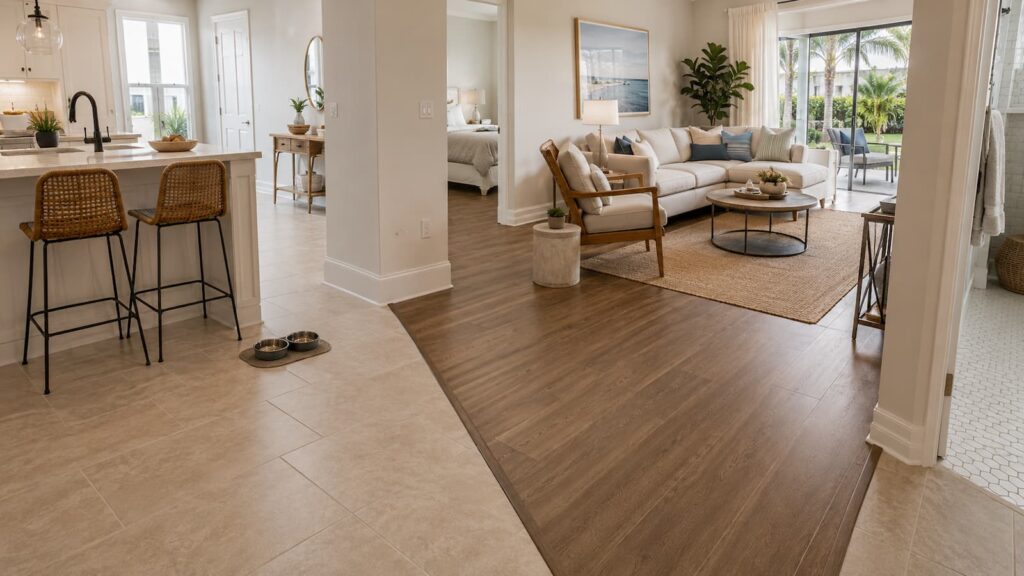
Tile and luxury vinyl plank are two of the most popular flooring choices for homeowners who want a practical, attractive, and durable floor. Both materials can work well in Florida homes. Both can handle daily traffic. Both can look clean and modern. Both can be used in kitchens, bathrooms, and living areas depending on the product and installation. But they do not perform the same way in every room.
The best choice depends on what the room needs most. A bathroom floor has to handle wet feet, splashes, steam, cleaning products, and possible toilet or plumbing issues. A kitchen floor has to deal with spills, chair movement, food messes, pets, heavy traffic, and occasional appliance leaks. A living room floor needs comfort, style, durability, and a surface that feels good underfoot every day. Tile and luxury vinyl plank can both meet some of these needs, but each material has clear strengths and trade-offs.
In many Florida homes, the practical answer is not “tile everywhere” or “LVP everywhere.” Tile is often the strongest choice for bathrooms, laundry rooms, wet entries, and areas where maximum moisture resistance matters. Luxury vinyl plank, often called LVP, is often the better all-around choice for living areas, bedrooms, hallways, and open layouts where homeowners want a warmer wood-look floor with easier comfort underfoot. Kitchens are the closest call: tile wins for long-term water resistance and hardness, while LVP wins for comfort, visual continuity, and everyday livability.
This guide compares tile vs luxury vinyl plank from a homeowner’s point of view. We will look at water resistance, humidity, durability, comfort, maintenance, installation, concrete slab conditions, pets, kids, kitchens, bathrooms, living areas, long-term value, and the mistakes to avoid before choosing either material.
The Short Answer: Tile Wins for Wet Areas, LVP Wins for Comfort and Whole-Home Use
If the room is a true wet area, tile is usually the safer and more durable choice. Bathrooms, laundry rooms, pool-adjacent spaces, and wet entryways are where tile performs especially well. It does not swell from water, it handles humidity easily, and it can last for many years when installed over a properly prepared surface.
If the room is a living area, bedroom, hallway, family room, or open-plan space where comfort and visual warmth matter, luxury vinyl plank usually has the advantage. LVP is softer than tile, warmer underfoot, quieter in many homes, and easier to run through connected spaces without making the home feel hard or cold. It also gives homeowners a wood-look floor with much better moisture resistance than hardwood or laminate.
Kitchens sit in the middle. Tile is excellent for kitchens because it handles water, cleaning, dropped items, and heavy traffic very well. LVP is also excellent because it is more comfortable for standing, handles everyday spills, and can continue into the living room for a clean, open look. The better choice depends on how the kitchen is used, whether the home has pets or kids, how much comfort matters, and how concerned the homeowner is about appliance leaks.
A simple practical breakdown looks like this:
- Bathrooms: tile usually wins.
- Kitchens: tile or LVP can both work well, depending on priorities.
- Living areas: LVP usually wins for comfort and everyday livability.
- Laundry rooms: tile usually wins, with LVP as a possible alternative.
- Open floor plans: LVP often works better if the goal is one continuous surface.
- Coastal or sandy homes: both can work, but tile is more abrasion-resistant and LVP feels more comfortable.
That short answer is helpful, but the details matter. Product quality, installation method, slab condition, subfloor preparation, grout choice, moisture risk, and lifestyle can all change the final recommendation.
What Tile Does Best
Tile has been a favorite flooring material in Florida for a long time because it fits the climate well. In a state where humidity, rain, sandy shoes, pets, and indoor-outdoor living are normal, tile gives homeowners a surface that can handle moisture and heavy use without becoming delicate.
Most residential tile floors are made from porcelain or ceramic tile. Porcelain is usually denser, harder, and less porous than standard ceramic, which makes it especially useful for flooring in high-traffic or moisture-prone spaces. Ceramic can still be a good choice in some rooms, but porcelain is often preferred for long-term durability in kitchens, bathrooms, and main living areas.
Tile’s biggest strength is that it does not react to humidity the way wood-based flooring can. It does not swell like laminate, cup like hardwood, or soften under moisture exposure. In bathrooms and laundry rooms, that stability is a major advantage. In kitchens and entries, it also helps because spills and wet shoes are part of normal life.
Main Advantages of Tile
Tile is one of the strongest choices when moisture resistance is the top priority. It handles wet areas better than most common residential flooring materials. A properly installed tile floor can deal with splashes, spills, mopping, steam, and humidity without the surface itself swelling or warping.
Tile is also very durable. It resists scratches better than many softer floors, holds up well to pets, and performs well in high-traffic areas. For homeowners who want a floor that can last for decades, tile has a strong reputation. This is especially true when the tile is installed correctly over a stable, properly prepared substrate.
Tile also offers a wide range of design choices. It can look like stone, marble, concrete, handmade ceramic, terrazzo, or even wood. Large-format tile can create a sleek modern look, while textured or matte tile can feel warmer and more natural. For bathrooms and kitchens, tile also allows homeowners to coordinate floors with backsplashes, shower walls, and other surfaces.
The strongest benefits of tile include:
- Excellent performance in wet and humid rooms
- Strong resistance to scratches and heavy traffic
- Long lifespan when installed correctly
- Easy surface cleaning
- Good choice for bathrooms, kitchens, laundry rooms, and entries
- Cool feel underfoot in warm climates
- Large design range, from modern to traditional
For bathrooms, kitchens, and high-traffic areas, proper tile installation is especially important because tile depends heavily on surface preparation, layout, mortar coverage, grout spacing, and clean transitions.
Where Tile Falls Short
Tile is durable, but it is not the most comfortable flooring material. It is hard underfoot, which can make long periods of standing more tiring. In kitchens, this can matter a lot. If someone cooks frequently, stands at the sink for long periods, or spends a lot of time walking barefoot at home, tile may feel less forgiving than LVP.
Tile is also less comfortable for children and older adults if falls are a concern. It is unforgiving when dishes, glasses, phones, or fragile items are dropped. It can also feel cold or acoustically hard in some living spaces, especially if the room has minimal rugs, curtains, or soft furnishings.
Grout is another consideration. The tile surface may be easy to clean, but grout lines can stain, discolor, collect dirt, or crack over time if they are not installed and maintained properly. Larger tiles can reduce the number of grout lines, and darker grout can hide some staining, but grout care is still part of owning a tile floor.
Tile also requires careful installation. It does not hide uneven surfaces well. If the slab or subfloor is not flat and stable, tile can crack, sound hollow, or show lippage between pieces. Large-format tile is especially demanding because bigger pieces require a flatter base. This is one reason tile can be more expensive to install correctly than some floating floors.
What Luxury Vinyl Plank Does Best
Luxury vinyl plank is popular because it gives homeowners a wood-look floor that is much more practical around moisture than hardwood or laminate. It is designed to imitate planks of natural wood, but it is built from synthetic layers that usually handle everyday spills and humidity better than wood-based flooring.
LVP is especially attractive in Florida homes because it balances several important needs. It is more comfortable than tile, more water-resistant than laminate, lower-maintenance than hardwood, and available in styles that work well with coastal, modern, transitional, and family-friendly interiors. For many homeowners, that combination makes LVP one of the easiest floors to live with.
There are different types of LVP. Some products are flexible glue-down planks. Others are rigid-core floating floors. Many rigid-core products use SPC or WPC construction. SPC usually feels denser and more rigid, while WPC can feel slightly softer or more cushioned. Product quality varies widely, so homeowners should compare more than color. Wear layer, core type, locking system, texture, thickness, warranty, and installation requirements all matter.
Main Advantages of LVP
LVP’s biggest everyday advantage is comfort. Compared with tile, luxury vinyl plank feels softer, warmer, and more forgiving underfoot. This makes a noticeable difference in living rooms, bedrooms, family rooms, and kitchens where people spend a lot of time standing or walking barefoot.
LVP is also very practical around daily moisture. Many products are marketed as waterproof, meaning the planks themselves are not likely to swell from surface spills. That is helpful in homes with pets, kids, kitchens, entryways, or open layouts where one flooring material runs through multiple spaces.
Another major advantage is visual continuity. Tile often works best in specific rooms, but LVP can run through living areas, hallways, bedrooms, dining spaces, and sometimes kitchens without making the home feel chopped up. In open Florida homes, this can make the space feel larger and more connected.
Key benefits of LVP include:
- Comfortable feel underfoot
- Good resistance to everyday surface moisture
- Wood-look design without hardwood maintenance
- Good option for open floor plans
- No grout lines to clean
- Practical for pets and families
- Often suitable for concrete slabs when the surface is properly prepared
- Useful in many rooms where homeowners want one consistent flooring style
Before installing vinyl plank flooring, the existing surface should still be evaluated carefully. LVP is practical, but it performs best when the slab or subfloor is flat, stable, clean, and suitable for the product.
Where LVP Falls Short
LVP is not the same as tile when it comes to extreme moisture exposure. A vinyl plank may be waterproof, but the entire room is not automatically waterproof. If water travels under a floating LVP floor and stays there, it can create odor, affect underlayment, damage baseboards, or cause problems with the surface underneath.
LVP can also be damaged by sharp impacts, dragging furniture, heavy appliances, or concentrated weight. Lower-quality products may dent, gouge, separate, or show wear faster than expected. Tile is generally harder and more scratch-resistant, while LVP is more comfortable but not indestructible.
Another important limitation is flatness. Many LVP products, especially floating click-lock floors, require a flat surface. If the slab has dips, humps, waves, or uneven transitions, the planks may flex or separate over time. A floor that looks fine right after installation can develop issues later if the base was not prepared properly.
Direct sunlight and heat can also matter. Some vinyl products have limitations near large windows, sliding glass doors, sunrooms, or areas with strong heat exposure. Manufacturer guidelines should always be checked before selecting LVP for a sun-heavy room.
Tile vs LVP for Kitchens
Kitchens are one of the hardest rooms to choose flooring for because they combine style, comfort, moisture, cleaning, and heavy use. A kitchen floor has to handle spills, dropped utensils, chairs, food messes, pet bowls, appliance movement, and occasional leaks from dishwashers, refrigerators, sinks, or ice maker lines.
Both tile and LVP can work very well in kitchens, but they solve the kitchen flooring problem in different ways. Tile is the more durable and water-resistant material. LVP is the more comfortable and visually flexible material. The better choice depends on which trade-off matters more in the home.
Why Tile Works Well in Kitchens
Tile is excellent in kitchens because it handles water and heavy cleaning well. If a sink splashes, a drink spills, or someone mops frequently, tile does not absorb moisture or swell. If chairs move back and forth around a kitchen table, tile is usually very resistant to surface scratches. If pets eat and drink in the kitchen, tile is easy to clean around bowls.
Tile also performs well near appliances. A refrigerator, dishwasher, or range can be heavy, and tile handles concentrated weight better than many softer flooring materials. If the floor is properly installed, it can support daily kitchen activity for many years.
The main downside is comfort. Kitchens are standing rooms. People cook, wash dishes, prep meals, unload groceries, and clean. Standing on tile for long periods can be tiring, especially for homeowners who cook often. Anti-fatigue mats can help near the sink or prep area, but tile will still feel harder than LVP.
Tile also has grout. In a kitchen, grout can collect food residue, grease, spills, and dirt if it is not maintained. Choosing the right grout color and grout type can reduce maintenance, but it will not eliminate it.
Why LVP Works Well in Kitchens
LVP is popular in kitchens because it feels more comfortable and still handles everyday spills well. It is softer than tile, easier on feet and joints, and less likely to break dropped dishes. For homeowners who spend a lot of time cooking, that comfort can make a real difference.
LVP also works well in open kitchen layouts. Many Florida homes have kitchens that flow into dining areas, family rooms, or living rooms. Using LVP across these connected spaces can make the home feel larger and more cohesive. Instead of creating a hard transition between tile in the kitchen and another material in the living room, LVP can create one continuous wood-look surface.
The main caution is water underneath the floor. Everyday spills are usually not the problem. Hidden appliance leaks are. A slow refrigerator line leak, dishwasher leak, or sink leak can travel under LVP. The planks may survive, but moisture beneath the floor can still require removal and inspection.
LVP can also be more vulnerable than tile to dents from heavy appliances or damage during appliance movement. When appliances are moved for repair or replacement, the floor should be protected carefully.
Kitchen Verdict: Tile or LVP?
For kitchens, tile is usually the best choice if the homeowner wants maximum durability, excellent water resistance, and a surface that can handle heavy use with minimal concern. It is especially strong for busy kitchens, rental properties, and homes where appliance leaks or frequent mopping are major concerns.
LVP is usually the better choice if comfort, warmth, and visual continuity matter more. It is a strong option for open kitchens that connect to living areas, homes with kids and pets, and homeowners who want a wood-look floor without switching materials between rooms.
A practical kitchen comparison looks like this:
| Kitchen Priority | Better Choice | Why |
|---|---|---|
| Maximum water resistance | Tile | Handles spills, mopping, and wet conditions very well |
| Comfort while standing | LVP | Softer and more forgiving underfoot |
| Open floor plan continuity | LVP | Can run into living and dining areas naturally |
| Heavy appliance durability | Tile | Hard surface handles weight well when installed correctly |
| Lower grout maintenance | LVP | No grout lines to clean |
| Long-term wet-area confidence | Tile | Best for moisture-prone kitchens |
For many homeowners, the kitchen decision comes down to this: choose tile if durability and water resistance are the top priorities; choose LVP if comfort and a continuous wood-look design are more important.
Tile vs LVP for Bathrooms
Bathrooms are the easiest room to evaluate because they are true wet areas. A bathroom floor is exposed to steam, splashes, wet feet, toilet overflows, cleaning products, humidity, and sometimes poor ventilation. Because of that, moisture resistance is not just a preference. It is a requirement.
Tile is usually the strongest bathroom flooring choice. LVP can work in some bathrooms, especially powder rooms or lower-risk bathrooms, but it requires careful installation and realistic expectations. If the bathroom has a shower, tub, children, heavy use, or frequent standing water, tile is generally the safer option.
Why Tile Usually Wins in Bathrooms
Tile is built for wet environments. Porcelain tile especially performs well in bathrooms because it is dense, durable, and moisture-resistant. It handles splashes and cleaning better than most flooring materials. It also pairs naturally with shower walls, tub surrounds, and bathroom tile design.
Tile’s strength in bathrooms is not only about the tile surface. A properly planned bathroom floor can include appropriate underlayment, waterproofing details where needed, correct transitions, and grout suitable for the room. This creates a more moisture-appropriate flooring system than most floating products can offer.
Tile also handles bathroom cleaning well. Homeowners can clean around toilets, vanities, tubs, and showers without worrying about the flooring material swelling from damp cleaning. Grout maintenance still matters, but tile remains one of the most proven options for wet residential spaces.
When LVP Can Work in a Bathroom
LVP can be used in some bathrooms, especially powder rooms, guest bathrooms, or spaces where water exposure is limited and controlled. It can make the bathroom feel warmer and softer underfoot than tile, and it can continue the same wood-look flooring from nearby rooms.
The concern is water getting underneath the floor. Around toilets, tubs, showers, vanities, and walls, edges and transitions matter. If water repeatedly reaches the perimeter or travels beneath a floating floor, the plank may not swell, but the floor system underneath can still be affected.
LVP may be reasonable in a bathroom when:
- The bathroom is a powder room or low-splash space
- The product is approved for bathroom use
- The installation details are handled carefully
- Water is not allowed to sit around edges or fixtures
- The homeowner wants visual continuity with nearby LVP areas
LVP is less ideal in bathrooms used heavily by children, bathrooms with frequent splashing, poorly ventilated bathrooms, or spaces where leaks have happened before.
Bathroom Verdict: Tile or LVP?
For bathrooms, tile is usually the better choice. It offers the highest level of moisture confidence, especially for full bathrooms, primary bathrooms, kids’ bathrooms, and any space with a tub or shower. LVP can still be considered for powder rooms or lower-risk bathrooms, but it does not replace tile’s proven wet-area performance.
If the bathroom has a history of leaks, soft spots, or water damage, the existing floor should be evaluated before any new material is installed. Covering moisture damage with new flooring can lead to more serious problems later. In some cases, replacing water-damaged flooring is necessary before a durable new bathroom floor can be installed.
The bathroom decision is usually clear: tile is the safest long-term option; LVP is a comfort-oriented alternative only when the moisture risk is limited and the installation is handled carefully.
Tile vs LVP for Living Areas
Living areas are different from kitchens and bathrooms because comfort, appearance, acoustics, and daily livability matter more. A living room floor still needs to be durable, but it usually does not face the same level of water exposure as a bathroom or laundry room.
This is where LVP often becomes the stronger choice. It gives homeowners a warm wood-look surface, feels more comfortable underfoot, and can run through open spaces without making the home feel too hard. Tile can also work very well in living rooms, especially in Florida, but it has comfort and acoustic trade-offs.
Why LVP Often Wins in Living Areas
Living rooms and family rooms are spaces where people relax, walk barefoot, sit on the floor, play with kids, spend time with pets, and move furniture. LVP feels more forgiving in these everyday situations. It is softer than tile, usually quieter, and visually warmer.
LVP is especially useful in open floor plans. Many Florida homes have living rooms that connect directly to kitchens, dining areas, hallways, and sliding glass doors. A continuous LVP floor can make the home feel larger and more unified. It can also help avoid awkward transitions between multiple flooring materials.
For homeowners who want a wood-look living room but do not want to worry about hardwood humidity issues, LVP is often the most practical compromise. It offers the style of wood with better moisture resistance and easier maintenance.
When Tile Works Well in Living Areas
Tile can still be excellent in living areas, especially in Florida homes where durability and easy cleaning are top priorities. Homes near the beach, homes with large dogs, rental properties, and homes with lots of indoor-outdoor traffic may benefit from tile’s toughness.
Large-format tile can create a clean, high-end look in living spaces. Wood-look porcelain tile can also give a plank-style appearance while keeping the durability of tile. In warm climates, some homeowners like the cool feel of tile throughout the home.
The trade-off is comfort. Tile can make a living room feel harder, louder, and less cozy if the space does not include rugs, upholstered furniture, curtains, or other soft materials. It can also be less comfortable for children and pets who spend time on the floor.
Living Area Verdict: Tile or LVP?
For most living areas, LVP is usually the better all-around choice. It provides the right mix of comfort, appearance, moisture resistance, and everyday practicality. Tile is still a strong option when durability, cooling effect, and easy cleaning are more important than softness underfoot.
If the living room connects directly to a patio, pool area, or sandy entry, tile may become more appealing. If the living room is part of an open floor plan and comfort matters, LVP is usually easier to live with.
Moisture and Humidity: Which Material Handles Florida Conditions Better?
Moisture is one of the biggest reasons homeowners compare tile and LVP. Both materials handle humidity better than laminate or traditional hardwood, but they do not handle water in exactly the same way.
Tile has the advantage in true wet conditions. The tile surface itself is not damaged by water, and porcelain tile is especially strong in humid or wet rooms. This makes tile the best choice for bathrooms, laundry rooms, and areas where water exposure is regular rather than occasional.
LVP has the advantage over wood-based flooring, but it is not the same as tile. The plank itself may be waterproof, but water can still travel underneath it. That matters in situations like appliance leaks, toilet overflows, or water entering near exterior doors. If moisture becomes trapped below the floor, the problem may affect the subfloor, underlayment, adhesive, or surrounding materials.
For normal Florida humidity, both tile and LVP can perform well. For standing water or repeated wet conditions, tile is stronger. For rooms where moisture is occasional and comfort matters, LVP is often the better balance.
A practical moisture comparison looks like this:
| Moisture Situation | Better Choice | Reason |
|---|---|---|
| Normal indoor humidity | Tile or LVP | Both can perform well in controlled homes |
| Bathroom splashes and steam | Tile | Better suited for true wet spaces |
| Kitchen spills | Tile or LVP | Tile is tougher; LVP is more comfortable |
| Wet shoes near entry | Tile or LVP | Tile is more durable; LVP is easier for whole-home continuity |
| Appliance leak risk | Tile | More reliable if water exposure is a major concern |
| Pet bowls and minor accidents | LVP or tile | Both can work, but LVP is softer underfoot |
The most important point is that neither material should be installed over hidden moisture damage. If water has already affected the existing floor system, the source of the problem should be fixed before the new floor is installed.
Comfort, Sound, and Everyday Feel
Comfort is where LVP clearly has an advantage. Tile is hard. Some homeowners love the cool, solid feeling, especially in Florida, but others find it tiring in kitchens and too unforgiving in living spaces. LVP feels warmer and slightly softer, which can make it more pleasant for daily use.
Sound is another difference. Tile can create a harder acoustic environment, especially in open rooms with high ceilings and limited soft furnishings. Footsteps, dropped objects, and pet nails may sound sharper. Rugs and furniture help, but the surface itself remains hard.
LVP often feels quieter and less sharp underfoot, especially when installed with an attached pad or appropriate underlayment. However, poor installation over an uneven floor can create clicking, hollow sounds, or movement. Comfort and sound depend not only on the material but also on the quality of the installation.
Homeowners should think carefully about who uses the space. A kitchen used by someone who cooks every day may benefit from LVP’s softer feel. A bathroom used by children may benefit from tile’s moisture resistance. A living room where pets and kids spend time on the floor may feel better with LVP. A coastal entry that sees sand and wet feet may perform better with tile.
Comfort priorities often point this way:
- Best underfoot comfort: LVP
- Best cool surface in hot weather: tile
- Best for long standing: LVP
- Best for solid, permanent feel: tile
- Best for barefoot living areas: usually LVP
There is no universal winner for feel because homeowners have different preferences. But for most living areas and comfort-focused kitchens, LVP is easier to live with.
Durability, Scratches, and Pets
Tile and LVP are both considered durable, but they resist damage in different ways. Tile is harder and more scratch-resistant. LVP is more resilient and forgiving, but it can dent or gouge under certain conditions.
For pets, tile is excellent from a scratch-resistance standpoint. Dog claws are unlikely to damage a quality tile surface. Pet accidents are easy to clean. Sand and dirt can be swept or mopped. The downside is that tile can be slippery or hard on older dogs, especially if the finish is smooth.
LVP is often very pet-friendly because it is softer and easier on paws. It handles water bowls, minor accidents, and daily cleaning better than wood-based flooring. A textured LVP surface can provide better traction than glossy tile. The concern is scratches from large dogs, dents from heavy furniture, or gouges from sharp objects, especially with lower-quality products.
For kids, LVP is often more comfortable because it is softer if a child sits, plays, or falls. Tile is easier to clean and very durable, but it is harder and less forgiving. In family rooms and play areas, LVP usually feels more practical. In bathrooms and entries, tile usually performs better.
A practical durability comparison looks like this:
- Scratch resistance: tile usually wins.
- Dent resistance: tile usually wins.
- Comfort for pets: LVP often wins.
- Water bowl and accident cleanup: both can work well, with tile stronger for repeated moisture.
- Family room comfort: LVP usually wins.
- Long-term heavy traffic: tile usually wins if installed correctly.
For active households, the strongest strategy is often room-specific: tile in wet and gritty areas, LVP in comfort-focused living spaces.
Maintenance and Cleaning
Both tile and LVP are easier to maintain than many natural flooring materials, but they have different cleaning needs. Tile is extremely durable on the surface, but grout can require attention. LVP has no grout, but it needs the right cleaning products and protection from damage caused by dragging or harsh chemicals.
Tile can be swept, vacuumed, and mopped easily. It handles wet cleaning well, which is a major advantage in bathrooms and kitchens. The challenge is grout. Light grout can discolor, especially in kitchens, entries, and high-traffic paths. Sealing grout where appropriate and choosing a practical grout color can help reduce maintenance.
LVP is simple to clean because there are no grout lines. Sweeping and damp mopping are usually enough. Homeowners should avoid steam mops unless the manufacturer allows them, and they should avoid abrasive cleaners that can damage the wear layer. LVP should also be protected from dragged furniture and sharp objects.
For regular maintenance, homeowners should follow these habits:
- Use mats at exterior doors to reduce sand and grit
- Clean spills quickly, even on water-resistant floors
- Use furniture pads under chairs and heavy pieces
- Avoid dragging appliances or furniture across LVP
- Maintain grout in tile areas before staining becomes severe
- Follow manufacturer-approved cleaning instructions
- Check appliance lines and plumbing fixtures regularly
If the homeowner dislikes grout maintenance, LVP may be more appealing. If the homeowner wants a surface that can tolerate frequent wet cleaning, tile may be more appealing.
Installation and Subfloor Preparation
Installation is one of the biggest differences between tile and LVP. Tile installation is usually more labor-intensive and less forgiving. LVP installation may be faster in many cases, but it still requires a suitable surface. Neither material performs well when installed over a bad foundation.
Tile requires a stable and properly prepared substrate. If the floor underneath moves, cracks, or has uneven areas, the tile may crack or show lippage. Mortar coverage, tile layout, grout spacing, perimeter movement, and transitions all affect the final result. Large-format tile requires especially careful flatness.
LVP also needs preparation, especially floating click-lock products. If the floor has dips or high spots, the planks may flex, separate, or make noise. Glue-down LVP has different requirements, but it still needs a clean, smooth, and suitable surface. Old adhesive residue, uneven concrete, and moisture issues can all affect performance.
Before either material is installed, the existing surface should be checked for:
- Flatness and high or low spots
- Cracks or movement
- Old flooring residue
- Moisture concerns
- Soft or damaged subfloor areas
- Transition height between rooms
- Door clearance and baseboard details
- Previous water damage
If the surface is uneven, leveling the floor may be necessary before tile or LVP is installed. This matters for both materials, although the symptoms of failure may look different. Tile may crack or show uneven edges; LVP may move, flex, or separate.
If the floor feels soft, unstable, or damaged, repairing the subfloor may be the first step. Installing beautiful new flooring over a weak base rarely leads to a durable result.
Cost and Long-Term Value
Cost is one of the most common reasons homeowners compare tile and LVP. In many projects, LVP can be less expensive to install than tile, especially when a floating installation is possible and the subfloor does not need major correction. Tile often requires more labor, more preparation, and more time.
However, the cheaper option is not always the better value. Tile can last a very long time when installed correctly, especially in bathrooms, kitchens, and entries. LVP may be more comfortable and easier to live with, but it may not match tile’s lifespan in heavy wet areas. The right value depends on the room.
Homeowners should compare cost based on the whole project, not just material price. The final cost may include removal of old flooring, disposal, floor preparation, leveling, crack treatment, underlayment, transitions, baseboards, appliance movement, and installation complexity.
Tile may be the better long-term value when:
- The room is a bathroom, laundry room, or wet entry
- Water resistance is the highest priority
- The homeowner wants a floor that can last for decades
- The harder feel underfoot is not a concern
- The existing surface is suitable for tile or can be prepared properly
LVP may be the better long-term value when:
- The homeowner wants a comfortable floor in living areas
- The goal is a continuous wood-look surface through multiple rooms
- The project needs a practical balance of cost, style, and performance
- The home has pets or children and comfort matters
- The room has occasional moisture but is not a true wet zone
A good flooring investment should match the room. Tile in a bathroom can be excellent value. LVP in a family room can be excellent value. Problems usually happen when the material is chosen for the wrong space.
Quick Comparison: Tile vs Luxury Vinyl Plank
Tile and LVP are both practical flooring options, but their strengths are different. This table gives a simple side-by-side view.
| Category | Tile | Luxury Vinyl Plank |
|---|---|---|
| Water resistance | Excellent, especially in wet areas | Very good for surface moisture, but water underneath can still be a problem |
| Humidity performance | Excellent | Very good |
| Comfort underfoot | Hard and cool | Softer and warmer |
| Best rooms | Bathrooms, kitchens, laundry rooms, entries | Living rooms, bedrooms, hallways, kitchens, open layouts |
| Kitchen use | Excellent for durability and water resistance | Excellent for comfort and visual continuity |
| Bathroom use | Usually the best choice | Possible in some bathrooms, but tile is usually stronger |
| Living area use | Durable but hard | Usually more comfortable and warmer |
| Pets | Very scratch-resistant but hard/slippery | Comfortable and easy to clean, but can scratch or dent |
| Maintenance | Easy surface cleaning; grout needs care | No grout; easy cleaning with proper products |
| Installation | More labor-intensive and substrate-sensitive | Often faster, but still needs flat surface |
| Long-term durability | Excellent when installed correctly | Good to very good, varies by product quality |
The table shows why there is no single winner for every room. Tile is stronger where water and long-term durability dominate the decision. LVP is stronger where comfort, warmth, and whole-home flow matter more.
Common Mistakes When Choosing Between Tile and LVP
Many flooring problems start before installation, when the homeowner chooses the material based on looks alone. Tile and LVP can both be excellent, but neither one should be selected without considering the room, moisture risk, subfloor condition, and daily use.
One common mistake is choosing LVP for a true wet room without thinking through edge details, fixture areas, and water risk. LVP may be waterproof on the surface, but bathrooms and laundry rooms can expose the floor to water in ways that go beyond normal spills.
Another mistake is choosing tile for a large living area without considering comfort. Tile may be extremely durable, but if the room is used for relaxing, playing with kids, or walking barefoot, the hard surface may not feel right over time.
Homeowners also sometimes skip preparation. This can affect both materials. Tile installed over an unstable or uneven surface can crack. LVP installed over an uneven slab can flex or separate. A successful floor starts below the surface.
The most important mistakes to avoid include:
- Choosing flooring based only on color or trend
- Using LVP in a wet room without understanding water-underneath risk
- Using tile in comfort-focused spaces without considering hardness
- Ignoring grout maintenance when choosing tile
- Assuming all LVP products are equal
- Skipping floor leveling when the slab is uneven
- Installing over soft spots, old moisture damage, or unstable areas
- Forgetting about transitions between rooms
The right flooring choice should make the home easier to live in, not just better looking on installation day.
Final Recommendation: Tile or LVP?
If the room is a bathroom, laundry room, wet entry, or space with regular water exposure, tile is usually the better choice. It offers the strongest moisture resistance, excellent durability, and long-term confidence in wet areas. It is hard underfoot and grout needs maintenance, but for true moisture-prone rooms, tile is difficult to beat.
If the room is a living room, family room, bedroom, hallway, or open-plan area, LVP is usually the better all-around choice. It feels more comfortable, creates a warm wood-look design, works well across connected spaces, and handles everyday moisture better than many other wood-look floors.
For kitchens, the decision depends on priorities. Choose tile if water resistance, heavy-use durability, and long-term toughness matter most. Choose LVP if comfort, visual continuity, and a softer everyday feel matter more. Both can work well when the product is appropriate and the installation is done correctly.
A smart room-by-room plan often looks like this:
- Bathrooms: tile
- Laundry rooms: tile
- Kitchens: tile or LVP depending on comfort and water-risk priorities
- Living rooms: LVP for most homes, tile for maximum durability
- Hallways: LVP or tile depending on traffic and wet entry exposure
- Open layouts: LVP if continuous flow matters most
- Coastal or rental properties: tile in wet/high-abuse zones, LVP in comfort-focused areas
The best answer is not about declaring one material better in every category. Tile and luxury vinyl plank solve different problems. Tile is the moisture-resistant workhorse. LVP is the comfortable, versatile wood-look option. In many Florida homes, the strongest flooring plan uses both materials strategically.
If you are comparing materials for a real project, working with an experienced flooring contractor can help you avoid common mistakes such as choosing the wrong material for the room, skipping surface preparation, or installing over hidden moisture damage. A floor performs best when the material, room, subfloor, and installation method all work together.