
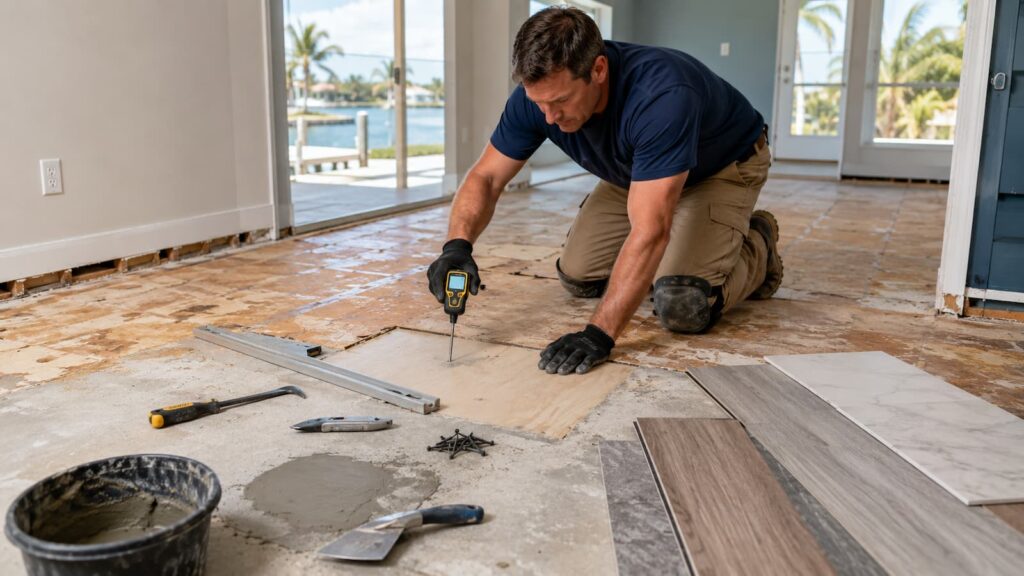
New flooring can completely change the way a home looks and feels, but the finished floor is only as reliable as the surface underneath it. Luxury vinyl plank, tile, laminate, and hardwood all depend on a stable base. If the subfloor is soft, damaged, uneven, wet, loose, or structurally weak, the new flooring may look good for a short time but develop problems later.
This is one of the most common issues homeowners underestimate before a flooring project. It is easy to focus on the visible material: plank color, tile size, wood tone, grout shade, pattern, or installation direction. Those choices matter, but they cannot compensate for a failing subfloor. A premium LVP floor can separate if it is installed over movement. Tile can crack if the surface below is unstable. Laminate can gap or swell if moisture is trapped underneath. Hardwood can cup, squeak, or move if the base is not ready.
Subfloor problems are especially important in Florida homes because moisture, humidity, slab foundations, plumbing leaks, appliance failures, and indoor-outdoor traffic are common realities. A floor may look mostly normal from above while hidden damage is developing underneath. By the time the symptoms are obvious, the issue may have already affected a larger area than expected.
The good news is that many flooring failures can be prevented if the subfloor is inspected and repaired before new material is installed. This guide explains the warning signs your subfloor may need repair, why those problems matter, how they affect different flooring types, and when it makes sense to fix the underlying surface before moving forward with new flooring.
If your floor already feels soft, uneven, damp, noisy, or unstable, it is worth evaluating the surface before choosing the finished material. In many cases, repairing the subfloor first is what allows the new flooring to perform the way it should.
The Short Answer: Do Not Install New Flooring Over a Bad Subfloor
If your subfloor is soft, rotten, uneven, water-damaged, moldy, loose, or moving, it should be repaired before new flooring is installed. Covering the problem with new LVP, tile, laminate, or hardwood may hide the symptoms temporarily, but it does not fix the cause. In many cases, it makes the future repair more expensive because the new floor must be removed to access the damage.
A damaged subfloor can affect flooring in several ways. It can create movement, noise, cracks, gaps, uneven transitions, premature wear, moisture problems, and weak areas underfoot. Some materials show the problem quickly. Others hide it for a while. But if the base is unstable, the finished floor is at risk.
The most common warning signs include:
- Soft, spongy, or bouncy areas underfoot
- Persistent squeaks, creaks, or popping sounds
- Uneven, sloping, or sagging sections of floor
- Musty smells or visible moisture stains
- Cracked tile or cracked grout in the same area
- Loose flooring, lifting edges, or gaps between planks
- Baseboard swelling, discoloration, or damage near the floor
- Past leaks from appliances, toilets, sinks, doors, or plumbing
- Visible damage after old flooring is removed
Not every squeak or uneven spot means the entire subfloor needs replacement. Some issues are localized and can be repaired in one area. Others reveal broader moisture or structural problems. The important point is to investigate before installing new flooring, not after problems appear in the finished surface.
What Is a Subfloor and Why Does It Matter?
The subfloor is the structural or supporting layer beneath the finished flooring. It is what the visible floor rests on. Depending on the home, the flooring may be installed over plywood, OSB, concrete slab, old underlayment, patching material, or another prepared surface. In many Florida homes, concrete slab foundations are common, while other homes or raised areas may have wood subfloor systems.
The subfloor has a simple but critical job: it must provide stable support for the finished floor. It needs to be strong enough, dry enough, flat enough, and clean enough for the flooring material being installed. If it cannot provide that support, the finished floor may fail even if the product itself is high quality.
Different flooring materials place different demands on the subfloor. Tile needs a rigid, stable surface because it does not flex. LVP needs a flat and consistent base so planks do not move or separate. Laminate needs a dry, stable surface with proper expansion space. Hardwood needs structural support and careful moisture control. The better the subfloor condition, the better the finished flooring can perform.
A good subfloor should be:
- Stable: no excessive movement, bounce, or flex
- Dry: no active leaks, trapped moisture, or damp materials
- Flat: no major dips, humps, waves, or uneven areas
- Clean: free from loose debris, old adhesive, rot, or unstable material
- Sound: strong enough to support the selected flooring
- Compatible: suitable for the material and installation method
When the subfloor does not meet these conditions, repairs or preparation may be needed before installation. This work may not be visible after the project is complete, but it is often what protects the entire flooring investment.
Sign 1: Soft, Spongy, or Bouncy Spots Underfoot
Soft spots are one of the clearest signs that something may be wrong underneath the finished flooring. If an area feels spongy, weak, bouncy, or slightly unstable when you step on it, the problem should be inspected before new flooring is installed.
A soft spot can have several causes. In a wood subfloor system, the material may be weakened by water damage, rot, age, poor fastening, or structural movement. In some cases, the issue may be localized near a bathroom, kitchen, laundry room, exterior door, or appliance. In other cases, a larger area may be affected.
Soft spots can also appear when old flooring or underlayment has separated from the surface below. A floating floor may feel soft because the surface underneath has dips or voids. Tile may sound hollow or move slightly if bonding has failed. The symptom feels simple, but the cause can vary.
Soft areas are especially important before installing LVP or tile. LVP can flex over weak spots, stressing the locking system. Tile can crack if the surface moves. Hardwood can squeak or shift. Laminate can separate or wear unevenly. A finished floor cannot perform well if the base beneath it compresses or moves.
Homeowners should pay close attention to soft spots near:
- Toilets and bathroom vanities
- Kitchen sinks and dishwashers
- Refrigerators and ice maker lines
- Washing machines and laundry areas
- Sliding doors and exterior entries
- Old flooring seams or transitions
- Areas where previous leaks occurred
A soft spot does not always mean a major repair is needed, but it should never be ignored. It is much easier to fix the area before new flooring goes down than to remove a finished floor later.
Sign 2: Persistent Squeaks, Creaks, or Popping Sounds
Some floor noise is normal in older homes, but persistent squeaks, creaks, popping, or clicking sounds can point to movement in the subfloor or finished flooring system. If the noise happens in the same area every time you walk across it, the surface underneath should be checked before new flooring is installed.
Squeaks often happen when wood components rub against each other, when fasteners loosen, or when subfloor panels move slightly under weight. Popping or clicking may happen with floating floors if the surface underneath is uneven or if the locking system is stressed. Tile can make hollow or crunchy sounds if bonding has failed or if the substrate is unstable.
Noise is important because it often indicates movement. Movement is one of the biggest enemies of a durable flooring installation. Tile needs a stable surface. Floating LVP needs consistent support. Laminate needs a stable base and correct expansion space. Hardwood needs a properly fastened and moisture-controlled substrate.
Before installing new flooring, noise should be evaluated along with other symptoms. A squeak alone may be a minor fastening issue. A squeak combined with softness, unevenness, staining, or a musty odor may point to a more serious problem.
Common causes of floor noise include:
- Loose subfloor panels
- Weak or damaged areas beneath the flooring
- Movement between old flooring layers
- Uneven concrete or voids under floating floors
- Failed tile bond or loose mortar
- Insufficient fastening in wood subfloor systems
- Moisture-related swelling or shrinkage
Fixing noise before installation can make the new floor feel much more solid. If the noise is caused by movement underneath, simply covering it with new material may not solve the issue.
Sign 3: Uneven, Sagging, or Sloping Areas
Uneven floors are another warning sign that the surface may need attention before new flooring installation. Some unevenness is related to floor leveling rather than subfloor repair, but the two issues are connected. The floor may need leveling, structural repair, surface preparation, or a combination of those steps.
An uneven floor may show up as a visible dip, a hump, a sloped area, a transition that does not line up, or furniture that rocks. Sometimes homeowners do not notice the problem until the old flooring is removed. Carpet can hide dips. Old tile can hide slab waves. Furniture can disguise sloping areas. Once new LVP or tile is installed, the unevenness can become much more obvious.
Uneven floors matter because different flooring materials respond differently. Floating LVP can flex over low spots, causing movement and joint stress. Tile can crack or show lippage if the surface is not flat. Laminate can gap, bounce, or make noise. Hardwood can feel unstable or develop movement over time.
Some unevenness is caused by concrete slab variation, especially in Florida homes built on slab foundations. Other unevenness may come from subfloor damage, moisture swelling, settling, poor previous repairs, or old flooring layers. The repair approach depends on the cause.
Signs of uneven floor problems include:
- Low spots that can be felt while walking
- High ridges or humps in the floor
- Furniture that rocks or leans
- Doors that rub after flooring changes
- Visible height differences between rooms
- Cracked tile in repeated areas
- Floating floors that move or sound hollow
- Old patching or leveling material visible after demolition
If the issue is flatness, leveling the floor may be the right solution. If the issue is softness, rot, water damage, or structural movement, subfloor repair may be needed first. The important step is identifying the cause before the finished floor is installed.
Sign 4: Musty Smells or Damp Odors
A musty smell near the floor is a warning sign that should be taken seriously. It can point to trapped moisture, old water damage, damp underlayment, mold or mildew concerns, or material that has absorbed moisture over time. Even if the floor looks acceptable, odor can suggest that something below the visible surface is not right.
Musty odors are common after slow leaks or hidden moisture events. A dishwasher may have leaked under cabinets. A refrigerator line may have dripped behind the appliance. A toilet seal may have failed. Water may have entered near a sliding door during heavy rain. If moisture stayed under the flooring, it may have affected the subfloor or underlayment.
Installing new flooring over a damp or musty area is risky. The smell may remain. The moisture source may continue. The new floor may trap the problem even more. LVP may resist surface water, but it can still trap moisture underneath if the underlying issue is not corrected. Laminate can swell. Hardwood can cup. Tile can hide moisture problems below if the substrate is not properly evaluated.
Musty smells are especially important in areas such as:
- Bathrooms
- Laundry rooms
- Kitchens
- Closets near plumbing walls
- Rooms with exterior doors or sliders
- Areas around water heaters or AC equipment
- Places where old flooring feels soft or lifted
If the floor smells musty, the source should be investigated before installing new material. In some cases, the old flooring must be removed so the surface underneath can dry, be cleaned, repaired, or replaced.
Sign 5: Water Stains, Swelling, or Discoloration
Visible water stains, swollen flooring, dark spots, or discoloration near the floor can point to moisture problems that may have reached the subfloor. The damage may appear on the surface, along baseboards, around cabinets, near appliances, or at room transitions. Sometimes the staining is old and inactive. Other times, it points to a current or recurring leak.
Water damage can affect flooring materials in different ways. Laminate may swell at the seams. Hardwood may cup or darken. Carpet may smell musty. Tile may loosen or crack if moisture affects the substrate. LVP may look fine on top while moisture remains trapped below. This is why surface appearance alone is not enough to judge the condition of the floor system.
Water damage is especially common near plumbing fixtures and appliances. A small leak can spread under flooring before the homeowner notices. By the time staining or swelling appears, the problem may have affected more than the visible area.
Watch for moisture signs near:
- Toilets and tubs
- Bathroom vanities
- Kitchen sinks
- Dishwashers
- Refrigerators with water lines
- Washing machines
- Water heaters
- Sliding glass doors
- Exterior entries
If moisture has already damaged the flooring system, replacing water-damaged flooring may involve more than removing the visible floor. The damaged material may need to be taken out, the subfloor evaluated, the source of moisture fixed, and the surface prepared before new flooring is installed.
Water stains should not be covered without investigation. If the source is still active, the new floor may fail too.
Sign 6: Cracked Tile or Cracked Grout
Cracked tile or cracked grout can be a sign of movement underneath the finished floor. One cracked tile may be caused by impact. Repeated cracking in the same area, cracks running across several tiles, or grout that keeps breaking apart usually deserves closer attention.
Tile is rigid, so it needs a stable base. If the subfloor moves, flexes, or has uneven support, stress can transfer into the tile and grout. Over time, this can cause cracks, loose tiles, hollow sounds, or lippage. In bathrooms and kitchens, cracked grout can also allow moisture and dirt to enter the floor system.
In concrete slab homes, cracked tile may also point to slab movement, cracks in the concrete, poor mortar coverage, or an uneven substrate. In wood subfloor systems, cracking may point to deflection, loose panels, weak underlayment, or moisture damage.
Before replacing tile with new tile, LVP, laminate, or hardwood, the cause of the cracking should be understood. If the old tile cracked because of movement or unevenness, installing new flooring without correcting the surface may lead to new problems.
Cracked tile or grout may suggest:
- Subfloor movement
- Insufficient support under the tile
- Uneven concrete or slab cracks
- Poor previous installation
- Moisture affecting the substrate
- Structural or framing issues in raised areas
- Need for leveling or surface correction before replacement
If the plan is to install new tile, the surface must be stable and prepared correctly. If the plan is to install LVP, the surface must still be flat enough to support the planks. Either way, cracked tile should be treated as a clue, not just an old finish to cover.
Sign 7: Existing Flooring Is Lifting, Separating, or Buckling
If your current flooring is lifting, separating, buckling, or pulling apart, the issue may be related to the flooring product, installation, subfloor condition, moisture, or a combination of those factors. Before replacing it, the cause should be identified.
Floating floors can separate if they were installed over an uneven surface, without proper expansion space, or in a room with moisture changes. Laminate may buckle or swell if water reaches the core. Hardwood may cup or crown with moisture imbalance. LVP may lift or gap if the locking system is stressed by movement underneath.
The temptation is to remove the old floor and install a new one as quickly as possible. But if the old floor failed because of unevenness, moisture, soft spots, or subfloor movement, the new floor can fail for the same reason.
Flooring that is lifting or separating may point to:
- Moisture trapped underneath
- Insufficient expansion space
- Uneven subfloor or slab
- Poor previous installation
- Weak adhesive bond
- Soft or damaged subfloor areas
- Excessive movement under the finished floor
Once the old flooring is removed, the exposed surface should be checked carefully. If the subfloor is stable and flat, the new installation can proceed more confidently. If problems are found, repairs should come first.
Sign 8: Damage Appears After Old Flooring Is Removed
Sometimes the clearest signs of subfloor damage do not appear until demolition begins. Old flooring can hide a lot: stains, cracks, adhesive residue, soft patches, moisture, uneven concrete, rotten wood, old repairs, and damaged underlayment. This is why flooring estimates sometimes change after removal. The contractor is not inventing a problem; the old floor may have been covering one.
After old flooring is removed, the exposed surface should be evaluated before moving forward. If the surface is clean, flat, dry, and stable, installation may be straightforward. If the exposed surface shows damage, it should be corrected before the new flooring is installed.
Visible issues after removal may include:
- Dark staining or water marks
- Soft wood or deteriorated panels
- Old adhesive that must be removed
- Cracks in concrete
- Thinset ridges from tile removal
- Uneven patches from previous repairs
- Loose underlayment
- Low spots or high spots
- Areas that smell damp or musty
This is the point where many homeowners have to make an important decision. They can rush forward and cover the issue, or they can fix the surface so the new floor has a better chance of lasting. The second option is usually the smarter long-term investment.
How Subfloor Problems Affect Different Flooring Types
Subfloor damage matters no matter what flooring material you choose, but each material reacts differently. Understanding these differences helps homeowners see why repairs should happen before installation, not after.
Luxury Vinyl Plank
LVP is durable and moisture-resistant on the surface, but it still needs support. Floating LVP can flex over soft spots or low areas, which may cause clicking, movement, broken locking edges, or gaps. Glue-down LVP needs a smooth, stable surface so the adhesive can perform correctly. If the subfloor is damaged or uneven, installing vinyl plank flooring without correction can lead to problems that appear after the project is complete.
Tile
Tile is strong, but it is not forgiving of movement. If the subfloor flexes, shifts, or has poor support, tile and grout can crack. Tile also needs proper flatness to avoid lippage and hollow areas. Before proper tile installation, the surface should be checked for stability, flatness, cracks, and moisture-related concerns.
Laminate
Laminate needs a dry, flat, and stable surface. It is more vulnerable to moisture than LVP or tile, especially if water reaches the core. If the subfloor has moisture damage or uneven areas, laminate can swell, gap, move, or sound hollow. It is best used in dry rooms where the surface underneath is already suitable or can be prepared correctly.
Hardwood
Hardwood is especially sensitive to moisture and movement. A weak or damp subfloor can cause squeaks, cupping, gaps, or instability. Engineered hardwood may be more stable than solid hardwood, but it still needs a suitable surface. Before installing hardwood flooring, moisture and subfloor conditions should be taken seriously.
The conclusion is simple: every flooring material needs a good base. The symptoms may look different, but the cause is often the same — the surface underneath was not ready.
Subfloor Repair vs Floor Leveling: What Is the Difference?
Subfloor repair and floor leveling are related, but they are not the same thing. Homeowners often confuse them, especially when a floor feels uneven. Understanding the difference helps clarify what kind of work may be needed before installation.
Subfloor repair addresses damage, weakness, moisture issues, soft spots, loose sections, or structural problems in the surface that supports the finished flooring. This may involve replacing damaged panels, securing loose areas, removing compromised material, correcting water-damaged sections, or preparing a stable base.
Floor leveling addresses flatness. It corrects dips, high spots, waves, or height variations so the finished flooring has a smooth and consistent surface. This may involve grinding, patching, applying leveling compound, or feathering transitions.
Some projects need one but not the other. Others need both. For example, a concrete slab with low spots may need leveling but not subfloor repair. A wood subfloor with water-damaged plywood may need repair first, then leveling or smoothing. A room with cracked tile may need demolition, surface evaluation, repair, and leveling before the new flooring can go in.
A simple comparison looks like this:
| Issue | Likely Need | Why It Matters |
|---|---|---|
| Soft or rotten area | Subfloor repair | The base is damaged or weak |
| Low spot in concrete | Floor leveling | The surface is not flat enough |
| High ridge in slab | Floor leveling or grinding | The finished floor may rock or flex |
| Water-damaged plywood | Subfloor repair | Damaged material should not be covered |
| Uneven transition between rooms | Leveling or transition planning | The finished floor needs a clean connection |
| Cracked tile from movement | Inspection, repair, possible leveling | The cause must be corrected before replacement |
The best approach is to identify the cause first. If the floor is uneven because it is damaged, leveling alone is not enough. If the floor is strong but not flat, leveling may solve the issue. If both problems exist, both should be addressed.
What Causes Subfloor Damage?
Subfloor damage can develop for many reasons. Some causes are sudden, such as an appliance leak or plumbing failure. Others happen slowly, such as repeated moisture exposure, poor ventilation, or years of movement. Understanding the cause helps determine the right repair.
In Florida homes, moisture is one of the most common causes. Humidity alone may not destroy a properly built floor, but repeated leaks, trapped water, and damp conditions can weaken materials over time. A small leak under a dishwasher or toilet can affect the subfloor long before the homeowner notices visible damage.
Age and previous installation issues can also contribute. Old flooring may have been installed over uneven surfaces. Underlayment may have been poorly fastened. Previous repairs may have used incompatible materials. Tile removal may damage the slab or leave ridges. Carpet tack strips may leave holes or weak edges.
Common causes of subfloor damage include:
- Plumbing leaks
- Dishwasher or refrigerator line leaks
- Washing machine overflows
- Toilet seal failures
- Water heater leaks
- Rainwater intrusion near doors or sliders
- Old moisture trapped under flooring
- Poor previous installation
- Insufficient fastening or support
- Age, wear, and repeated movement
Once the cause is known, the repair can be planned correctly. If the source of moisture is still active, fixing the subfloor without fixing the leak is only a temporary solution.
Can You Install New Flooring Over an Existing Floor?
Sometimes new flooring can be installed over an existing floor, but only if the existing surface is suitable. This is not a decision to make based only on convenience or cost. The existing floor must be stable, flat, dry, clean, and compatible with the new material.
Installing over an old floor can reduce demolition work in some situations, but it can also hide problems. If the existing floor is loose, soft, damp, uneven, cracked, or poorly bonded, it should not be used as the base for new flooring. Covering it may create a thicker flooring system without solving the underlying issue.
New flooring should generally not be installed over existing flooring when:
- The old floor is loose or lifting
- The surface feels soft or unstable
- There are signs of water damage
- The floor is uneven or wavy
- Tile is cracked because of movement
- Laminate is swollen or buckling
- There are musty odors
- The added height would create door or transition problems
Even when installation over an existing floor is technically possible, the surface should be evaluated carefully. A shortcut at the beginning can become a bigger repair later.
What Happens During Subfloor Repair?
Subfloor repair depends on the type of damage and the type of surface. A concrete slab, plywood subfloor, OSB subfloor, old underlayment layer, or moisture-damaged area may each require a different repair approach. The goal is always the same: create a stable, dry, suitable base for the new flooring.
The process usually begins with inspection. The old flooring may need to be removed in the affected area so the surface underneath can be seen clearly. The installer looks for moisture, softness, cracks, movement, old adhesive, damaged panels, and unevenness.
Depending on the findings, repair may involve removing damaged material, replacing sections, fastening loose areas, cleaning the surface, patching low spots, grinding high spots, treating transitions, or preparing the area for the finished flooring. If moisture caused the problem, the source must be fixed before the repair can be considered complete.
Common repair steps may include:
- Removing damaged flooring and underlayment
- Identifying the cause of moisture or movement
- Replacing weak or damaged subfloor sections
- Securing loose panels or unstable areas
- Cleaning old adhesive, debris, or residue
- Patching or smoothing the surface
- Leveling low or uneven areas if needed
- Preparing transitions and edges
- Confirming the area is ready for the selected flooring
The repair does not need to be dramatic to be important. Even a small weak area can affect the finished floor if it sits in a high-traffic path or near a transition. Fixing it before installation helps protect the finished result.
How Subfloor Repair Affects Flooring Cost
Subfloor repair can add cost to a flooring project, but ignoring it can cost more later. The price depends on the size of the damaged area, the type of subfloor, the cause of damage, the amount of demolition required, and whether leveling or moisture correction is also needed.
A small localized repair near a doorway or appliance may be relatively straightforward. A larger area affected by water damage, repeated movement, or old flooring failure may require more work. If the damage is not visible until old flooring is removed, the scope may change after demolition begins.
Several factors can affect repair cost:
- Size of the damaged area
- Whether old flooring must be removed first
- Type of subfloor or slab condition
- Severity of moisture damage
- Whether the source of moisture has been fixed
- Need for patching or leveling after repair
- Transition and trim details
- Selected finished flooring material
It can be tempting to skip repair to keep the initial flooring budget lower. But that approach often creates risk. A new floor installed over a weak base may require removal, repair, and reinstallation later. Doing the repair first is usually the more practical long-term decision.
Questions to Ask Before Installing New Flooring
Before approving a flooring installation, homeowners should ask questions about the surface underneath. A good estimate should not only discuss the visible flooring material. It should also address whether the existing floor is stable, flat, dry, and ready.
Useful questions include:
- Will the existing floor or subfloor be inspected before installation?
- Are there soft spots, squeaks, or movement that need attention?
- Is there any sign of water damage or musty odor?
- Will old flooring need to be removed to inspect the surface?
- Is the floor flat enough for the selected material?
- Will floor leveling be needed after removal?
- Are subfloor repairs included in the estimate or priced separately?
- What happens if hidden damage is discovered during demolition?
- How will transitions and height differences be handled?
- Is the selected flooring appropriate for the room’s moisture risk?
These questions help homeowners avoid surprises. They also make it easier to compare estimates fairly. A low quote that ignores subfloor problems may not be cheaper in the long run.
Common Mistakes Homeowners Should Avoid
Subfloor problems often become expensive because they were ignored at the beginning. Homeowners naturally want the project to move quickly, but flooring installation is not just a surface update. It is a system, and the system starts below the visible material.
One common mistake is assuming new flooring will hide the problem. It usually does not. LVP may still flex. Tile may still crack. Laminate may still move. Hardwood may still squeak. A new surface can make the room look better, but it cannot make a damaged subfloor stable.
Another mistake is treating water damage as cosmetic. If a floor has been wet, the visible staining or swelling may be only part of the issue. Moisture can travel under flooring and affect areas that are not obvious from above.
The most common mistakes include:
- Installing new flooring over soft spots
- Ignoring musty smells or old water stains
- Choosing flooring before inspecting the surface
- Assuming waterproof flooring solves subfloor moisture
- Covering cracked tile without checking why it cracked
- Skipping floor leveling when the surface is uneven
- Comparing estimates without checking what prep is included
- Waiting until after installation to address movement or noise
A successful flooring project should solve underlying problems, not hide them. If the subfloor is repaired and prepared correctly, the finished floor has a much better chance of lasting.
Final Thoughts: Fix the Base Before Installing the Finish
The signs that your subfloor needs repair are not always dramatic. Sometimes it is a soft spot near the kitchen sink, a musty smell near a sliding door, a squeak that keeps coming back, or cracked grout in the same hallway. These small symptoms can point to bigger issues below the finished floor.
Before installing new flooring, the surface underneath should be stable, dry, flat, and suitable for the material. If it is not, the new floor may develop movement, gaps, cracks, swelling, noise, or premature wear. LVP, tile, laminate, and hardwood all depend on a reliable base, even though they show failure in different ways.
Repairing the subfloor may not be the most visible part of the project, but it is one of the most important. It protects the finished flooring, improves comfort underfoot, reduces future repair risk, and helps the installation perform as intended.
For homeowners planning new flooring, working with an experienced flooring contractor can help identify problems before they become expensive mistakes. The best flooring projects do not begin with the plank, tile, or wood sample. They begin with the condition of the floor underneath.