
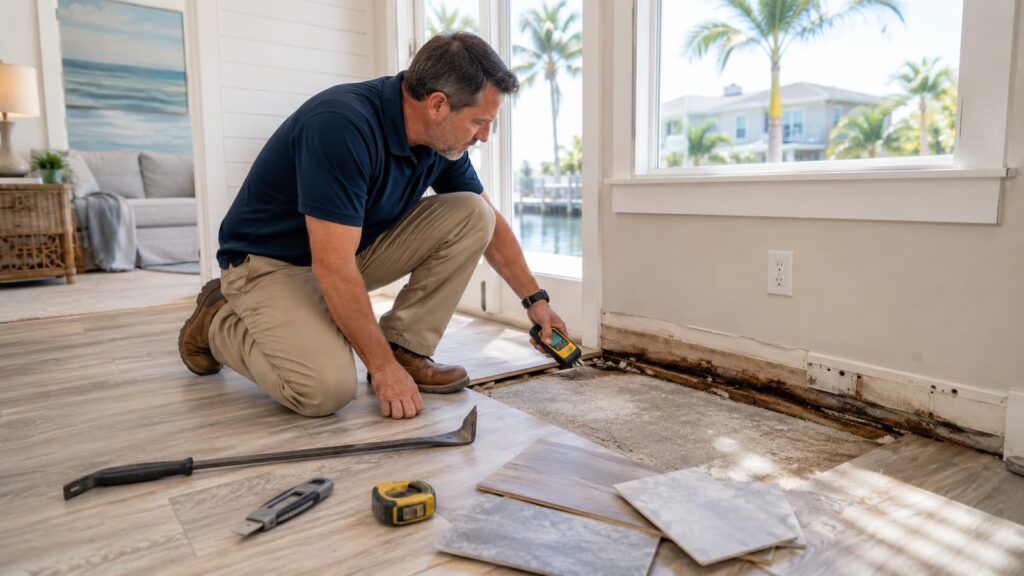
Water-damaged flooring can be confusing because the visible damage does not always tell the full story. Sometimes a floor looks terrible on the surface but the damage is limited and repair may be possible. Other times, the flooring looks mostly normal, but moisture has traveled underneath and affected the subfloor, underlayment, adhesive, baseboards, or surrounding materials. That is why deciding whether to repair or replace a water-damaged floor requires more than a quick look at the top layer.
The right decision depends on several factors: what type of flooring you have, how much water was involved, how long the water sat, whether the source has been fixed, whether moisture reached underneath the floor, and whether the flooring system is still stable. A small spill cleaned quickly is very different from a slow dishwasher leak that went unnoticed for weeks. A wet tile surface is different from swollen laminate. A luxury vinyl plank floor may survive surface water, but trapped moisture underneath can still create a serious problem.
In Florida homes, water-damaged floors are especially common because moisture can come from many everyday sources. Heavy rain near sliding doors, leaking refrigerator lines, dishwasher drips, toilet seal failures, washing machine overflows, AC condensate issues, water heater leaks, and humid indoor conditions can all affect floors. The damage may be obvious immediately, or it may develop slowly over time.
So should you repair or replace a water-damaged floor? In general, minor surface damage may be repairable if the floor is dry, stable, and the source of water has been corrected. Replacement is usually safer when the flooring is swollen, buckled, soft, separating, moldy-smelling, repeatedly wet, or when moisture has reached the subfloor. If the floor system has been compromised, replacing only the visible surface may not solve the real problem.
This guide explains how to decide between repair and replacement, how water affects different flooring materials, what warning signs homeowners should watch for, and why the subfloor should be inspected before new flooring is installed. If the damage is more than cosmetic, replacing water-damaged flooring may be the most practical way to restore a stable, clean, and reliable surface.
The Short Answer: Repair Minor Surface Damage, Replace Compromised Flooring Systems
The simplest way to think about water-damaged floors is this: repair may be possible when the damage is limited to the surface and the floor underneath is dry, stable, and clean. Replacement is usually needed when water has affected the structure, shape, stability, smell, or safety of the flooring system.
If a small amount of water was cleaned quickly and the floor shows no swelling, movement, odor, staining, or soft areas, a repair or simple cleanup may be enough. If a few planks are scratched, stained, or lightly damaged but the surrounding floor is stable, replacing individual pieces may be possible depending on the material and installation method.
However, replacement becomes more likely when water sits for a long time or travels beneath the finished flooring. Once moisture reaches the underlayment, subfloor, adhesive, baseboards, or wall edges, the issue is no longer only about appearance. It becomes a flooring system problem.
Replacement is usually the safer choice when you notice:
- Swollen laminate or raised plank edges
- Buckling, cupping, crowning, or warping
- Soft, spongy, or unstable areas underfoot
- Persistent musty odors
- Visible mold or mildew concerns
- Flooring that lifts, separates, gaps, or moves
- Baseboard swelling or staining near the floor
- Moisture trapped beneath LVP, laminate, tile, or hardwood
- Repeated leaks in the same area
The most important rule is to fix the source of water before repairing or replacing the floor. If the leak is still active, any new material may be damaged again. A repaired floor over an unresolved moisture issue is not a real repair. It is a temporary cover-up.
Common Causes of Water-Damaged Floors
Water damage does not always come from a major flood. In many homes, the most serious floor damage comes from small leaks that continue long enough to spread under the flooring. A sudden water event is easier to notice. A slow leak can remain hidden until the floor begins to smell, swell, lift, or feel soft.
Kitchens, bathrooms, laundry rooms, and entryways are the most common places for moisture-related flooring problems. These rooms have plumbing, appliances, exterior doors, or frequent wet traffic. In Florida homes, sliding glass doors, patios, pool access, humid air, and heavy rain can also contribute to flooring problems near exterior walls and thresholds.
Common sources of water damage include:
- Dishwasher leaks under cabinets or along the front edge
- Refrigerator or ice maker supply line leaks
- Washing machine overflows or hose failures
- Toilet seal leaks around the base
- Bathroom sink, vanity, tub, or shower leaks
- Water heater leaks
- AC condensate line backups or drain issues
- Rainwater entering near exterior doors or sliding glass doors
- Wet pet areas, water bowls, or repeated accidents
- Previous flooding or storm-related water intrusion
The source matters because it changes the repair plan. A one-time spill that was cleaned quickly is very different from a slow leak behind an appliance. A toilet seal leak may affect the subfloor around the toilet. A sliding door leak may affect flooring, baseboards, and the edge of the slab. A washing machine overflow can spread across a large area quickly.
Before deciding whether to repair or replace the floor, homeowners should identify where the water came from, whether it is still active, how far it traveled, and how long it was present. Without that information, it is easy to underestimate the damage.
First Step: Stop the Water Before Thinking About the Floor
Before repairing or replacing any floor, the water source must be stopped. This may sound obvious, but it is one of the most common mistakes homeowners make. They replace swollen flooring, install new planks, or patch a damaged area before confirming that the leak is fully fixed. When moisture returns, the new floor is damaged again.
If the water came from a plumbing issue, the plumbing should be repaired first. If it came from an appliance, the appliance line or connection should be checked. If rainwater entered near a door, the door threshold, weatherstripping, grading, or exterior drainage may need attention. If moisture came from an AC condensate issue, the line or drain pan should be corrected.
After the water source is stopped, the floor should be allowed to dry and be evaluated. Drying time depends on the material, the amount of water, the ventilation, and whether moisture has reached underneath the surface. Some floors dry on the surface while remaining damp below. This is why relying only on what the floor looks like can be misleading.
Before deciding on repair or replacement, confirm the following:
- The leak or water source has been fixed
- No additional moisture is entering the area
- The visible flooring has been inspected
- The area near walls, cabinets, appliances, and baseboards has been checked
- There are no soft spots, odors, or signs of trapped moisture
- The subfloor or slab is dry and stable enough for repair or replacement
A floor repair is only successful when the moisture problem is no longer active. Otherwise, even the best flooring material can fail.
How Water Affects Different Flooring Materials
Different flooring materials react to water in very different ways. This is why the repair-or-replace decision depends heavily on what type of floor you have. A wet tile floor, a wet laminate floor, and a wet hardwood floor can all require different decisions.
Some materials show water damage quickly. Others hide moisture beneath the surface. Some can be repaired in small sections. Others are difficult to patch without visible differences. Understanding how water affects each flooring type helps homeowners make a more realistic decision.
Luxury Vinyl Plank
Luxury vinyl plank is often marketed as waterproof, and the planks themselves usually handle surface water well. If water is spilled and cleaned quickly, LVP may not swell or warp the way laminate or hardwood can. This is one reason LVP is popular in Florida homes.
The concern with LVP is not always the plank surface. The concern is water underneath the floor. If water travels between planks, under baseboards, around transitions, or beneath a floating floor, it can become trapped. The LVP may look fine, but moisture underneath can affect the underlayment, slab, adhesive, baseboards, or subfloor.
Repair may be possible if only a few planks are damaged and the area underneath is dry and stable. Replacement may be needed if water spread beneath a large area, if odor develops, if planks are lifting or separating, or if the subfloor has been affected. Before installing vinyl plank flooring as a replacement, the surface underneath should be inspected carefully.
Laminate Flooring
Laminate is more vulnerable to water because many laminate floors have a wood-fiber-based core. When water reaches the seams or edges, the core can swell. Once swelling happens, the damage is usually permanent. Raised seams, bubbling edges, peaking, and uneven plank joints are common signs of water-damaged laminate.
Some modern laminate products are more water-resistant than older versions, but they still need quick cleanup and proper installation. If water sat for a long time or reached the core, replacement is usually more realistic than repair. A few damaged planks may be replaceable in some installations, but widespread swelling usually means the floor needs replacement.
Laminate should be evaluated carefully after leaks near kitchens, bathrooms, laundry rooms, exterior doors, or pet areas. If the damage is visible, there is a good chance moisture has affected the plank structure.
Tile Flooring
Tile is one of the strongest materials for wet areas. The tile surface itself can usually handle water very well, especially porcelain tile. That is why tile is commonly used in bathrooms, kitchens, laundry rooms, and entries. But tile is not always immune to water problems.
Water can enter through cracked grout, loose tiles, failed caulk lines, damaged transitions, or edges. If moisture affects the substrate below the tile, the tile may loosen, sound hollow, crack, or allow odors to develop. In bathrooms and kitchens, repeated water exposure can eventually damage the areas surrounding the tile even when the tile surface looks intact.
Repair may be possible when damage is limited to grout, a small number of tiles, or surface-level issues. Replacement may be needed if tiles are loose across a wider area, the substrate is damaged, or the floor has repeated moisture problems. For wet rooms, proper tile installation matters because water performance depends on more than the visible tile.
Hardwood Flooring
Hardwood is highly sensitive to moisture. Water can cause cupping, crowning, warping, staining, swelling, gaps, and finish damage. Solid hardwood and engineered hardwood react differently, but both can be damaged by prolonged moisture exposure.
Repair may be possible if the water exposure was minor, the wood dried properly, and the damage is mostly cosmetic. Some hardwood floors can be sanded and refinished, depending on the product and the depth of damage. However, if boards are severely cupped, buckled, stained, delaminated, or affected by moisture from underneath, replacement may be needed.
Before installing hardwood flooring after water damage, moisture conditions should be taken seriously. Hardwood should not be installed over a damp, unstable, or questionable surface.
Repair May Be Enough When the Damage Is Minor
Not every water-damaged floor needs full replacement. In some cases, repair is reasonable. The key is making sure the problem is limited, the floor is dry, and the underlying surface is still stable. Repair should be based on condition, not wishful thinking.
Repair is more likely to make sense when the water event was small, short, and quickly cleaned up. For example, a minor spill on LVP or tile may not require replacement. A small localized leak that affected only a few removable planks may be repairable if the area underneath is dry and undamaged. A small grout issue may be repairable if the tile is still bonded and the substrate is not compromised.
Repair may be appropriate when:
- The water source has been fixed
- The damage is limited to a small area
- The floor is dry underneath
- There is no musty odor
- The subfloor is stable and not soft
- The flooring material can be patched or replaced in sections
- Matching replacement material is available
- The damage is cosmetic rather than structural
The biggest challenge with repair is matching the existing floor. Flooring colors, dye lots, plank textures, tile batches, and grout shades can vary. Even if replacement material is technically available, a patch may be slightly visible. This matters more in open living spaces than in closets, laundry rooms, or small areas near appliances.
Repair also makes less sense when the existing floor is old or already nearing the end of its life. If the floor has multiple damaged areas, visible wear, discontinued material, or hidden moisture concerns, replacement may be more practical than trying to patch one section at a time.
Replacement Is Usually Better When Moisture Reaches Underneath
Replacement becomes more likely when moisture has moved below the visible flooring surface. This is the point where the issue changes from a cosmetic floor problem to a flooring system problem. The finished floor, underlayment, subfloor, slab, trim, and surrounding materials may all need to be evaluated.
Moisture underneath the floor can be difficult to judge from above. The surface may dry quickly while the underside remains damp. LVP may look normal while water sits beneath it. Tile may appear intact while the substrate is affected. Hardwood may continue to move after the visible water is gone. Laminate may show swelling only after moisture has already penetrated the core.
Replacement is usually the better choice when:
- Water sat for a long time
- The floor feels soft, spongy, or unstable
- There is a musty smell that does not go away
- The flooring is buckling, lifting, or separating
- Laminate or hardwood has swollen or warped
- Baseboards or trim show water damage
- There is repeated moisture in the same area
- The subfloor or underlayment is wet or damaged
- The existing material cannot be matched for repair
Replacement does not always mean replacing the entire house of flooring. Sometimes only a room, section, or connected area needs to be replaced. The decision depends on how far the water spread, how the flooring is installed, and whether a clean transition can be made.
In many cases, the safest approach is to remove the affected flooring, inspect the surface underneath, fix the source of water, repair the base if needed, and then install a material that makes sense for the room’s moisture risk.
Warning Signs That Water Damage Is More Serious Than It Looks
Water damage can be deceptive. A floor may look mostly fine but feel different underfoot. A room may smell musty even after the surface is dry. A plank may look normal while the baseboard nearby is swollen. These clues can suggest that water reached areas below or around the finished flooring.
The more warning signs you see, the more likely replacement or deeper inspection will be needed. One minor stain may not mean much. A stain combined with odor, softness, and lifting edges is more serious.
Signs of deeper water damage include:
- Soft or spongy flooring
- Persistent musty odor
- Planks that lift, gap, or separate
- Tile that sounds hollow or feels loose
- Cracked grout after a water event
- Laminate edges that are raised or swollen
- Hardwood that is cupped, crowned, or buckled
- Dark staining around walls or cabinets
- Baseboard swelling or paint bubbling near the floor
- Water marks near appliances, toilets, tubs, or exterior doors
When these signs appear, the floor should not simply be covered with new material. Covering moisture damage can trap the problem and lead to another failure. If the subfloor is soft or damaged, repairing the subfloor may be necessary before new flooring is installed.
Why the Subfloor Matters in a Water-Damage Decision
The subfloor is the support layer below the visible flooring. In some homes, this may be plywood, OSB, underlayment, or another wood-based surface. In many Florida homes, the flooring may be installed over a concrete slab. Either way, the surface underneath the finished floor must be stable, dry, and suitable for new installation.
Water damage becomes more serious when the subfloor is affected. A damaged subfloor can create soft spots, movement, unevenness, odors, and poor support. If new flooring is installed over a compromised base, the new floor may fail even if the material itself is appropriate.
For LVP, subfloor problems can cause clicking, plank separation, hollow areas, or movement. For tile, subfloor movement can cause cracks, loose tiles, or grout failure. For laminate, moisture in the subfloor can lead to swelling and odor. For hardwood, subfloor moisture can contribute to cupping, gapping, or instability.
Subfloor evaluation is especially important when:
- The water event lasted more than a short time
- The flooring feels soft or unstable
- The damage is near a toilet, shower, tub, dishwasher, or washing machine
- The old flooring has lifted or separated
- There is a musty smell
- Moisture reached baseboards or walls
- You are planning to install new flooring over the same area
Repairing or replacing the finished floor without checking the subfloor is risky. The visible material is only one part of the flooring system. The surface underneath determines whether the replacement floor will feel solid and last.
Water Damage on Concrete Slabs
Concrete slabs do not rot like wood, but that does not mean water damage can be ignored. Concrete can hold moisture, allow vapor movement, show staining, and hide water beneath flooring. If water gets trapped between a slab and a flooring system, the finished floor may develop odor, adhesive issues, underlayment damage, or movement.
In Florida homes, concrete slab flooring is common. After a water event, homeowners may assume that removing the wet flooring is enough because the concrete itself is solid. Sometimes that is true. Other times, the slab needs drying, cleaning, patching, leveling, or moisture evaluation before new flooring is installed.
Concrete should be checked for:
- Moisture staining or dark spots
- Musty odors after flooring removal
- Efflorescence or white powdery residue
- Old adhesive or underlayment stuck to the slab
- Uneven patches caused by previous flooring removal
- Low spots where water may have collected
- Cracks that may allow moisture movement
If the slab is uneven after the damaged floor is removed, floor leveling may be needed before new LVP or tile is installed. This is not only about appearance. A flat surface helps the new flooring feel stable and perform properly.
Concrete is a strong base when it is prepared correctly. It is not a reason to skip moisture evaluation or surface preparation after water damage.
Repair or Replace by Flooring Type
The repair-or-replace decision becomes easier when you look at the flooring material separately. Each type of floor has different repair options, moisture risks, and replacement triggers.
LVP: Repair or Replace?
Luxury vinyl plank may be repairable if only a small area is affected and matching planks are available. Floating LVP can sometimes be disassembled to replace damaged pieces, depending on where the damage is located. Glue-down LVP may allow individual plank replacement in some situations, but the adhesive and surface condition matter.
Replacement is more likely if water spread underneath a large area, if the planks are lifting or separating, if the locking system is damaged, or if moisture has affected the underlayment or subfloor. LVP is moisture-resistant, but it should not trap water below the floor.
Laminate: Repair or Replace?
Laminate is often harder to save after water damage. If water reached the core and caused swelling, repair is usually limited. A few individual planks may be replaceable if matching material is available and the damage is localized. But widespread swelling, raised seams, buckling, or edge damage usually means replacement is the better option.
Laminate should also be replaced if it smells musty or if water reached underneath. Because laminate is more moisture-sensitive than LVP or tile, homeowners should be cautious about trying to preserve a floor that has already swollen.
Tile: Repair or Replace?
Tile may be repairable when the issue is limited to grout, caulk, or a few loose or cracked tiles. If matching tile is available and the substrate is still sound, a localized repair may make sense. Tile is often more water-resistant than other flooring materials, so surface water alone does not always mean replacement.
Replacement is more likely if multiple tiles are loose, the substrate is damaged, cracks are widespread, or moisture has affected the base below the tile. If the tile floor has repeated water-related problems, simply regrouting may not solve the issue.
Hardwood: Repair or Replace?
Hardwood repair depends on the severity of the damage. Minor surface staining or finish damage may be repairable. Some hardwood floors can be sanded and refinished if the boards are thick enough and the moisture damage has not compromised the wood. Engineered hardwood depends on the thickness of the wear layer and whether the product has delaminated.
Replacement is usually needed when hardwood is severely cupped, buckled, warped, stained from below, delaminated, or affected by long-term moisture. Hardwood should be fully dry and stable before any repair or refinishing decision is made.
Choosing Replacement Flooring After Water Damage
If replacement is needed, the next question is what material should go back into the room. The answer depends on why the water damage happened and how likely it is to happen again. Replacing damaged flooring with the same material may be fine in some rooms, but it may be a mistake in others.
For bathrooms, laundry rooms, wet entries, and pool-adjacent spaces, tile is often the safest long-term choice. It handles water and cleaning better than most flooring materials. For living rooms, bedrooms, hallways, and many kitchens, LVP is often a practical replacement because it offers better everyday moisture resistance than laminate or hardwood while still feeling more comfortable than tile.
Replacement material should be chosen based on room risk:
- Bathrooms: tile is usually strongest, especially full bathrooms with showers or tubs.
- Laundry rooms: tile is usually safest, though LVP may work in some lower-risk installations.
- Kitchens: tile or LVP can both work, depending on comfort and leak-risk priorities.
- Living rooms and hallways: LVP is often a strong balance of comfort and moisture resistance.
- Bedrooms: LVP, laminate, or engineered hardwood may work if the room is dry and stable.
- Areas with repeated leaks: address the source first, then choose a more moisture-appropriate material.
The replacement decision should not be based only on what looks best. It should be based on what happened, what was damaged, and how the room will be used in the future.
Can You Install New Flooring Over Water-Damaged Flooring?
In most cases, new flooring should not be installed over water-damaged flooring. Covering damaged material may seem faster and less expensive, but it can trap moisture, hide soft spots, preserve odors, and create an unstable base for the new floor. The result may look better for a short time but fail later.
Installing over old flooring is only reasonable when the existing surface is dry, stable, flat, clean, and not damaged. Water-damaged flooring usually fails at least one of those conditions. It may be swollen, loose, uneven, musty, or contaminated by moisture. It may also hide damage underneath.
Do not install new flooring over existing flooring if:
- The old floor is swollen, buckled, or warped
- The floor feels soft or spongy
- There is a musty smell
- Water reached underneath the floor
- Baseboards or walls show moisture damage
- The old flooring is loose or separating
- The surface is uneven from swelling or movement
- The source of moisture has not been corrected
Removing damaged flooring gives the installer a chance to inspect the surface underneath. That inspection is often what determines whether the new floor will last.
How to Make the Decision: Repair or Replace?
A good repair-or-replace decision should follow a clear process. The goal is to avoid two mistakes: replacing a floor that could have been repaired safely, or repairing a floor that is too compromised to keep.
Start with the source of water. Was it a one-time spill, a sudden leak, or a slow ongoing problem? Then look at the flooring material. LVP, tile, laminate, and hardwood all have different tolerance levels. Next, check how far the water traveled. Surface-only water is very different from trapped moisture underneath. Finally, evaluate the subfloor or slab. If the base is damaged, replacement or repair of the base becomes part of the project.
A practical decision process looks like this:
- Find and fix the source of water. Do not repair or replace flooring until the leak or moisture problem is resolved.
- Identify the flooring material. Laminate and hardwood are more moisture-sensitive than tile and LVP.
- Check the amount of damage. A small affected area is more repairable than widespread damage.
- Look for signs of moisture underneath. Odor, softness, baseboard swelling, and lifting edges are warning signs.
- Inspect the subfloor or slab. The new floor needs a dry, stable, flat base.
- Consider whether matching material is available. If not, repair may be visually obvious.
- Choose replacement material based on future risk. Do not repeat a material choice that failed because the room was too wet for it.
If most signs point to surface-only damage, repair may be enough. If moisture has entered the flooring system, replacement is usually safer.
Cost Factors: Why Replacement Prices Vary
The cost of dealing with water-damaged floors can vary widely because the visible damage is only one part of the project. A simple repair may involve replacing a few planks or tiles. A more serious replacement may involve removing flooring, drying or cleaning the surface, repairing the subfloor, leveling the slab, replacing trim, and installing new material.
Several factors affect cost:
- Type of existing flooring
- Size of the damaged area
- How long water was present
- Whether flooring removal is required
- Whether the subfloor or slab needs repair
- Whether floor leveling is needed before replacement
- Selected replacement material
- Baseboard, trim, and transition work
- Furniture or appliance moving
- Whether matching material is available for repair
A repair may look cheaper at first, but if it leaves moisture damage underneath, the floor may fail again. A replacement may cost more upfront, but it can be the better value when the damaged material is removed and the underlying surface is corrected.
The most reliable estimate is one that separates the work clearly: removal, inspection, repairs, preparation, material, installation, transitions, and finishing details. This helps homeowners understand what they are paying for and why.
How to Prevent Future Water Damage
After repairing or replacing a water-damaged floor, prevention becomes important. No flooring material is a substitute for good moisture control. Even tile and LVP can become part of a larger problem if water is allowed to enter underneath or remain trapped for long periods.
Homeowners can reduce future flooring damage by checking common leak sources regularly and choosing materials that fit each room’s risk level. Bathrooms, laundry rooms, and wet entries should be treated differently from bedrooms and living rooms. A flooring material that works well in a dry space may not be the best option near frequent water exposure.
Helpful prevention steps include:
- Inspect dishwasher and refrigerator water lines periodically
- Replace worn washing machine hoses before they fail
- Check around toilets for movement, staining, or odors
- Use mats near exterior doors, sliders, and pet bowls
- Clean spills quickly, even on water-resistant floors
- Monitor baseboards near wet areas
- Keep AC condensate lines maintained
- Address exterior door leaks before installing new flooring
- Choose tile or moisture-appropriate flooring in high-risk rooms
Prevention is especially important after a replacement project. Once the new floor is installed, keeping water away from the floor system helps protect the investment.
Questions to Ask Before Repairing or Replacing Water-Damaged Floors
Before approving a repair or replacement, homeowners should ask questions that clarify the true condition of the floor. A good plan should not only focus on the visible material. It should address the moisture source, the affected area, and the surface underneath.
Useful questions include:
- Has the source of water been fully fixed?
- How far did the water spread?
- Is the damage only on the surface, or did moisture reach underneath?
- Does the floor feel soft, unstable, or hollow?
- Are there musty odors or visible staining?
- Does the subfloor or concrete slab need repair or drying?
- Is matching material available for a repair?
- Would replacement be more reliable than patching?
- Is the replacement material appropriate for future moisture risk?
- Will the estimate include removal, preparation, transitions, and trim details?
These questions help prevent rushed decisions. A good repair-or-replace decision should protect the next floor, not only remove the visible damage.
Common Mistakes Homeowners Should Avoid
Water-damaged flooring projects often become more expensive when the initial decision is rushed. The most common mistakes come from focusing only on the surface and ignoring the cause of the moisture or the condition underneath.
One common mistake is assuming waterproof flooring solves every water problem. LVP may resist surface water, but it can still trap moisture underneath. Another mistake is replacing damaged flooring before fixing the leak. If water returns, the new floor can fail quickly.
Homeowners also sometimes try to repair flooring that has already lost its shape or stability. Swollen laminate, buckled hardwood, loose tile, and soft subfloor areas are not just cosmetic issues. They are signs that the floor system may be compromised.
The most important mistakes to avoid include:
- Installing new flooring before fixing the water source
- Covering water-damaged flooring instead of removing it
- Ignoring musty smells or soft spots
- Assuming LVP makes the whole floor system waterproof
- Trying to save swollen laminate that cannot return to shape
- Replacing only the visible flooring while leaving damaged subfloor below
- Choosing the same material again in a room where moisture risk is high
- Skipping floor leveling after damaged flooring is removed
- Comparing estimates without checking what preparation is included
A successful water-damage flooring project should remove damaged material, correct the underlying issue, and install a floor that fits the room’s real conditions.
Final Recommendation: Repair or Replace?
Repair may be enough when water damage is minor, localized, and limited to the surface. The floor should be dry, stable, odor-free, and supported by a sound subfloor or slab. Matching replacement material should also be available if individual planks, boards, or tiles need to be changed.
Replacement is usually the better choice when water has affected the flooring system beyond the surface. If the floor is swollen, buckled, soft, musty, separating, repeatedly wet, or damaged underneath, replacement is more reliable than patching. The goal is not only to make the room look normal again. The goal is to restore a stable and safe surface for daily use.
A practical decision summary looks like this:
- Repair if the damage is small, dry, stable, and cosmetic.
- Replace if the floor is swollen, warped, soft, musty, or unstable.
- Inspect underneath if water may have traveled below the finished floor.
- Fix the source before any repair or replacement begins.
- Choose the new material based on the room’s future moisture risk.
For homeowners dealing with water-damaged flooring, working with an experienced flooring contractor can help determine whether the floor can be repaired or whether replacement is the smarter long-term option. The most important step is not simply choosing new material. It is understanding how far the water went, what it affected, and what needs to be corrected before the next floor is installed.
Water damage does not always mean panic, but it does require a careful decision. When the source is fixed, the damaged material is removed where needed, the subfloor or slab is properly prepared, and the replacement flooring matches the room’s conditions, the result is a floor that looks good and performs reliably instead of hiding a problem underneath.