
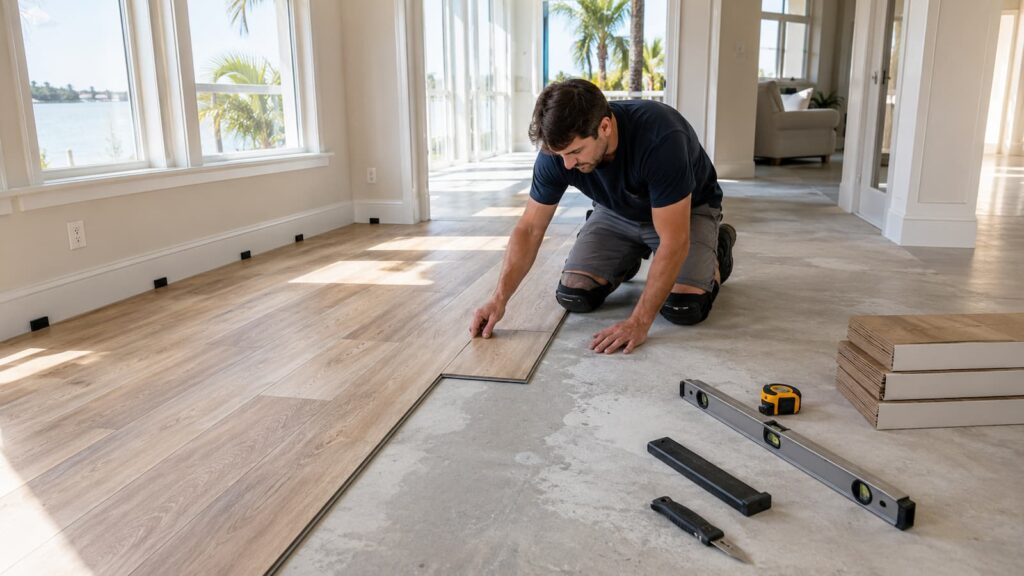
Yes, vinyl plank flooring can often be installed over concrete. In fact, concrete slabs are one of the most common surfaces for luxury vinyl plank installation, especially in Florida homes where slab foundations are very common. But there is an important condition: the concrete must be properly prepared before the flooring goes down.
A concrete slab may look strong and ready at first glance, but vinyl plank flooring needs more than a hard surface. The slab should be clean, dry, flat, stable, and suitable for the specific LVP product being installed. If the concrete has moisture problems, cracks, dips, humps, old adhesive, rough patches, or uneven transitions, those issues can affect the finished floor. Sometimes the problem appears right away. Other times, it shows up months later as movement, clicking, gaps, plank separation, hollow spots, or moisture-related damage.
This is why the better question is not simply “Can you install vinyl plank flooring over concrete?” The better question is: “Is this concrete slab ready for vinyl plank flooring?” In many homes, the answer is yes after basic cleaning and preparation. In other homes, the slab may need moisture evaluation, patching, grinding, floor leveling, crack attention, or removal of old flooring residue before installation can begin.
Luxury vinyl plank is popular because it offers the look of wood with better moisture resistance than hardwood or traditional laminate. It can be comfortable, attractive, and practical for living rooms, bedrooms, hallways, kitchens, and open layouts. But even a high-quality LVP product will perform poorly if it is installed over a problem slab. The floor you see depends heavily on the surface you do not see.
This guide explains what homeowners should know before installing vinyl plank flooring over concrete. We will cover when concrete is suitable, what can go wrong, how moisture affects the project, why flatness matters, whether underlayment is needed, how floating and glue-down LVP differ, and when repairs or leveling should happen before installation.
The Short Answer: Yes, But the Concrete Must Be Ready
Vinyl plank flooring can usually be installed over concrete if the slab meets the flooring manufacturer’s requirements. The concrete should be dry enough, flat enough, clean enough, and stable enough for the installation method. If those conditions are not met, the floor may not perform correctly, even if the product itself is durable and moisture-resistant.
For many homeowners, concrete seems like an ideal base because it is solid and permanent. That is partly true. A well-prepared concrete slab can be an excellent foundation for LVP. But concrete can also hide problems. It may have moisture vapor, old adhesive residue, uneven areas, hairline cracks, thinset from previous tile, paint, sealer, dust, or surface contamination. Any of these issues can affect installation.
The basic requirements for concrete before vinyl plank installation are:
- Clean: free from dust, debris, old adhesive, loose material, paint flakes, and residue.
- Dry: no active leaks, trapped moisture, or slab moisture conditions that exceed product requirements.
- Flat: no major dips, humps, waves, ridges, or unsupported areas.
- Stable: no loose patches, crumbling areas, or movement that could affect the floor.
- Compatible: suitable for the selected LVP type, underlayment, and installation method.
When these conditions are met, LVP can be a strong option over concrete. When they are ignored, the finished floor may develop avoidable problems. That is why preparation should be treated as part of the flooring installation, not as a separate optional detail.
If you are planning vinyl plank flooring installation, the condition of the concrete slab should be evaluated before the material is installed. A good LVP floor starts with a good base.
Why Concrete Slabs Are Common Under Vinyl Plank Flooring
Concrete slabs are common in many homes, especially in warm climates and slab-on-grade construction. In Florida, many homes do not have basements, and the main living area is often built directly over a concrete slab. That means homeowners replacing old carpet, tile, laminate, or vinyl frequently discover concrete underneath.
Vinyl plank flooring is often chosen for these homes because it works well with the way people live. It can provide a wood-look surface without the same moisture sensitivity as hardwood. It is usually more comfortable than tile. It can work in living rooms, bedrooms, hallways, and many kitchens. It also helps create a consistent look across open floor plans.
Concrete and vinyl plank can be a good combination when the slab is properly prepared. Concrete gives the floor a firm base. LVP gives the home a warmer, more comfortable surface. But the relationship only works when the slab conditions match the product requirements.
The most common concrete-related concerns before LVP installation include:
- Moisture vapor coming through the slab
- Dips, low spots, and uneven areas
- High spots or ridges
- Old thinset after tile removal
- Adhesive residue from previous flooring
- Cracks or surface damage
- Height differences between rooms
- Moisture staining or musty odors from previous leaks
These problems are not always deal-breakers. Many can be corrected. But they should be addressed before the flooring is installed. Once LVP is down, correcting the slab usually means removing part of the finished floor.
Concrete Moisture: The Issue Homeowners Should Not Ignore
Moisture is one of the most important things to evaluate before installing vinyl plank flooring over concrete. Concrete can look dry on the surface while still allowing moisture vapor to move through it. In some homes, this is not a major issue. In others, slab moisture can affect underlayment, adhesive, surrounding materials, or the environment underneath a floating floor.
Many LVP products are described as waterproof, but that does not mean moisture under the floor can be ignored. Waterproof usually refers to the plank itself, not the entire flooring system. If moisture becomes trapped underneath, the plank may not swell, but other problems can develop. There may be odor, underlayment damage, adhesive issues, baseboard damage, or conditions that make the floor need removal and inspection.
Moisture can come from several sources. Some moisture comes from the concrete slab itself. Some comes from leaks, appliances, plumbing, exterior doors, or past water damage. In Florida homes, water may also enter near sliding glass doors, patios, laundry areas, kitchens, and bathrooms. The source matters because an active leak must be fixed before flooring is installed.
Signs that moisture should be investigated include:
- Dark stains or discoloration on concrete
- Musty smells after old flooring is removed
- Efflorescence or white powdery residue on the slab
- Old flooring that was swollen, lifted, or separating
- Baseboard swelling or water stains near the floor
- Repeated dampness near exterior doors or appliances
- Previous leak history in kitchens, bathrooms, or laundry rooms
Different LVP products have different moisture requirements. Some floating products need a vapor barrier over concrete. Some products have attached pads with specific restrictions. Glue-down products may require moisture testing because adhesive performance can be affected by slab conditions. Homeowners should not assume one rule applies to every vinyl plank floor.
If water has already damaged the existing floor, replacing water-damaged flooring should include checking what happened underneath. Installing new LVP over hidden moisture can lead to another problem later.
Flatness Matters More Than Many Homeowners Realize
Concrete does not need to be perfectly level for vinyl plank flooring, but it does need to be flat enough. This distinction is important. A floor can slope slightly across a room and still be acceptable if the surface is smooth and consistent. The bigger problems are dips, humps, ridges, waves, and sudden height changes that prevent the planks from being supported evenly.
Floating LVP is especially sensitive to flatness. Since the planks click together and float over the slab, the locking system needs consistent support. If the concrete has a low spot, the plank may bridge over that area. When someone walks across it, the plank can flex. Over time, that movement can stress the joints and cause clicking, gaps, or broken locking edges.
High spots can be just as problematic. A ridge or hump in the slab can create pressure under the floor. That pressure can make planks rock, separate, or wear unevenly. In long hallways or open rooms, even small variations can become noticeable after installation.
Common signs that concrete may not be flat enough include:
- Visible dips or waves after old flooring is removed
- Furniture that rocks or leans
- Existing flooring that moved, separated, or cracked
- Low areas near room transitions
- High ridges from old patching or thinset
- Hollow sounds under previous floating floors
- Uneven door thresholds or height changes between rooms
If the slab is not flat enough, floor leveling may be needed before LVP installation. This may involve grinding high spots, filling low spots, smoothing rough areas, or applying leveling compound where appropriate. The goal is not always to make the floor perfectly level from wall to wall. The goal is to make the surface suitable for the flooring system.
Skipping this step can be expensive later. Once vinyl plank flooring begins to move or separate because of slab unevenness, correcting the issue often requires removing flooring, preparing the slab, and reinstalling material. It is usually smarter to fix the concrete first.
Cracks in Concrete: Are They a Problem for LVP?
Small hairline cracks in concrete are common and do not automatically mean vinyl plank flooring cannot be installed. Many slabs have minor cracking from normal settling or curing. The important question is whether the cracks are stable, whether they create unevenness, whether moisture is present, and whether there is ongoing movement.
A flat, stable hairline crack may not be a major issue for floating LVP, especially if the product and underlayment are suitable. But cracks that are raised, spreading, uneven, damp, or associated with movement should be evaluated before installation. If one side of the crack is higher than the other, the flooring may not sit properly. If moisture is coming through the crack, that is a separate concern.
Cracks can also matter more for glue-down LVP because the surface condition affects bonding. Adhesive systems usually require clean, sound, properly prepared concrete. Crumbling edges, dust, moisture, or unstable patching can interfere with the installation.
Concrete cracks should be reviewed when they are:
- Wide or growing
- Uneven from one side to the other
- Associated with moisture or staining
- Located in a high-traffic path
- Causing existing flooring to crack or separate
- Surrounded by loose or crumbling concrete
Minor cracks may only require cleaning or patching. More serious cracks may need additional evaluation before flooring is installed. The key is not to cover a problem without understanding whether it could affect the new floor.
Can You Install LVP Over Old Tile on Concrete?
Sometimes homeowners want to install vinyl plank flooring over old tile instead of removing it. This may be possible in some situations, but it depends on the condition of the tile. The old tile must be stable, well-bonded, flat enough, clean, and free from moisture problems. If the tile is loose, cracked, uneven, hollow, or shifting, it is not a good base for LVP.
Installing over old tile may sound like a shortcut, but it can create problems if the old floor is not suitable. Grout lines can sometimes telegraph through certain products, especially thinner or glue-down vinyl. Height increases can affect doors, appliances, transitions, and baseboards. If tile is cracked because of slab movement, covering it does not correct the cause.
Old tile should be evaluated for:
- Loose or hollow-sounding sections
- Cracks in tile or grout
- Uneven grout lines or raised edges
- Moisture staining or musty odors
- Height problems at doors and transitions
- Whether the LVP manufacturer allows installation over tile
If tile removal is needed, the concrete underneath may require additional preparation. Removing tile often leaves thinset ridges, chipped areas, and dust. The slab may need grinding, scraping, patching, or leveling before LVP can be installed. The project may take more work, but it creates a better foundation for the new floor.
Installing LVP over tile can make sense only when the existing tile is truly stable and flat enough. If there is any doubt, removing the old flooring and preparing the concrete may be the better long-term choice.
Floating LVP vs Glue-Down LVP Over Concrete
Vinyl plank flooring can be installed over concrete in different ways. The two most common methods are floating click-lock installation and glue-down installation. Both can work, but they have different requirements and behave differently over concrete.
Floating LVP clicks together and rests over the slab without being glued directly to the concrete. It is popular in residential projects because it can be efficient, comfortable, and suitable for many rooms. It may also allow easier plank replacement in some situations. However, floating LVP needs a flat slab and correct expansion space around walls and fixed objects.
Glue-down LVP is attached to the concrete with adhesive. It can be useful in certain high-traffic areas or situations where a lower profile is preferred. It may feel more firmly connected to the slab, but it also demands more surface preparation. The concrete must be clean, smooth, dry enough, and compatible with the adhesive system. Moisture conditions are especially important because slab moisture can affect bonding.
| Installation Method | Best For | Concrete Requirements |
|---|---|---|
| Floating click-lock LVP | Living rooms, bedrooms, hallways, many residential spaces | Flat, clean slab; proper expansion space; underlayment or vapor barrier if required |
| Glue-down LVP | Some high-traffic areas, lower-profile installations, specific project needs | Smooth, clean, dry slab; adhesive-compatible surface; careful moisture evaluation |
Neither method is automatically better for every home. Floating LVP may be more common for many residential projects. Glue-down may be preferred in certain conditions. The right method should be chosen based on the product, room use, slab condition, and long-term expectations.
The mistake is choosing an installation method only because it seems faster or cheaper. If the slab is not suitable for that method, the savings may disappear later through repairs or replacement.
Do You Need Underlayment Over Concrete?
Whether you need underlayment over concrete depends on the LVP product and installation method. Some vinyl plank products have an attached pad. Some require a separate underlayment. Some allow only specific types of underlayment. Some glue-down products do not use underlayment at all because they must bond directly to the slab.
Underlayment can serve different purposes. It may provide sound reduction, comfort, minor smoothing, or moisture protection depending on the product. But underlayment should not be used as a substitute for fixing an uneven slab. If the concrete has dips or high spots, underlayment will not solve the problem. In some cases, using the wrong underlayment can actually damage the locking system or void the warranty.
Over concrete, homeowners should pay close attention to whether a vapor barrier is required. Some floating LVP systems require a moisture barrier over concrete even if the planks themselves are waterproof. Others have specific limitations based on the attached backing. The manufacturer’s installation instructions should guide the decision.
Underlayment questions to ask include:
- Does this LVP product already have an attached pad?
- Does the manufacturer allow additional underlayment?
- Is a vapor barrier required over concrete?
- Is the underlayment compatible with the locking system?
- Will the underlayment affect height at transitions?
- Is the installation floating or glue-down?
Underlayment can help in the right situation, but it is not a universal fix. The slab still needs to be prepared correctly before installation.
How to Prepare Concrete for Vinyl Plank Flooring
Preparing concrete for vinyl plank flooring usually involves more than sweeping the room. The goal is to create a surface that meets the product requirements and supports the floor evenly. The exact steps depend on the condition of the slab and the type of LVP being installed.
A clean, dry, flat slab may only need basic preparation. A slab with old tile residue, adhesive, moisture staining, dips, humps, or cracks may need more work. The preparation phase is where many future flooring problems are prevented.
Step 1: Remove Old Flooring and Loose Material
If old flooring is being removed, the slab underneath should be checked carefully. Carpet, laminate, tile, glue-down vinyl, and old underlayment can all leave different conditions behind. Loose material, dust, old staples, tack strips, adhesive residue, and thinset ridges should be removed as needed.
Step 2: Clean the Concrete
The concrete should be clean before installation. Dust, grit, adhesive residue, paint flakes, and loose debris can interfere with underlayment, vapor barriers, adhesives, or the way floating planks sit on the floor. Cleaning may involve sweeping, vacuuming, scraping, or more detailed surface preparation depending on the slab.
Step 3: Check Moisture Conditions
Moisture should be evaluated according to the product requirements. This is especially important over concrete. If there are signs of moisture staining, musty odor, previous water intrusion, or slab moisture concerns, those issues should be addressed before the flooring is installed.
Step 4: Check Flatness
The slab should be checked with appropriate tools to identify low spots, high spots, and uneven areas. These are not always visible by eye. Flatness is especially important for floating click-lock LVP because unsupported areas can cause movement and joint stress.
Step 5: Patch, Grind, or Level as Needed
Low spots may need patching or leveling compound. High spots may need grinding. Rough areas may need smoothing. Cracks may need attention depending on their size and condition. The preparation method should match the flooring product and the slab condition.
Step 6: Plan Transitions, Doorways, and Expansion Space
Before installation begins, transitions between rooms should be planned. Door clearance, baseboard details, closet openings, appliances, and adjoining flooring heights all matter. Floating floors also need proper expansion space around walls and fixed objects.
When these steps are handled correctly, vinyl plank flooring over concrete can feel stable, look clean, and perform well. When they are skipped, the finished floor may show avoidable problems.
Common Problems When LVP Is Installed Over Concrete Incorrectly
Many vinyl plank flooring problems are not caused by the visible plank. They are caused by the condition of the concrete or by installation details that were missed. Understanding these problems helps homeowners know why preparation is so important.
One common issue is movement. If floating LVP is installed over low spots, the planks may flex when walked on. This can create clicking or popping sounds, stress the locking system, and eventually lead to gaps or separation. A floor that moves underfoot rarely feels high quality, even if the material is expensive.
Another problem is moisture. If the slab has moisture vapor or if water gets trapped under the floor, the planks may not swell, but the floor system can still be affected. Odor, underlayment damage, adhesive issues, or baseboard damage may occur. In kitchens, laundry rooms, and near exterior doors, this risk deserves attention.
Old adhesive and uneven residue can also create problems. Glue-down LVP may not bond correctly. Floating LVP may sit unevenly. Thinset ridges from tile removal can create high spots. Paint, sealer, or contamination can interfere with adhesives or patching materials.
Common problems from poor concrete preparation include:
- Clicking, popping, or hollow sounds
- Plank separation or gaps
- Broken locking edges
- Visible unevenness in the finished floor
- Moisture odor or trapped dampness
- Adhesive failure in glue-down installations
- Premature wear in high-traffic paths
- Awkward transitions between rooms
- Warranty problems if manufacturer requirements were not followed
The best way to avoid these problems is to evaluate and prepare the concrete before installation. A beautiful floor needs a stable foundation.
Best Rooms for Vinyl Plank Flooring Over Concrete
Vinyl plank flooring over concrete can work well in many rooms, especially when homeowners want a warmer and more comfortable alternative to tile. The best rooms are usually spaces where the slab can be prepared properly and where the moisture conditions match the product.
LVP is often a strong choice for living rooms, bedrooms, hallways, dining rooms, home offices, and many kitchens. It can make a slab home feel less hard and more finished. It also allows a wood-look floor to run through connected spaces without the moisture concerns of hardwood or traditional laminate.
Living Rooms and Family Rooms
Living rooms and family rooms are often ideal for LVP over concrete. These rooms benefit from LVP’s comfort and style. A properly prepared slab allows the floor to feel stable, while the vinyl plank surface makes the room feel warmer than bare concrete or tile.
Bedrooms
Bedrooms are another strong fit. Many homeowners do not want tile in bedrooms because it feels hard or cold. LVP over concrete can provide a softer wood-look finish while still being practical and easy to maintain.
Hallways and Open Layouts
Hallways and open layouts can benefit from LVP because it creates visual continuity. However, these areas also make flatness important. Long runs can make unevenness or plank alignment issues more noticeable, so preparation and layout planning matter.
Kitchens
LVP can work well in kitchens over concrete because it handles everyday spills and feels more comfortable than tile. The main concerns are appliance leaks and water getting underneath the floor. If LVP is used in a kitchen, plumbing and appliance lines should be in good condition, and the installation should be planned carefully around cabinets, islands, and transitions.
Bathrooms and Laundry Rooms
LVP may be used in some bathrooms and laundry rooms, but these spaces require caution. Tile is often stronger in true wet areas. If LVP is selected, the product must be approved for the room, and water should not be allowed to sit near edges, toilets, tubs, showers, or appliances. In high-risk wet rooms, tile may be a better long-term choice.
The best room for LVP over concrete is not just the room where it looks good. It is the room where moisture risk, slab condition, installation method, and product requirements all line up.
When Concrete Needs Repair Before LVP Installation
Some concrete problems require attention before vinyl plank flooring is installed. Minor imperfections may be handled with basic preparation. More serious issues may need repair, leveling, or additional evaluation. The goal is to avoid installing a finished floor over a surface that will cause problems later.
Concrete should be repaired or corrected before LVP when there are significant dips, high spots, loose patches, crumbling areas, moisture concerns, uneven cracks, or old flooring residue that prevents a proper installation. If the old flooring failed because of moisture or movement, the cause should be addressed before new material goes down.
Repair may be needed when you see:
- Large low spots that leave planks unsupported
- Raised cracks or uneven slab sections
- Crumbling or loose concrete patches
- Old thinset ridges after tile removal
- Heavy adhesive residue
- Moisture staining or active dampness
- Uneven transitions between rooms
- Previous flooring movement or failure
In some projects, the issue is not the concrete itself but damaged subfloor or underlayment in an adjoining area. If the floor feels soft, unstable, or damaged, repairing the subfloor may need to happen before the new flooring can be installed properly.
Repair work may add time and cost, but it protects the finished floor. A stable, prepared slab helps LVP perform the way it is designed to perform.
Can Vinyl Plank Flooring Hide Uneven Concrete?
Vinyl plank flooring should not be used to hide uneven concrete. While some products are more forgiving than others, LVP is not a substitute for surface preparation. A thicker plank may feel more substantial, but it still needs support. A floating floor that bridges over low spots can move, flex, and stress the locking system.
Some homeowners assume that because LVP is not as rigid as tile, it can handle rough or uneven surfaces. This is a misunderstanding. LVP may not crack like tile, but it can fail in other ways. It may click, separate, gap, feel hollow, or wear unevenly. Thin or flexible products may also show imperfections from below.
Underlayment is also not a cure for uneven concrete. Underlayment may improve sound, comfort, or moisture protection, depending on the product, but it will not correct significant dips or high spots. In some cases, using extra underlayment that is not approved by the manufacturer can create too much cushion and damage the locking system.
If the concrete is uneven, the right solution is to prepare the slab. That may mean filling low spots, grinding high spots, removing residue, or leveling the surface. Once the concrete is suitable, LVP can be installed with much better results.
Questions to Ask Before Installing Vinyl Plank Over Concrete
Before approving an LVP installation over concrete, homeowners should ask practical questions about the slab and the installation plan. These questions help reveal whether the estimate includes the preparation needed for a durable finished floor.
Useful questions include:
- Will the concrete be checked for flatness before installation?
- Are there any low spots, high spots, cracks, or uneven transitions?
- Does the slab show signs of moisture or previous water damage?
- Is a vapor barrier or underlayment required for this product?
- Is the installation floating or glue-down?
- Does the manufacturer approve this product for installation over concrete?
- Will old adhesive, thinset, or residue need to be removed?
- What happens if the slab needs leveling after old flooring is removed?
- How will transitions between rooms be handled?
- Are baseboards, doorways, and appliance clearances part of the plan?
These questions are not overly technical. They are basic project planning questions. A good flooring plan should explain how the concrete will be prepared, how moisture will be handled, and how the selected product will be installed.
Common Mistakes Homeowners Make With LVP Over Concrete
Many problems with vinyl plank over concrete are preventable. They usually happen because the project is treated as a simple surface update instead of a flooring system. The plank, slab, moisture conditions, underlayment, transitions, and installation method all need to work together.
One common mistake is assuming waterproof LVP can ignore concrete moisture. The plank may resist water, but moisture under the floor can still create issues. Another common mistake is installing over old adhesive or thinset without preparing the slab. This can create unevenness or affect bonding.
Homeowners also sometimes skip floor leveling to reduce cost. This can be risky, especially with floating LVP. If the floor moves, clicks, or separates later, the repair may cost more than the original preparation would have.
The most common mistakes include:
- Installing over concrete without checking moisture conditions
- Ignoring low spots, high spots, or slab waves
- Using underlayment as a substitute for leveling
- Installing over loose old tile or unstable flooring
- Leaving adhesive residue or thinset ridges behind
- Using the wrong installation method for the slab condition
- Skipping manufacturer requirements
- Forgetting door clearance and transition height
- Covering moisture damage instead of correcting it
A successful LVP installation over concrete starts with careful evaluation. The visible flooring is only the final layer. The concrete underneath determines how stable and durable that layer will feel.
Final Recommendation: Is LVP Over Concrete a Good Idea?
Vinyl plank flooring over concrete can be an excellent choice when the slab is clean, dry, flat, stable, and properly prepared. It can give Florida homes a comfortable wood-look surface without the same moisture sensitivity as hardwood or traditional laminate. It works well in many living rooms, bedrooms, hallways, open layouts, and kitchens when the product and installation method are appropriate.
The biggest mistake is assuming that concrete is automatically ready because it feels hard. Concrete can have moisture, dips, high spots, cracks, adhesive residue, old thinset, and uneven transitions. These issues should be addressed before the flooring is installed.
A practical decision process looks like this:
- If the concrete is clean, dry, flat, and stable: LVP can usually be a strong option.
- If the concrete has low spots or high spots: preparation or leveling may be needed first.
- If moisture is present: the source and product requirements should be addressed before installation.
- If old flooring is loose or damaged: removal and surface evaluation may be necessary.
- If the room is a true wet area: tile may be worth considering instead, depending on the level of water exposure.
The best results come from matching the product to the room and preparing the concrete correctly. LVP is practical, attractive, and versatile, but it still needs a good foundation. For homeowners planning flooring over concrete, working with an experienced flooring contractor can help identify slab issues before they become expensive problems. When the concrete is prepared properly, vinyl plank flooring can look better, feel more stable, and last longer.