
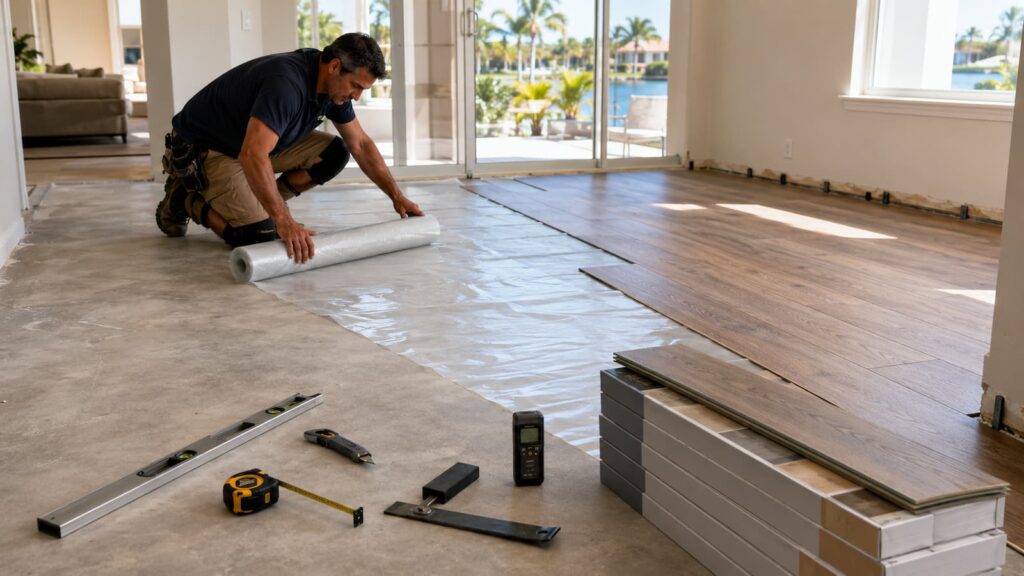
Vinyl plank flooring is one of the most popular flooring choices for homes built on concrete slabs. It offers a clean wood-look appearance, handles everyday spills better than hardwood or laminate, and feels more comfortable than tile in many living spaces. But when LVP is installed over concrete, one question comes up again and again: do you need a moisture barrier under vinyl plank flooring?
The honest answer is: sometimes yes, sometimes no. A moisture barrier may be required under vinyl plank flooring on concrete depending on the product, the installation method, the condition of the slab, and the manufacturer’s instructions. Some floating vinyl plank products require a vapor barrier over concrete. Some have an attached pad but still require a separate moisture barrier. Some products already include backing designed for specific conditions. Glue-down vinyl plank usually does not use a traditional loose moisture barrier because the flooring must bond directly to the slab, but moisture still has to be evaluated carefully because it can affect adhesive performance.
One of the biggest misunderstandings is assuming that waterproof vinyl plank means moisture under the floor does not matter. The plank itself may be waterproof or highly water-resistant, but the entire flooring system is not automatically protected. Concrete can release moisture vapor. Water can enter near sliding doors, appliances, bathrooms, or exterior walls. Moisture can become trapped under floating floors. Underlayment can be affected. Adhesive can fail. Baseboards can swell. Odors can develop. In some cases, the finished floor may need to be removed so the area underneath can dry or be inspected.
This is especially important in Florida homes, where concrete slabs, humidity, rain, wet entries, pool traffic, appliance leaks, and indoor-outdoor living are common. A concrete slab may look dry and solid, but that does not always mean it is ready for vinyl plank flooring. The slab should be clean, dry enough for the selected product, flat, stable, and prepared according to the installation requirements.
This guide explains when a moisture barrier is needed under vinyl plank flooring on concrete, what a vapor barrier actually does, how concrete moisture affects LVP, how floating and glue-down installations differ, and what homeowners should check before installation. If you are planning vinyl plank flooring installation, moisture planning should be part of the project from the beginning.
The Short Answer: Follow the Product Requirements and Check the Concrete
If you are installing floating vinyl plank flooring over concrete, a moisture barrier is often required or strongly recommended, but the exact answer depends on the product. Some manufacturers require a 6-mil polyethylene vapor barrier or another approved moisture barrier over concrete. Others allow installation without a separate barrier if the product has a specific attached pad or if the slab meets certain moisture conditions. The only safe answer is to follow the manufacturer’s installation instructions for the exact flooring product being installed.
If you are installing glue-down vinyl plank flooring over concrete, a loose moisture barrier is usually not used because the plank must bond directly to the slab. However, that does not mean moisture can be ignored. Glue-down products and adhesives have moisture limits. If the concrete releases too much moisture vapor, the adhesive may not bond properly or may fail over time. In those cases, the slab may need testing, preparation, or a moisture-control system approved for that adhesive and product.
A practical rule for homeowners is this: waterproof planks are not a substitute for moisture planning. The floor may resist spills from above, but concrete moisture from below or water trapped underneath can still create problems.
You are more likely to need a moisture barrier when:
- The LVP is floating over a concrete slab
- The manufacturer requires a vapor barrier over concrete
- The slab is on grade or below grade
- The home has a history of slab moisture or water intrusion
- The room is near sliding doors, patios, garages, pool areas, kitchens, or laundry spaces
- The flooring has an attached pad but still requires added moisture protection
- The concrete shows staining, musty odor, efflorescence, or previous moisture signs
You may not need a separate moisture barrier when the product specifically does not require one, the slab moisture conditions meet the product requirements, and the installation method does not allow or use a loose barrier. But that decision should never be guessed. It should be based on product instructions and slab evaluation.
What Is a Moisture Barrier?
A moisture barrier is a layer used to reduce moisture vapor movement from the concrete slab into the flooring system above. In flooring conversations, homeowners may hear several related terms: moisture barrier, vapor barrier, vapor retarder, underlayment, pad, or moisture-resistant underlayment. These terms are sometimes used loosely, but they are not always the same thing.
A basic vapor barrier for floating floors is often a thin plastic sheet, commonly polyethylene, installed over concrete before the floating floor is placed. It is meant to help reduce moisture vapor reaching the underside of the flooring or underlayment. Some underlayments also include moisture-barrier properties. Some LVP products have attached pads, but an attached pad does not automatically mean a vapor barrier is included or that no extra barrier is required.
A moisture barrier is not designed to fix an active water leak. It is not a waterproofing system for a flooding problem. It does not make a wet slab dry. It does not repair cracks, stop water intrusion at doors, or solve plumbing leaks. It is a protective layer used in specific flooring systems to manage moisture vapor under normal installation conditions.
A moisture barrier may help protect against:
- Moisture vapor moving from concrete into the flooring system
- Condensation-related issues under some floating floors
- Moisture reaching certain attached pads or underlayments
- Odor risk caused by damp material under the floor
- Some moisture-related problems when the slab meets product limits
A moisture barrier does not fix:
- Active leaks from appliances or plumbing
- Standing water under the flooring
- Flooding or storm water intrusion
- Major slab moisture problems that exceed product limits
- Uneven concrete
- Cracked, loose, or contaminated slab surfaces
- Mold or odor problems already present under old flooring
That distinction matters. A moisture barrier is useful only when it is the right product for the right installation. It is not a shortcut around proper inspection, moisture evaluation, floor preparation, or water-damage repair.
Why Concrete Moisture Matters Under Vinyl Plank Flooring
Concrete seems solid, but it is porous. Moisture can move through concrete as vapor, especially in slab-on-grade homes. A slab can look dry from the top while still releasing moisture vapor. In some homes, that moisture is minor and manageable. In others, it can affect flooring performance if ignored.
Moisture under vinyl plank flooring can create several problems. With a floating floor, moisture can become trapped between the slab and the flooring system. The planks may not swell, but the attached pad, underlayment, baseboards, or surrounding materials can be affected. A damp environment under the flooring can also lead to odors or concerns that require removal and inspection.
With glue-down vinyl plank, slab moisture can affect adhesive performance. Adhesive may soften, lose bond strength, or fail if moisture conditions exceed the adhesive’s limits. Glue-down flooring depends on a stable bond between the plank and the concrete. If the slab is not suitable, the finished floor may release, curl, bubble, or develop loose areas.
Concrete moisture concerns can come from:
- Moisture vapor moving through the slab
- Missing or damaged vapor retarder below the slab
- High groundwater or poor exterior drainage
- Plumbing leaks
- Appliance leaks
- Rainwater entering near doors or sliding glass doors
- AC condensate issues
- Old flooring that trapped moisture against the concrete
- Previous water damage that was never fully dried or corrected
Moisture is not only a technical flooring issue. It affects comfort, odor, cleanliness, long-term performance, and whether the finished floor needs future repair. That is why concrete should be evaluated before LVP is installed, especially in Florida homes where slab foundations and humid conditions are common.
Does Waterproof Vinyl Plank Still Need a Moisture Barrier?
Waterproof vinyl plank may still need a moisture barrier over concrete. This is one of the most important points for homeowners to understand. Waterproof usually describes the plank’s resistance to water damage, not the entire installation system. A waterproof plank can still be installed over an environment where moisture causes problems below or around it.
For example, a floating LVP plank may not swell when exposed to water from above. But if moisture vapor rises from the slab and becomes trapped under the floor, the attached pad, underlayment, or baseboards may still be affected. If water enters from a dishwasher leak and travels under the floor, the plank may survive, but the area underneath may stay damp. If a room smells musty after installation, the fact that the plank itself is waterproof does not solve the problem.
Waterproof LVP does not automatically protect against:
- Moisture vapor from concrete
- Trapped water underneath floating flooring
- Baseboard swelling
- Underlayment damage
- Adhesive failure in glue-down installations
- Odors from damp conditions below the floor
- Active leaks from appliances, plumbing, or exterior doors
This does not mean vinyl plank is a bad choice over concrete. It can be an excellent choice. It simply means moisture planning still matters. The right moisture barrier, when required, helps the flooring system perform as intended. The wrong assumption can lead to avoidable problems.
The safest approach is to read the installation instructions for the exact flooring product and ask whether a vapor barrier is required over concrete. If the instructions say one is required, skipping it may affect performance and warranty coverage. If the instructions say not to add one because the product has specific backing requirements, adding the wrong material can also create problems.
Floating LVP Over Concrete: Moisture Barrier Considerations
Floating vinyl plank flooring is one of the most common LVP installation methods in residential homes. The planks lock together and float over the prepared surface rather than being glued directly to the concrete. This method can work very well in living rooms, bedrooms, hallways, dining areas, and many kitchens when the slab is clean, dry, flat, and stable.
Because floating LVP sits over the concrete, many products require a moisture barrier or vapor barrier between the slab and the flooring system. This is especially common for slab-on-grade installations. The barrier helps reduce moisture vapor from reaching the underside of the flooring or attached pad.
Some floating LVP products have attached pads. This can be convenient, but it does not always eliminate the need for a moisture barrier. Some attached pads provide sound reduction or comfort but are not a vapor barrier. Other products may include moisture protection but still require seams to be handled a certain way. Some products restrict additional underlayment because too much cushion can damage the locking system.
When installing floating LVP over concrete, homeowners should ask:
- Does this product require a vapor barrier over concrete?
- Is the attached pad also a moisture barrier, or only a comfort/sound pad?
- Does the manufacturer allow additional underlayment?
- What thickness of moisture barrier is approved?
- How should seams be overlapped or taped?
- Does the slab need moisture testing before installation?
- Is the concrete flat enough for a floating floor?
Floating LVP also needs proper expansion spacing, clean transitions, and a flat surface. A moisture barrier does not solve floor flatness problems. If the slab has dips or high spots, floor leveling may be needed before the moisture barrier and flooring are installed.
In many Florida homes, floating LVP over concrete can be a strong choice. But it should be installed as a complete system: prepared slab, approved moisture barrier if required, correct underlayment or attached pad, proper expansion space, and professional finishing details.
Glue-Down Vinyl Plank Over Concrete: Does It Need a Barrier?
Glue-down vinyl plank flooring is different from floating LVP because the planks are bonded directly to the concrete with adhesive. Because of that direct bond, a loose plastic moisture barrier is usually not placed under glue-down LVP. If a plastic sheet is placed between the plank and concrete, the adhesive cannot bond to the slab.
However, glue-down LVP still requires moisture planning. In fact, slab moisture can be even more critical because it can affect adhesive performance. If the concrete releases too much moisture vapor or has a high pH condition, some adhesives may fail. The floor may release, bubble, curl, or develop loose areas.
Instead of a loose moisture barrier, glue-down installations may require one of the following, depending on the product and slab conditions:
- Concrete moisture testing before installation
- Approved adhesive rated for the slab conditions
- Surface preparation to remove old adhesive, dust, paint, or sealer
- Moisture mitigation products approved for the flooring system
- Primers or patching compounds compatible with the adhesive
- Professional evaluation if moisture readings are too high
Glue-down LVP needs a clean, smooth, dry, adhesive-compatible surface. Old adhesive residue, dust, oil, paint, sealer, loose patching, or moisture can all create problems. A glue-down floor can feel very stable when installed correctly, but it is less forgiving of slab preparation mistakes.
If homeowners are comparing floating vs glue-down LVP over concrete, the moisture question should be part of the decision. Floating floors may need a separate vapor barrier. Glue-down floors may need moisture testing and adhesive-compatible slab preparation. Neither method allows moisture to be ignored.
Attached Pad vs Moisture Barrier: They Are Not Always the Same
Many vinyl plank products come with an attached pad. Homeowners often assume this pad acts as a moisture barrier, but that is not always true. An attached pad may be designed for comfort, sound reduction, minor support, or installation convenience. It may or may not provide moisture protection over concrete.
This distinction is important because installing the wrong layers can cause problems. If the product requires a vapor barrier and the attached pad does not provide one, skipping the barrier can leave the flooring system exposed to slab moisture. If the product already includes a backing system and does not allow additional underlayment, adding extra padding can create too much cushion and stress the locking system.
Attached pad may help with:
- Sound reduction
- Comfort underfoot
- Minor smoothing of acceptable surface texture
- Installation convenience
- Warmth and feel over concrete
Attached pad does not automatically mean:
- A vapor barrier is included
- No moisture barrier is needed
- The product can be installed over damp concrete
- The floor can hide low spots or high spots
- Additional underlayment is allowed
- The manufacturer warranty will remain valid if instructions are ignored
The only reliable answer is the product’s installation guide. It should state whether a moisture barrier is required over concrete, whether additional underlayment is allowed, and what slab conditions must be met before installation. If that information is unclear, ask the flooring supplier or installer before the project begins.
Signs Your Concrete Slab May Have Moisture Problems
Concrete moisture is not always visible, but there are warning signs homeowners can watch for. If any of these signs are present, the slab should be evaluated before vinyl plank flooring is installed. A moisture barrier may help in some situations, but active moisture problems should not be covered without understanding the source.
Common warning signs include:
- Dark stains on concrete after old flooring is removed
- Musty smells near the floor
- White powdery residue on the slab
- Old flooring that lifted, buckled, or separated
- Swollen baseboards or water stains near walls
- Damp areas near sliding glass doors or exterior entries
- Moisture problems near kitchens, bathrooms, or laundry rooms
- Previous flooding or storm water intrusion
- Repeated flooring failure in the same area
- Condensation or dampness under old flooring
These signs do not automatically mean vinyl plank cannot be installed. They mean the cause should be understood first. Sometimes the issue is old and inactive. Sometimes it is caused by an appliance leak that has been repaired. Sometimes it points to an ongoing slab moisture problem or exterior water intrusion. The next step depends on the source and severity.
If old flooring was damaged by water, the replacement project should include inspection of the surface underneath. In many cases, replacing water-damaged flooring requires more than removing the visible material. The slab or subfloor needs to be checked, cleaned, dried, repaired, or leveled before new flooring is installed.
Moisture Testing Before Installing LVP Over Concrete
Moisture testing helps determine whether a concrete slab is suitable for the flooring product and installation method. It is especially important for glue-down vinyl plank, but it can also matter for floating floors depending on product requirements and slab conditions.
Some homeowners skip moisture testing because the slab looks dry. That can be risky. A slab can look dry from above while still releasing moisture vapor. This is more likely in slab-on-grade homes, older homes, homes with drainage issues, or areas where previous flooring showed moisture-related damage.
Moisture testing may help answer:
- Is the slab dry enough for the selected flooring?
- Does the adhesive allow the measured moisture conditions?
- Is a vapor barrier required for a floating installation?
- Is the moisture problem localized or widespread?
- Should the slab be allowed to dry longer?
- Is additional moisture mitigation needed?
Different products and adhesives have different acceptable moisture limits. That is why test results should be interpreted according to the flooring manufacturer’s requirements. A moisture reading that is acceptable for one product may not be acceptable for another. A floating floor with an approved vapor barrier may have different requirements than a glue-down floor with adhesive.
Moisture testing is not always required for every simple residential project, but it is wise when there are warning signs, previous water damage, glue-down installation, old flooring failure, or uncertainty about the slab. It is much easier to address moisture before installation than after a finished floor develops problems.
Florida Homes and Concrete Slab Moisture
Florida homes often make moisture planning more important because many properties are built on concrete slabs and exposed to humid conditions. The climate itself does not mean every slab has a serious moisture problem, but it does mean homeowners should be thoughtful before installing flooring directly over concrete.
Several Florida-specific conditions can affect flooring:
- Slab-on-grade construction
- High outdoor humidity
- Air conditioning and indoor humidity differences
- Heavy rain and storm events
- Sliding glass doors and patio access
- Pool traffic and wet feet
- Sandy shoes and frequent cleaning
- Appliance leaks in kitchens and laundry rooms
- AC condensate line issues
- Older floors hiding moisture stains or residue
In many Florida homes, LVP over concrete can be an excellent flooring choice. It can make a slab home feel warmer and more modern. It can also provide a practical surface for busy households, pets, and open layouts. But the concrete should be evaluated before installation, and moisture-barrier requirements should not be guessed.
Homes near water, homes with older slabs, homes with previous flooring failures, and homes with sliding doors or wet entries may deserve extra attention. The same is true for rooms where water exposure is likely, such as kitchens, bathrooms, laundry rooms, and utility areas.
A good Florida flooring plan looks at the whole system: slab condition, moisture risk, product instructions, barrier requirements, floor flatness, transitions, and room use. That is more reliable than choosing a product only because it says waterproof on the box.
Floor Flatness Still Matters With a Moisture Barrier
A moisture barrier does not fix an uneven concrete slab. This is another common misunderstanding. The barrier may help manage vapor movement, but it does not fill dips, grind high spots, smooth old thinset, or repair damaged areas. If the slab is uneven, the flooring can still move, click, gap, or fail.
Floating LVP is especially sensitive to flatness. If the floor bridges over a low spot, it can flex when walked on. Repeated movement can stress the locking system. High spots can create pressure points. Old adhesive or tile mortar can create ridges that make the floor feel unstable. A moisture barrier placed over those problems does not make them disappear.
Before installing a moisture barrier and LVP, the slab should be checked for:
- Low spots
- High spots
- Waves in the slab
- Old adhesive ridges
- Thinset from tile removal
- Cracks or raised sections
- Loose patching material
- Uneven room transitions
If these conditions are present, the slab may need patching, grinding, or leveling. This preparation protects the floor more than most homeowners realize. The finished floor may look like the visible planks, but its performance depends on the surface underneath.
For homes with uneven slabs, leveling the surface before LVP installation can help prevent movement, noise, and long-term problems. Moisture protection and flatness preparation work together. One does not replace the other.
Can You Install Vinyl Plank Directly on Concrete Without a Barrier?
Sometimes vinyl plank flooring can be installed over concrete without a separate moisture barrier, but only when the product allows it and the slab meets the required conditions. This is not a decision to make based on convenience or guesswork. It should come from the product instructions and the condition of the concrete.
Some floating LVP products may allow direct installation over concrete with an attached backing under certain conditions. Others require a separate vapor barrier even with an attached pad. Some products do not allow extra underlayment but still require moisture control in another form. Glue-down LVP is installed directly to concrete, but moisture limits and adhesive requirements still apply.
Direct installation may be acceptable when:
- The product instructions allow it
- The slab meets moisture requirements
- The concrete is clean, dry, flat, and stable
- There is no history of moisture problems
- The installation method does not require a separate barrier
- The attached pad or adhesive system is approved for concrete
- The manufacturer warranty is not affected
Direct installation is risky when:
- The instructions require a vapor barrier
- The slab has moisture stains or musty odors
- Old flooring failed because of moisture
- The room is near exterior water exposure
- The slab is below grade or moisture-prone
- The homeowner is unsure what the product requires
- There is active leakage or water intrusion
Skipping a required barrier may save a small amount during installation, but it can create major problems later. It can also affect warranty coverage if the floor fails and the manufacturer determines the installation did not follow instructions.
Moisture Barrier vs Underlayment: What Is the Difference?
Underlayment and moisture barriers are often discussed together, but they are not always the same. Underlayment is a layer installed under flooring to provide sound reduction, comfort, minor smoothing, or other performance benefits. A moisture barrier is specifically intended to reduce moisture vapor movement from the slab into the flooring system. Some products combine both functions, but many do not.
For floating LVP, underlayment may be built into the product as an attached pad. Some products allow an additional underlayment. Some do not. If an extra underlayment is too soft or too thick, it can create excessive movement and damage the locking system. This is why homeowners should not add underlayment just because it seems like extra comfort.
A moisture barrier is usually thinner and less cushioned than comfort underlayment. It is not meant to make the floor softer. It is meant to protect the installation from moisture vapor. In some cases, the product may require both an underlayment function and a moisture-barrier function. In other cases, the attached pad may handle comfort while a separate vapor barrier handles moisture.
| Layer | Main Purpose | Important Warning |
|---|---|---|
| Moisture barrier | Reduces moisture vapor movement from concrete | Does not fix active leaks or uneven concrete |
| Underlayment | Adds sound control, comfort, or approved support | Must be compatible with the LVP product |
| Attached pad | Built-in comfort or sound layer on some planks | May or may not count as a vapor barrier |
| Adhesive system | Bonds glue-down LVP to concrete | Must match slab moisture conditions |
The safest approach is to treat the flooring product as a system. Do not mix random underlayment, plastic sheeting, attached pads, and adhesives without confirming compatibility. More layers do not always mean better performance.
What Happens If You Skip a Required Moisture Barrier?
If the flooring manufacturer requires a moisture barrier and it is skipped, several problems can develop. Some may show up quickly. Others may take months. The risk depends on the slab, moisture level, product, installation method, and room conditions.
The most obvious problem is moisture reaching the underside of the flooring system. With floating LVP, this can affect the attached pad, underlayment, or material below the floor. It can also contribute to odors, dampness, or concerns around baseboards and transitions. The planks may still look fine from above, which can make the problem harder to detect.
Skipping a required barrier can also create warranty problems. If the flooring fails and the installation did not follow the manufacturer’s instructions, the warranty may not apply. Even if the plank itself is not damaged, the installation may be considered incorrect.
Possible consequences include:
- Musty odors under or around the floor
- Damp underlayment or attached pad
- Baseboard swelling or discoloration
- Moisture trapped below floating LVP
- Mold or mildew concerns in damp areas
- Adhesive failure in glue-down systems with moisture issues
- Flooring movement or instability if moisture affects underlying material
- Warranty denial due to incorrect installation
- Need to remove flooring for inspection or correction
Not every floor without a moisture barrier will fail. But if the barrier was required and the slab has moisture vapor, the risk is unnecessary. A proper moisture barrier is relatively simple compared with removing and reinstalling a finished floor later.
Can a Moisture Barrier Trap Moisture?
A moisture barrier can help protect flooring from normal slab vapor, but it can also trap moisture if the wrong system is used or if there is an active water problem. This is why installation details matter. A moisture barrier is not a solution for a wet slab, plumbing leak, flooding, or exterior water intrusion.
If water is entering from a dishwasher, refrigerator line, washing machine, toilet, sliding door, or exterior wall, a vapor barrier under LVP will not fix that source. Water may still travel under the floor or sit at the edges. If moisture is trapped between layers and cannot dry, odor and damage can develop.
A moisture barrier is most appropriate when:
- The slab meets the flooring product’s moisture limits
- The barrier is required or approved by the product instructions
- There is no active leak or standing water issue
- The concrete is clean and properly prepared
- The flooring system is installed as designed
A moisture barrier is not enough when:
- Water is actively entering the room
- The slab has severe moisture problems
- There is trapped water from previous flooring damage
- The room has unresolved plumbing or appliance leaks
- The concrete is contaminated, crumbling, or uneven
- The product does not allow that type of barrier
This is why professional evaluation can be valuable. Moisture management is not only about adding plastic under the floor. It is about understanding where the moisture is coming from and choosing the correct installation system.
Moisture Barriers in Kitchens, Bathrooms, and Laundry Rooms
Kitchens, bathrooms, and laundry rooms require extra caution because they have higher water risk than living rooms or bedrooms. However, a moisture barrier under vinyl plank flooring does not make these rooms waterproof. It may help manage moisture vapor from concrete, but it does not prevent water from entering from above or around fixtures.
Kitchens
LVP can work well in many kitchens because it is comfortable, attractive, and resistant to everyday spills. A moisture barrier may be required if the floor is floating over concrete. But kitchen leaks usually come from above, not below: dishwasher lines, refrigerator ice maker lines, sink plumbing, or spills around cabinets. A vapor barrier under the floor does not stop those leaks from reaching the flooring edges or getting underneath.
Before installing LVP in a kitchen, appliances and plumbing should be checked, and any old water damage should be corrected. The flooring should be planned carefully around cabinets, transitions, and appliance areas.
Bathrooms
Bathrooms are true wet areas. LVP may be acceptable in some bathrooms depending on the product, but full bathrooms with showers and tubs often benefit from tile because water exposure is frequent. A vapor barrier under LVP does not protect the edges around toilets, tubs, showers, or vanities from water getting underneath.
If a bathroom has a history of leaks, soft spots, musty odors, or damaged flooring, the surface underneath should be inspected before any new flooring is installed. For many full bathrooms, proper tile installation may be the better long-term moisture solution.
Laundry Rooms
Laundry rooms are high-risk because washing machines, hoses, utility sinks, and water heaters can leak. A moisture barrier under floating LVP may help with slab vapor, but it will not protect against a washing machine overflow. If LVP is used in a laundry room, leak prevention and appliance maintenance are critical.
Tile is often the safer option in laundry rooms where water exposure risk is high. If LVP is chosen, product approval, slab preparation, moisture planning, and edge details matter.
How to Prepare Concrete Before Installing a Moisture Barrier and LVP
Before a moisture barrier or vinyl plank flooring is installed, the concrete slab should be prepared. Preparation is what allows the barrier and flooring system to sit correctly. A dirty, uneven, damaged, or damp slab can create problems even if the right barrier is used.
Concrete preparation usually starts with removing old flooring and loose material. Carpet, tile, laminate, glue-down vinyl, and old underlayment can leave debris, adhesive, staples, tack-strip damage, thinset, or residue. These materials should be removed or corrected according to the flooring requirements.
After removal, the slab should be cleaned and inspected. Any moisture signs should be investigated. Low spots and high spots should be addressed. Cracks should be evaluated. Transitions between rooms should be planned. The goal is to create a clean, dry, flat, stable surface before the barrier and flooring are installed.
Concrete prep may include:
- Removing old flooring
- Scraping adhesive residue
- Grinding thinset ridges after tile removal
- Sweeping and vacuuming dust
- Checking for moisture stains or odors
- Repairing cracks or damaged areas where needed
- Filling low spots
- Grinding high spots
- Leveling uneven areas
- Planning transitions and expansion space
If there are soft areas, old water damage, or unstable sections in the floor system, repairing the subfloor may be needed before installation. A vapor barrier should never be used to cover a weak or damaged base.
Common Mistakes Homeowners Make With Moisture Barriers
Moisture barriers can be helpful, but mistakes with them can cause problems. Many issues happen because homeowners assume all products work the same way or because they treat the barrier as a universal solution.
One common mistake is skipping the moisture barrier when the manufacturer requires it. Another is adding extra underlayment or plastic when the product does not allow it. Both mistakes can create problems. The installation system should match the flooring product.
Another mistake is using a moisture barrier to ignore an active water problem. If a sliding door leaks during storms, if a dishwasher line is dripping, or if a toilet seal has failed, a barrier under the floor will not fix the issue. The water source must be corrected first.
Avoid these mistakes:
- Assuming waterproof LVP never needs a vapor barrier
- Skipping the barrier when the product requires it
- Adding extra underlayment when the product does not allow it
- Using underlayment as a substitute for floor leveling
- Installing over damp, dirty, or uneven concrete
- Ignoring musty odors or moisture stains
- Installing over old water-damaged flooring
- Using a floating-floor barrier under glue-down LVP
- Failing to tape or overlap seams according to instructions
- Forgetting about transitions, edges, and baseboards
- Choosing LVP in a wet room where tile would be safer
The correct moisture plan is product-specific. What works under one vinyl plank product may be wrong under another. Reading and following the instructions is not optional; it is part of a successful installation.
Questions to Ask Before Installing LVP Over Concrete
Before installing vinyl plank flooring over concrete, homeowners should ask practical questions about moisture, product requirements, and slab preparation. These questions can prevent expensive mistakes and make estimates easier to compare.
- Does this LVP product require a moisture barrier over concrete?
- Does the attached pad count as a vapor barrier?
- Is additional underlayment allowed?
- What type and thickness of barrier is approved?
- Does the slab need moisture testing?
- Are there signs of previous water damage?
- Is the concrete flat enough for floating LVP?
- Does the slab need patching, grinding, or leveling?
- Is the installation floating or glue-down?
- If glue-down, what are the adhesive moisture limits?
- How will transitions and baseboards be handled?
- What happens if moisture or damage is found after old flooring removal?
- Could tile be a better choice for wet rooms?
A good contractor should be able to answer these questions clearly and explain why a moisture barrier is or is not needed for the exact product and slab. Be cautious if the answer is a universal “yes, always” or “no, never.” The correct answer depends on the flooring system.
Final Recommendation: Do You Need a Moisture Barrier?
You may need a moisture barrier under vinyl plank flooring on concrete, especially if the floor is a floating LVP system and the manufacturer requires vapor protection over concrete. In many Florida homes with slab foundations, moisture-barrier planning is a smart part of the installation process. But the final answer depends on the exact product, installation method, slab condition, and manufacturer instructions.
For floating LVP, a moisture barrier is often required or recommended over concrete. For glue-down LVP, a loose barrier is usually not used, but slab moisture still matters because it can affect adhesive bond. For products with attached pads, the pad may or may not count as a vapor barrier. For rooms with active leaks or repeated water problems, a moisture barrier is not enough; the water source must be fixed before flooring is installed.
A practical summary looks like this:
- Use a moisture barrier when the floating LVP product requires one over concrete.
- Do not guess based only on the word waterproof.
- Do not add random underlayment unless the product allows it.
- Check slab moisture when there are stains, odors, old flooring failure, or glue-down installation.
- Fix leaks first before installing any new flooring.
- Level the slab if low spots or high spots could affect the finished floor.
- Consider tile in full bathrooms, laundry rooms, and true wet areas.
The best vinyl plank installation over concrete starts with a prepared slab, the right moisture plan, and a product that fits the room. A moisture barrier can be an important part of that system, but it is not the whole system. Surface preparation, moisture evaluation, product compatibility, and installation quality all matter.
For homeowners planning LVP over concrete, working with an experienced flooring contractor can help determine whether a moisture barrier is needed, whether the slab is ready, and whether the chosen flooring is appropriate for the room. When the moisture plan is handled correctly before installation, the finished floor has a much better chance of looking good, feeling stable, and performing well for years.