
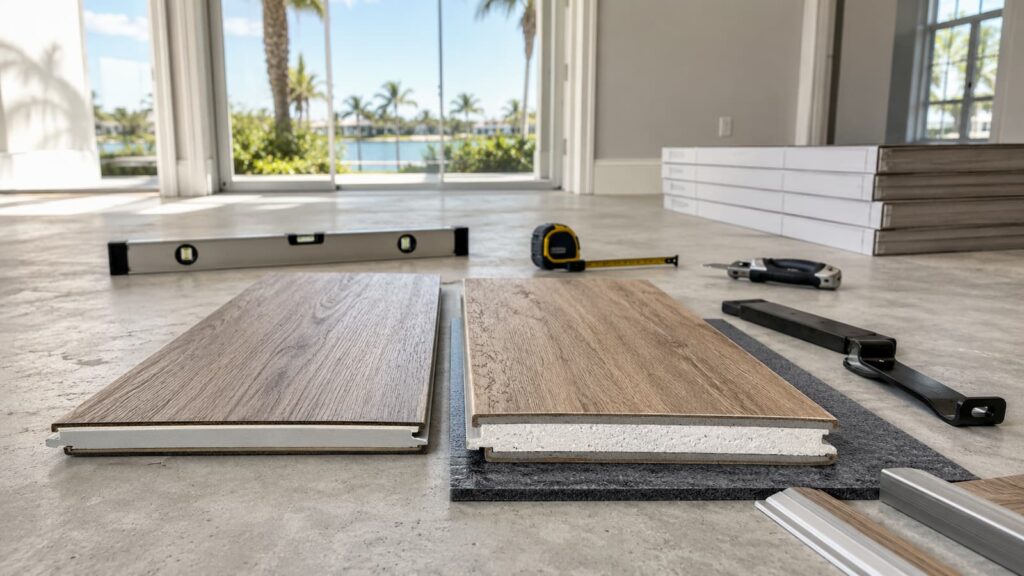
Luxury vinyl plank flooring has become one of the most popular flooring choices for Florida homes because it offers a practical mix of style, comfort, water resistance, and everyday durability. It can give homeowners the look of wood without the same moisture concerns as hardwood or laminate, and it feels warmer and softer than tile in many living spaces. But once homeowners begin comparing vinyl plank products, they often run into two terms that can be confusing: SPC and WPC.
SPC and WPC are both types of rigid-core vinyl plank flooring. They can look very similar from the top. Both can come in realistic wood-look designs. Both can be used in many residential spaces. Both may be marketed as waterproof or water-resistant. Both can be installed as floating click-lock floors in many projects. But the core construction is different, and that difference affects how the flooring feels, how it handles dents, how it responds to uneven surfaces, how it performs over concrete, and where it makes the most sense in a home.
In simple terms, SPC vinyl plank flooring usually has a denser, stone-based rigid core. It tends to feel firmer underfoot and is often chosen for durability, dent resistance, and stability. WPC vinyl plank flooring usually has a wood-plastic or polymer-composite core. It often feels slightly softer, warmer, and more cushioned, which can make it appealing in living rooms, bedrooms, and spaces where comfort matters.
There is no universal winner for every home. SPC may be better for high-traffic areas, rental properties, pets, and rooms where dent resistance is a priority. WPC may be better for homeowners who want more comfort underfoot and a quieter, warmer feel. In Florida homes, the decision also depends on concrete slab condition, humidity, moisture risk, room use, sunlight exposure, and installation quality.
This guide explains what homeowners should know before choosing SPC vs WPC vinyl plank flooring. We will cover core construction, comfort, durability, water resistance, concrete slab preparation, pets, kids, kitchens, bathrooms, living areas, cost, installation requirements, and common mistakes to avoid before installation.
The Short Answer: SPC Is Firmer and More Dent-Resistant, WPC Is Softer and More Comfortable
If you want the fastest comparison, SPC is usually the better choice when durability, firmness, and dent resistance matter most. WPC is usually the better choice when comfort, warmth, and a slightly softer feel underfoot matter more. Both can be good options, but they are built for slightly different priorities.
SPC is often preferred in busy homes, rental properties, kitchens, hallways, and areas where heavy furniture, pets, or frequent traffic are expected. Its dense core can make it feel very stable and resistant to dents from everyday use. However, that same dense core can feel harder underfoot, especially when compared with WPC.
WPC is often preferred in bedrooms, living rooms, family rooms, and spaces where homeowners want LVP to feel warmer and more comfortable. Its core construction can provide a slightly more cushioned feel. However, WPC may be less dent-resistant than SPC in some conditions, especially under heavy furniture or concentrated weight.
A quick overview looks like this:
| Category | SPC Vinyl Plank | WPC Vinyl Plank |
|---|---|---|
| Core feel | Dense, firm, rigid | Softer, warmer, slightly cushioned |
| Comfort | Good, but firmer underfoot | Usually more comfortable |
| Dent resistance | Usually stronger | Good, but often less dent-resistant than SPC |
| Best rooms | Kitchens, hallways, rentals, busy homes, high-traffic spaces | Bedrooms, living rooms, family rooms, comfort-focused spaces |
| Concrete slab use | Can work well when slab is flat and prepared | Can work well when slab is flat and prepared |
| Moisture resistance | Very good at the plank level | Very good at the plank level |
| Main concern | Can feel harder underfoot | Can dent more easily under heavy point loads |
The best choice depends on how the room will be used. A home with pets, kids, rental traffic, and heavy furniture may benefit from SPC. A homeowner who wants a softer floor in bedrooms and living areas may prefer WPC. In either case, the installation surface must be properly prepared. Even the best rigid-core vinyl plank can perform poorly if it is installed over an uneven, damp, dirty, or unstable surface.
Before installing vinyl plank flooring, homeowners should compare product quality and installation requirements, not just the words SPC or WPC on the label.
What Is SPC Vinyl Plank Flooring?
SPC stands for stone plastic composite or stone polymer composite. The exact wording can vary by manufacturer, but the basic idea is the same: SPC vinyl plank flooring has a dense rigid core that includes limestone or mineral-based material mixed with plastic polymers. This creates a plank that is firm, stable, and resistant to dents compared with many softer flooring products.
Most SPC products are built in layers. The top layer is usually a wear layer that protects the surface from daily traffic. Beneath that is a printed design layer that gives the plank its wood-look, stone-look, or other visual style. Below the design layer is the SPC rigid core. Many products also include an attached pad for sound reduction, comfort, or installation convenience, although attached pads vary in quality and purpose.
SPC became popular because it offers a strong combination of durability and water resistance. It can be a practical option in homes where traditional hardwood or laminate would be risky because of moisture, pets, or heavy use. It is also often used in rental properties and commercial-style residential spaces because it can handle traffic well when installed correctly.
The main advantages of SPC include:
- Dense, rigid core construction
- Strong dent resistance compared with many softer vinyl products
- Good stability in many residential environments
- Practical performance in high-traffic spaces
- Good option for pets, kids, and rental use
- Wood-look design with better moisture resistance than laminate or hardwood
- Often suitable for concrete slabs when the surface is prepared correctly
The biggest trade-off is feel. SPC can feel harder underfoot than WPC. Some homeowners like that firm, stable feel. Others prefer something softer and warmer, especially in bedrooms and family rooms. The attached pad can help, but SPC will usually still feel denser than WPC.
Where SPC Flooring Usually Makes Sense
SPC often makes sense in rooms that need durability and stability more than softness. This includes busy hallways, kitchens, rental homes, family areas with pets, and spaces where furniture movement or heavy use is likely. In Florida homes, SPC can also be a practical option over concrete slabs when the slab is clean, dry, flat, and suitable for the product.
Good places to consider SPC include:
- Kitchens
- Hallways
- Dining areas
- Rental properties
- Pet-friendly homes
- Busy family rooms
- Home offices with chairs or furniture movement
- Open floor plans where durability matters
SPC is not automatically the best option for every room, but it is often a strong choice when performance and dent resistance are top priorities.
What Is WPC Vinyl Plank Flooring?
WPC stands for wood plastic composite or wood polymer composite. Like SPC, the wording can vary, but WPC vinyl plank flooring usually has a rigid core made from a blend of plastic polymers and wood-like or foaming agents. The result is a plank that is generally thicker, softer, and more cushioned than SPC.
WPC products are also usually layered. They commonly include a wear layer, a printed design layer, a WPC core, and often an attached backing or pad. From the top, WPC and SPC can look almost identical. The difference is felt more than seen. WPC often feels warmer and quieter underfoot, which can make it appealing in bedrooms, living rooms, and spaces where people walk barefoot.
WPC became popular because it made vinyl plank flooring feel more comfortable and residential. It can provide the practical benefits of vinyl while feeling less hard than tile or dense SPC. For many homeowners, that comfort is the main reason to choose WPC.
The main advantages of WPC include:
- Softer feel underfoot than many SPC products
- Warmer and more cushioned walking experience
- Good sound absorption in many residential spaces
- Comfortable option for bedrooms and living areas
- Wood-look design with better moisture resistance than hardwood or laminate
- Often thicker than SPC products
- Good choice when comfort is a priority
The main trade-off is dent resistance. Because WPC is usually softer, it may be more vulnerable to dents from heavy furniture, concentrated weight, appliance movement, or sharp impacts. Product quality matters, and some WPC products perform very well, but homeowners should be realistic about how the room will be used.
Where WPC Flooring Usually Makes Sense
WPC often makes sense in comfort-focused areas. If the goal is a floor that feels warmer and softer underfoot, WPC may be more appealing than SPC. It can be a good option for bedrooms, living rooms, family rooms, and spaces where homeowners want the practical benefits of vinyl plank without a very firm feel.
Good places to consider WPC include:
- Bedrooms
- Living rooms
- Family rooms
- Low-to-moderate traffic areas
- Homes where barefoot comfort matters
- Rooms where warmth and sound absorption are priorities
- Open residential spaces without heavy rolling loads
WPC can be an excellent choice when comfort is more important than maximum dent resistance. However, it should still be installed over a flat, stable, properly prepared surface.
SPC vs WPC: Core Construction and Why It Matters
The core is the biggest difference between SPC and WPC. It affects how the plank feels, how it handles dents, how stable it feels underfoot, and how forgiving it may be in daily use. Many homeowners compare flooring only by color, but the core is what determines much of the floor’s performance.
SPC has a denser core. That density usually makes the plank harder and more resistant to dents. It also creates a firm, solid feel. This can be useful in busy homes, rentals, kitchens, and high-traffic paths. However, the firmness can make SPC feel less cushioned than WPC.
WPC has a lighter, more cushioned core. It often feels more comfortable and quieter. This can make it more pleasant in bedrooms and living spaces. However, because it is usually less dense than SPC, it may not handle heavy point loads as well.
Core construction affects several practical details:
- How hard or soft the floor feels underfoot
- How well the plank resists dents
- How the floor responds to heavy furniture
- How stable the plank feels over concrete
- How much sound the floor absorbs
- How much comfort homeowners feel when walking barefoot
- How suitable the floor is for rental or high-traffic use
It is important not to assume all SPC products are equal or all WPC products are equal. A premium WPC may perform better than a low-quality SPC in some situations. A high-quality SPC may feel more stable and durable than a cheaper WPC. The core type matters, but so do wear layer, locking system, backing, thickness, texture, installation requirements, and manufacturer quality.
Comfort Underfoot: Which Feels Better?
Comfort is one of the clearest differences between SPC and WPC. WPC usually feels softer, warmer, and more cushioned. SPC usually feels firmer, denser, and more solid. Neither feel is automatically better. It depends on what the homeowner wants from the room.
In bedrooms and living rooms, many homeowners prefer WPC because it feels more comfortable for everyday walking. If you walk barefoot often, sit on the floor with kids, or want a warmer feel than tile, WPC can be appealing. It can also help reduce the sharp, hard feeling that some floors have over concrete slabs.
In kitchens, hallways, and high-traffic areas, some homeowners prefer SPC because the floor feels firm and stable. Standing on SPC for long periods may feel harder than WPC, but the dense core can make the floor feel durable and secure underfoot.
Comfort also depends on:
- Attached pad quality
- Product thickness
- Subfloor or slab flatness
- Underlayment approval and compatibility
- Room size and acoustics
- Whether rugs or soft furnishings are used
- Personal preference for firm vs cushioned floors
If comfort is the main priority, WPC often has the advantage. If a firmer, denser feel is preferred, SPC may be the better fit. Homeowners should walk on full-size samples when possible, not just look at small pieces. A sample held in your hand does not always reveal how the floor will feel across an entire room.
Durability and Dent Resistance
Durability is one of the biggest reasons homeowners compare SPC and WPC. Both can be durable, but they resist damage differently. SPC usually has an advantage in dent resistance because the core is denser. WPC often has an advantage in comfort because the core is softer.
Dent resistance matters in homes with heavy furniture, dining chairs, bar stools, rolling office chairs, large pets, workout equipment, or frequent furniture movement. A softer floor may feel better underfoot but may also be more vulnerable to compression under concentrated weight. A denser floor may feel harder but may resist dents better.
The wear layer also matters. The wear layer is the top protective surface that helps resist scratches and traffic wear. A strong SPC core with a weak wear layer is not automatically better than a quality WPC product with a strong wear layer. Homeowners should compare the full product, not just the core name.
Durability factors to compare include:
- Wear layer thickness and quality
- Surface coating
- Core density
- Locking system strength
- Overall plank thickness
- Attached pad construction
- Scratch resistance
- Dent resistance
- Manufacturer warranty and limitations
SPC is usually the safer choice for high-traffic and high-impact use. WPC can still perform well in many residential spaces, but homeowners should be careful in rooms with heavy furniture or frequent rolling loads. Furniture pads are recommended for both SPC and WPC, especially under chairs, sofas, beds, tables, and cabinets.
Water Resistance and Florida Humidity
Both SPC and WPC vinyl plank flooring are commonly chosen because they handle moisture better than laminate or hardwood. The planks themselves are usually highly water-resistant and often marketed as waterproof. This makes both options appealing in Florida homes where humidity, spills, pets, and indoor-outdoor living are part of daily life.
However, waterproof planks do not make the entire room waterproof. This is one of the most important points homeowners should understand. Water can still travel between planks, under baseboards, around appliances, at transitions, or beneath a floating floor. If moisture becomes trapped underneath, it can affect underlayment, baseboards, adhesive, the concrete slab surface, or the subfloor.
SPC and WPC both resist normal humidity well when installed in suitable spaces. The difference is usually not that one is “waterproof” and the other is not. The bigger issue is the room and the installation. A kitchen spill cleaned quickly is different from a dishwasher leak that runs under the floor. A pet bowl spill is different from water entering at a sliding glass door during heavy rain.
Moisture questions to ask before installation include:
- Is the room exposed to frequent standing water?
- Is the floor being installed over concrete?
- Does the product require a vapor barrier?
- Is there any history of leaks or water damage?
- Could water enter near doors, sliders, or appliances?
- Is the room a bathroom, laundry room, or wet entry?
- Does the installation method allow moisture to be trapped underneath?
If the existing floor has already been affected by water, the damaged material should be removed and the surface underneath should be inspected before new flooring is installed. In some cases, replacing water-damaged flooring is not only about choosing a new plank. It is about correcting the moisture-related issue below the surface.
For true wet areas such as full bathrooms and laundry rooms, tile may still be the safer long-term choice. SPC and WPC can be practical in many rooms, but they are not replacements for a fully moisture-managed flooring system in spaces with frequent water exposure.
SPC vs WPC Over Concrete Slabs
Concrete slabs are common in Florida homes, so homeowners often ask whether SPC or WPC is better over concrete. The answer depends on the slab condition. Both can work well over concrete when the slab is clean, dry, flat, stable, and compatible with the product requirements. Neither performs well over a bad slab.
SPC’s dense core can feel very stable over concrete, but it still needs even support. If the slab has low spots, the plank can bridge over those areas and flex when walked on. Over time, that movement can stress the locking system. WPC may feel more cushioned over concrete, which can be more comfortable, but it also needs a flat surface. Its softer core does not mean it can hide serious unevenness.
Concrete slabs can have several issues that affect both SPC and WPC:
- Dips or low spots
- High spots or ridges
- Old adhesive residue
- Thinset left after tile removal
- Cracks or surface damage
- Dust, paint, sealer, or contamination
- Moisture vapor or previous water staining
- Uneven transitions between rooms
If the slab is uneven, floor leveling may be needed before SPC or WPC is installed. This may involve filling low spots, grinding high spots, removing old residue, or smoothing transitions. Leveling is not just about making the floor look better. It helps prevent movement, noise, plank separation, and premature wear.
Homeowners should also check the product instructions for concrete installation. Some products require a vapor barrier. Some include attached pads. Some restrict additional underlayment. Some have specific flatness requirements. The product label alone is not enough; the installation instructions matter.
Over concrete, choose SPC if you want a firmer, denser floor and stronger dent resistance. Choose WPC if comfort and warmth underfoot are more important. But before choosing either one, make sure the concrete slab is ready.
Installation Requirements: What Homeowners Should Know
SPC and WPC flooring are often installed as floating click-lock floors, although some vinyl plank products may be glue-down or have different installation systems. The installation method should always follow the product manufacturer’s instructions. A product that looks easy to install can still fail if the surface is not ready or the installation details are ignored.
Most rigid-core vinyl plank installations require attention to floor flatness, expansion space, underlayment compatibility, room temperature, material condition, and transitions. The planks need to be installed over a clean and stable surface. Doorways, closets, cabinets, appliances, and baseboards all need planning.
Important installation considerations include:
- Checking the slab or subfloor for flatness
- Removing loose old flooring
- Correcting low spots and high spots
- Checking for moisture concerns
- Following manufacturer underlayment rules
- Leaving proper expansion space where required
- Planning plank direction and layout
- Handling transitions between rooms
- Protecting the locking system during installation
- Using proper trim and finishing details
The locking system is especially important. SPC and WPC planks can both have click-lock edges, but quality varies. A weak locking system can lead to gaps or broken edges, especially if the floor underneath is uneven. A strong locking system, installed over a flat surface, can help the floor feel stable and perform better.
Surface preparation matters more than many homeowners expect. If the existing floor has soft spots, old water damage, or unstable areas, subfloor repair may be needed before installation. New flooring should not be used to hide a damaged base.
A successful SPC or WPC installation is not only about choosing the right plank. It is about making sure the room, surface, product, and installation method all work together.
SPC vs WPC for Kitchens
Kitchens are one of the most common places homeowners consider vinyl plank flooring. The floor needs to handle spills, dropped utensils, chair movement, pet bowls, food messes, appliance movement, and possible leaks from dishwashers, sinks, refrigerators, or ice maker lines.
SPC often has the advantage in kitchens because of its dent resistance and firm core. Kitchens see heavy use, and appliances or chairs can create concentrated pressure. SPC’s dense construction can make it a practical choice in these conditions. It also handles everyday spills well at the plank level.
WPC can also work in kitchens, especially if comfort is a major priority. Standing at the sink or island for long periods can be tiring on very hard floors. WPC’s softer feel can make the kitchen more comfortable. However, homeowners should be careful with heavy appliances, rolling loads, and furniture pressure.
For kitchens, the bigger concern is water underneath the flooring. Whether the product is SPC or WPC, a slow dishwasher leak or refrigerator line leak can travel under the floor. The planks may resist water, but the flooring system below may still be affected. Appliance lines should be checked, and any previous water damage should be corrected before installation.
Kitchen recommendation:
- Choose SPC if durability, dent resistance, and heavy-use performance matter most.
- Choose WPC if comfort underfoot is a high priority and the room is not exposed to heavy point loads.
- Consider tile if the kitchen has repeated water problems or if maximum moisture resistance is the top priority.
SPC vs WPC for Bathrooms and Laundry Rooms
Bathrooms and laundry rooms require extra caution. These are wet areas, and water exposure is more likely than in bedrooms or living rooms. Both SPC and WPC may be approved for some bathrooms or laundry rooms depending on the product, but homeowners should not assume that waterproof planks make the entire room waterproof.
In bathrooms, water can reach edges, toilets, tubs, showers, vanities, and baseboards. In laundry rooms, washing machines, hoses, utility sinks, and water heaters can leak. If water gets under a floating vinyl plank floor and remains trapped, problems can develop even if the plank itself does not swell.
SPC may be preferred over WPC in some wet-adjacent areas because it is denser and less cushioned, but the difference does not remove the need for proper room planning. WPC may feel more comfortable, but it is not the best choice for standing water risk. In many full bathrooms and laundry rooms, tile remains the stronger long-term option because it is better suited to true wet conditions.
Bathroom and laundry recommendations:
- Use SPC or WPC only if the product is approved for the room.
- Pay close attention to edges, transitions, and fixtures.
- Do not allow water to sit on the floor or reach under baseboards.
- Fix leaks before installing any new flooring.
- Consider tile for full bathrooms, laundry rooms, and high-risk wet areas.
If maximum moisture durability is the priority, proper tile installation may be a better solution for bathrooms and laundry rooms than either SPC or WPC.
SPC vs WPC for Living Rooms and Bedrooms
Living rooms and bedrooms are where WPC often becomes more appealing. These spaces are usually less exposed to water and more focused on comfort, appearance, sound, and everyday feel. A softer, warmer floor can make a home feel more inviting.
WPC can be a strong choice in bedrooms because it feels comfortable when walking barefoot. It may also be quieter and more cushioned, depending on the product and attached pad. In living rooms, WPC can make the space feel less hard than tile or dense SPC over concrete.
SPC can also work very well in living rooms and bedrooms, especially in homes with pets, kids, furniture movement, or rental use. It may feel firmer, but it offers durability and dent resistance. Some homeowners prefer that solid feel, particularly in open floor plans or busy family areas.
Living room and bedroom recommendations:
- Choose WPC if comfort, warmth, and sound absorption matter most.
- Choose SPC if pets, kids, heavy furniture, or high traffic are bigger concerns.
- Use rugs and furniture pads with either product to protect the floor and improve comfort.
- Make sure the slab or subfloor is flat before installation.
In comfort-focused areas, the decision often comes down to personal preference. If possible, walk on installed samples or larger product displays before choosing. The difference between SPC and WPC is easier to feel than to see.
Pets, Kids, and Busy Homes
Homes with pets and kids need flooring that can handle scratches, spills, toys, food messes, running, dropped objects, pet bowls, and frequent cleaning. Both SPC and WPC can work, but SPC often has an advantage in durability and dent resistance.
For large dogs, SPC may be a safer choice because it tends to resist dents and pressure better. However, the surface wear layer is still important for scratch resistance. A dense core does not automatically mean the top surface cannot scratch. Homeowners should compare texture, wear layer, and surface coating as well as core type.
For families with young children, WPC may be appealing because it feels softer for playing, sitting, and walking barefoot. It can make a family room feel more comfortable. However, heavy toys, furniture, and active use may increase the chance of dents if the product is softer.
For busy homes, consider:
- Wear layer quality
- Surface texture for traction
- Dent resistance under furniture
- Scratch resistance with pets
- Ease of cleaning spills
- Comfort for barefoot use
- Ability to replace damaged planks later
SPC is often the more practical choice for high-activity homes. WPC is often the more comfortable choice for relaxed family spaces. In some homes, SPC in main traffic areas and WPC in bedrooms may be a reasonable strategy, although using multiple products requires careful planning for color, thickness, and transitions.
Rental Properties: SPC or WPC?
Rental properties need flooring that is durable, easy to clean, attractive to tenants, and practical to repair between turnovers. Tenants may not protect the floor the way owners would. Furniture may be dragged. Spills may sit longer. Pet accidents may happen. Cleaning products may not always be ideal. For that reason, SPC is often the better choice for many rental properties.
SPC’s dense core and dent resistance can make it a strong option for rental living areas, hallways, bedrooms, and kitchens. It can provide a modern wood-look appearance while standing up to tenant use better than many softer products. A medium-tone SPC floor can also hide dust, sand, and minor wear better than very dark or very light flooring.
WPC may still work in higher-end rentals where comfort and feel matter more. It can make a property feel warmer and more residential. However, owners should consider the risk of dents, furniture movement, and rougher use between tenants.
For rental properties, homeowners and investors should also think about repairability. Keeping extra planks from the original installation is important. Flooring batches can change, and matching a replacement plank later can be difficult.
Rental property recommendation:
- Choose SPC for most standard rentals where durability is the priority.
- Choose WPC only when comfort and premium feel justify the extra care.
- Use tile in bathrooms, laundry rooms, and wet entries.
- Keep extra flooring material for future repairs.
- Do not skip floor prep to reduce turnover cost.
For rental properties in Florida, SPC plus tile in wet areas is often one of the most practical flooring combinations.
Cost: Is SPC or WPC More Expensive?
SPC and WPC pricing can overlap. One is not always cheaper than the other. Cost depends on product quality, wear layer, brand, design realism, plank thickness, attached pad, warranty, and installation requirements. A premium SPC product can cost more than a basic WPC product, and a premium WPC product can cost more than a budget SPC product.
When budgeting for SPC or WPC, homeowners should look beyond material price. The total installed cost may include old flooring removal, disposal, slab preparation, floor leveling, underlayment or vapor barrier, transitions, baseboard work, furniture movement, appliance handling, and installation labor.
The biggest cost surprises often come from the surface underneath. If old tile is removed and leaves thinset ridges, the slab may need grinding or smoothing. If there are low spots, leveling may be needed. If water damage is discovered, repairs may be necessary before installation continues. These costs affect both SPC and WPC.
When comparing cost, ask:
- What is the wear layer?
- What is the total plank thickness?
- Does the product have an attached pad?
- Is underlayment or vapor barrier required?
- Does the slab need leveling?
- Is old flooring removal included?
- Are transitions and baseboards included?
- What warranty does the product provide?
- What maintenance limits does the manufacturer specify?
The best value is not simply the cheapest plank. It is the product that fits the room, performs under real use, and is installed over a properly prepared surface.
SPC vs WPC: Quick Comparison Table
The right choice depends on your priorities, but this comparison can help simplify the decision.
| Feature | SPC Vinyl Plank | WPC Vinyl Plank |
|---|---|---|
| Core construction | Dense stone-based composite core | Softer wood/plastic or polymer composite core |
| Feel underfoot | Firm and solid | Softer and more cushioned |
| Comfort | Good, but harder | Usually better |
| Dent resistance | Usually stronger | Good, but softer core may dent more easily |
| Sound | Can sound firmer over concrete | Often quieter and warmer |
| Best for pets | Often better for large dogs and active homes | Comfortable, but product quality matters |
| Best for rentals | Often better because of durability | Good for comfort-focused or higher-end rentals |
| Best for bedrooms | Good if durability matters | Often better if comfort matters |
| Best for kitchens | Often better for durability and dent resistance | Good if comfort is the priority |
| Concrete slab use | Good with proper prep | Good with proper prep |
| Main drawback | Can feel harder underfoot | Can be less dent-resistant |
This table gives general guidance, but product quality can change the outcome. A well-made WPC product may outperform a cheap SPC product in some situations. A premium SPC product may be the best option in a busy home. Always compare the full product specifications and installation requirements before deciding.
Common Mistakes Homeowners Should Avoid
Many homeowners choose SPC or WPC based on a sample board, a salesperson’s quick explanation, or a product label that says waterproof. Those details are useful, but they are not enough. The right flooring decision should consider the room, the surface underneath, traffic, comfort, moisture risk, and installation requirements.
One common mistake is assuming SPC is always better because it is denser. SPC is often more dent-resistant, but it can feel harder underfoot. In a bedroom where comfort matters, WPC may be more enjoyable. Another mistake is assuming WPC is always better because it feels softer. In a rental or busy kitchen, SPC may be the more durable choice.
Another major mistake is skipping floor preparation. Rigid-core flooring still needs a suitable surface. It may hide tiny imperfections better than some thin products, but it cannot fix low spots, high ridges, soft subfloors, moisture damage, or old adhesive problems.
Avoid these mistakes:
- Choosing based only on color
- Assuming all SPC products are the same
- Assuming all WPC products are the same
- Ignoring wear layer and locking system quality
- Using WPC in heavy-use areas without considering dent risk
- Using SPC in comfort-focused rooms without testing the feel
- Installing over uneven concrete
- Ignoring moisture or previous water damage
- Using the wrong underlayment
- Buying too little extra material for future repairs
- Choosing LVP for a true wet area where tile would be safer
The best choice is not about picking the trendiest product. It is about choosing flooring that fits how the room will actually be used.
Questions to Ask Before Installing SPC or WPC Flooring
Before choosing SPC or WPC, homeowners should ask practical questions. These questions help reveal whether the product and installation plan match the home’s conditions.
- Is this product SPC or WPC?
- What is the wear layer?
- What is the total plank thickness?
- Does the product have an attached pad?
- Does it require a vapor barrier over concrete?
- Is the slab or subfloor flat enough for installation?
- Does the manufacturer allow additional underlayment?
- Is this product suitable for kitchens, bathrooms, or laundry rooms?
- How does the product handle direct sunlight near sliding doors?
- What cleaning methods are approved?
- What can void the warranty?
- How much extra material should be kept for repairs?
- Would SPC or WPC be better for pets, kids, or rental use?
A good flooring contractor should be able to walk through these questions and explain the trade-offs clearly. If the answer is simply “they are basically the same,” that is not enough. SPC and WPC can look similar, but they do not always feel or perform the same way.
Final Recommendation: Should You Choose SPC or WPC?
Choose SPC vinyl plank flooring if you want a firmer, denser, more dent-resistant floor. SPC is often the better choice for kitchens, hallways, busy homes, pet-friendly homes, rental properties, and areas where durability matters more than softness. It is a practical option for many Florida homes, especially over properly prepared concrete slabs.
Choose WPC vinyl plank flooring if comfort, warmth, and a softer feel underfoot are more important. WPC is often a good option for bedrooms, living rooms, family rooms, and spaces where homeowners want a more cushioned residential feel. It can make a concrete slab home feel less hard underfoot, but it may be less ideal for heavy point loads or rough rental use.
A practical room-by-room recommendation looks like this:
- Kitchens: SPC for durability, WPC if comfort matters more and moisture risk is controlled.
- Living rooms: WPC for comfort, SPC for pets, kids, or heavy traffic.
- Bedrooms: WPC is often more comfortable, but SPC works if durability is preferred.
- Hallways: SPC is often stronger for traffic.
- Rental properties: SPC is usually the safer all-around choice.
- Bathrooms and laundry rooms: consider tile when true wet-area performance matters most.
- Concrete slab homes: either can work if the slab is clean, dry, flat, and properly prepared.
The most important takeaway is that SPC vs WPC is only one part of the decision. Product quality, wear layer, locking system, surface preparation, moisture conditions, and installation quality all matter. A good SPC floor installed over a bad slab can still fail. A good WPC floor used in the wrong room can still dent or wear faster than expected.
For homeowners comparing SPC and WPC, working with an experienced flooring contractor can help identify the best option for the room, the concrete slab, the moisture risk, and the way the home is used. The right vinyl plank floor should not only look good in a sample. It should feel right, perform well, and be installed over a surface that supports long-term success.