
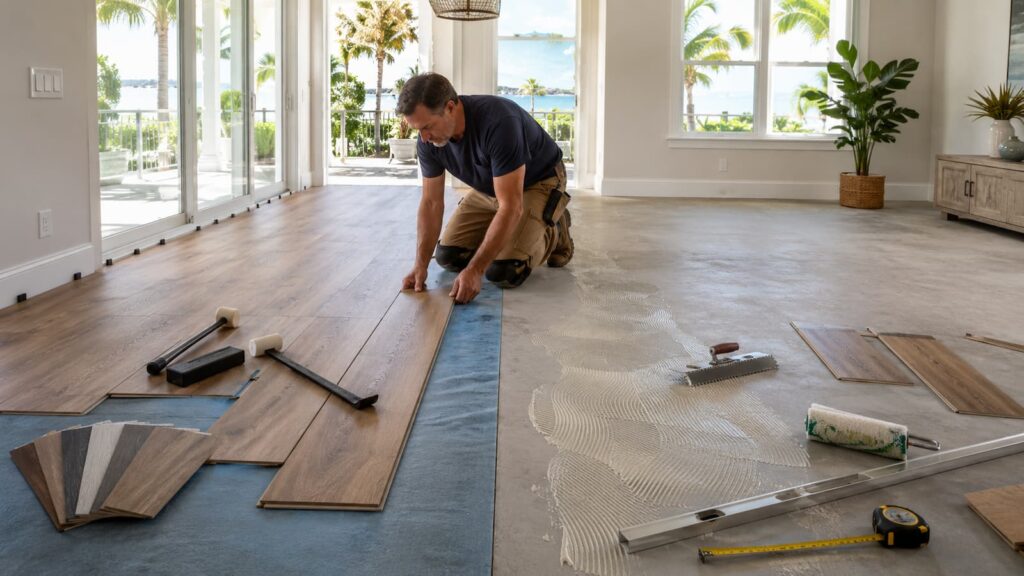
Vinyl plank flooring is one of the most popular flooring choices for Florida homes, and it is easy to understand why. It offers the look of wood without the same moisture sensitivity as hardwood, it feels more comfortable than tile, and it works well in many living rooms, bedrooms, hallways, kitchens, rental properties, and open floor plans. But once homeowners decide they like luxury vinyl plank, another question often comes up: should the floor be floating or glue-down?
The answer matters more than many homeowners realize. Floating and glue-down vinyl plank floors may look similar once installed, but they behave differently. They have different preparation requirements, different strengths, different weaknesses, and different best-use cases. A floating floor may be the right choice in one Florida home and the wrong choice in another. Glue-down LVP may be excellent for one project and unnecessary for another.
In general, floating vinyl plank flooring is often the better choice for many residential Florida homes when the concrete slab or subfloor is flat, clean, dry, and properly prepared. It is efficient to install, comfortable underfoot, and practical for living rooms, bedrooms, hallways, and whole-home updates. Glue-down vinyl plank flooring can be better in certain high-traffic areas, commercial-style spaces, some rental properties, rooms with heavy rolling loads, or projects where a lower-profile floor and direct bond are preferred.
The best choice depends on the home. Florida flooring projects often involve concrete slabs, humidity, sandy shoes, pets, wet entries, sliding glass doors, appliance leaks, and indoor-outdoor living. The installation method should be selected based on those real conditions, not only on the price of the product or the speed of the installation.
This guide compares floating vs glue-down vinyl plank flooring from a practical Florida homeowner’s point of view. We will look at how each method works, which performs better over concrete, how moisture affects the decision, what happens in kitchens and bathrooms, how rentals and pets change the choice, and what surface preparation is needed before installation begins.
The Short Answer: Floating LVP Is Best for Many Homes, Glue-Down LVP Is Best for Specific Conditions
For most standard residential projects, floating vinyl plank flooring is often the more common and practical choice. It works well in many Florida homes because it can be installed efficiently over a properly prepared concrete slab, creates a comfortable surface, and can run through connected living spaces with a clean wood-look appearance. When installed correctly, floating LVP can be a strong option for living rooms, bedrooms, hallways, dining areas, home offices, and many kitchens.
Glue-down vinyl plank flooring is not automatically better or worse. It is simply different. It is bonded directly to the prepared surface with adhesive. This can create a firmer, lower-profile floor that works well in some high-traffic areas or spaces where a floating floor may not be ideal. Glue-down LVP can be a smart choice in certain rentals, commercial-style rooms, large open spaces, areas with rolling loads, or rooms where transitions and height limits matter.
A quick comparison looks like this:
| Installation Method | Best For | Main Advantage | Main Concern |
|---|---|---|---|
| Floating LVP | Living rooms, bedrooms, hallways, whole-home updates, many residential spaces | Efficient installation, comfortable feel, easier over many prepared residential slabs | Needs a flat surface; can flex or separate over dips |
| Glue-down LVP | High-traffic spaces, some rentals, commercial-style areas, lower-profile transitions | Firm direct bond, stable feel, good for certain heavy-use conditions | Requires very clean, smooth, dry, adhesive-compatible surface |
The most important point is that neither method fixes a bad floor underneath. Floating LVP cannot hide major dips or high spots. Glue-down LVP cannot bond properly to a dirty, damp, dusty, uneven, or contaminated slab. Both methods need preparation. The right question is not only “Which installation method is better?” but “Which method fits the room, the slab, the moisture risk, and the way the home will be used?”
For homeowners planning vinyl plank flooring installation, the best results usually come from choosing the installation method after evaluating the surface, not before.
What Is Floating Vinyl Plank Flooring?
Floating vinyl plank flooring is installed without being permanently attached to the subfloor or concrete slab. The planks usually lock together along the edges using a click-lock system. Once connected, the floor “floats” as one continuous surface over the prepared base. It is held in place by its own weight, the connected plank system, proper expansion space, and the room’s perimeter details.
Many floating LVP products are rigid core products, often described as SPC or WPC. SPC usually refers to stone plastic composite, a dense core that provides stability and dent resistance. WPC usually refers to wood plastic composite, which often feels slightly softer or warmer underfoot. Product quality varies, so homeowners should compare more than color. Wear layer, locking system, total thickness, core construction, attached pad, warranty, and installation requirements all matter.
Floating LVP is popular because it can be efficient to install in residential spaces. It can often be installed over concrete when the slab is clean, dry, flat, and compatible with the product requirements. It may also work over certain existing floors if the old surface is stable, flat, and approved by the manufacturer. However, installing over old flooring should never be treated as automatic. Loose tile, swollen laminate, old water damage, or uneven surfaces should be corrected first.
The main benefits of floating LVP include:
- Efficient installation in many residential spaces
- Comfortable feel compared with tile
- Good option for open layouts and connected rooms
- Often easier to replace sections than some fully bonded systems
- Wide range of wood-look styles
- Works well over properly prepared concrete slabs
- No adhesive odor or adhesive cure concerns in most standard installations
- Good fit for many living rooms, bedrooms, hallways, and family spaces
The main limitation is that floating LVP depends heavily on floor flatness. If the concrete slab has dips, humps, waves, or old adhesive ridges, the floor can move underfoot. That movement can lead to clicking sounds, gaps, joint stress, or broken locking edges. Floating does not mean forgiving of every surface condition. It means the floor needs the right support underneath.
Where Floating LVP Works Best
Floating LVP is often a strong choice for residential spaces where comfort, appearance, and practical installation matter. It works especially well in rooms where the floor will be walked on daily but not exposed to constant standing water or heavy rolling loads.
Good uses for floating LVP often include:
- Living rooms
- Bedrooms
- Hallways
- Dining areas
- Home offices
- Family rooms
- Open floor plans
- Many kitchens
- Pet-friendly homes when the product has good traction and durability
Floating LVP is especially attractive when homeowners want the same flooring to continue through multiple connected spaces. It creates a clean, consistent look without the hardness of tile or the moisture sensitivity of hardwood.
What Is Glue-Down Vinyl Plank Flooring?
Glue-down vinyl plank flooring is installed by bonding each plank directly to the prepared surface with flooring adhesive. Unlike floating LVP, the floor does not rely on a click-lock system to hold the planks together as one floating surface. Instead, each plank is secured to the substrate.
Glue-down LVP is often thinner than many floating rigid core products, although product types vary. Because it sits closer to the slab or subfloor, it can be useful where height matters. It can also provide a firm, direct feel underfoot. In some high-traffic spaces, rental settings, or commercial-style applications, glue-down LVP may be preferred because individual damaged planks can sometimes be cut out and replaced without disassembling a larger floating floor.
The trade-off is preparation. Glue-down vinyl plank needs a very clean, smooth, dry, and adhesive-compatible surface. Any dust, old adhesive, paint, sealer, moisture, residue, rough texture, or uneven patch can affect the bond or show through the finished floor. Glue-down LVP can be excellent when installed over the right surface, but it is not a shortcut around surface problems.
The main benefits of glue-down LVP include:
- Firm, bonded feel underfoot
- Lower profile than many floating products
- Good for some high-traffic or commercial-style spaces
- Can be useful where transitions or height are a concern
- Individual plank replacement may be practical in some layouts
- Less risk of floating-floor movement if the adhesive bond and surface prep are correct
- May perform well in certain rentals or heavy-use areas
The main concern is that glue-down installation is less forgiving during preparation. The slab or subfloor must be suitable for adhesive. Moisture conditions are especially important. If the concrete has too much moisture vapor, if old adhesive remains, or if the surface is dusty or uneven, the floor may not bond correctly.
Where Glue-Down LVP Works Best
Glue-down LVP can be a strong choice when the project needs a lower-profile floor, a firm feel, or good performance under frequent traffic. It may also be useful in certain rental properties where isolated plank replacement is important. However, it should be selected only after confirming that the surface can be prepared correctly.
Good uses for glue-down LVP may include:
- Some rental properties
- High-traffic hallways
- Commercial-style residential spaces
- Rooms where floor height must stay low
- Large open spaces where a direct bond is preferred
- Areas where rolling loads may be more common
- Projects where individual plank replacement is a priority
Glue-down LVP is not always necessary for a standard residential living room or bedroom. In many homes, floating LVP provides the right balance of performance, comfort, and installation efficiency. Glue-down becomes more attractive when the conditions or performance goals call for it.
Florida Homes: Why the Installation Method Matters
Florida homes create specific flooring challenges. Many homes are built on concrete slabs. Many rooms connect directly to patios, garages, pools, or outdoor living areas. Humidity is common. Sand and grit are tracked inside. Rainwater can enter near doors. Appliances and plumbing can leak. Air conditioning cycles can affect indoor conditions. All of these factors influence how flooring performs.
Floating and glue-down LVP both can work in Florida, but both need the right preparation. Concrete slab conditions are especially important. A slab may look solid and still have low spots, high ridges, old tile mortar, adhesive residue, cracks, or moisture stains. These issues can affect floating and glue-down floors differently.
Floating LVP is sensitive to dips and high spots because the floor needs even support. If a plank bridges over a low area, it can flex when walked on. Glue-down LVP is sensitive to surface smoothness and cleanliness because the adhesive bond depends on the condition of the slab. If the surface has dust, old residue, moisture, or texture problems, the bond can be affected.
Florida homeowners should think about:
- Concrete slab flatness
- Slab moisture or previous water damage
- Old tile or adhesive residue
- Room use and foot traffic
- Pets, kids, or rental turnover
- Wet entries, kitchens, laundry rooms, and bathrooms
- Sun exposure near sliding glass doors
- Height differences at transitions
- Whether the floor may need future plank replacement
The Florida climate does not automatically make one method better in every situation. Instead, it makes proper evaluation more important. A well-installed floating LVP floor can perform very well in a Florida home. A well-installed glue-down LVP floor can also perform very well. Problems usually happen when the method is chosen without considering the slab and room conditions.
Concrete Slabs: Floating vs Glue-Down Over Concrete
Concrete slabs are one of the biggest factors in the floating vs glue-down decision. Many Florida homes have concrete underneath the existing flooring. That concrete can be an excellent base for vinyl plank flooring when it is properly prepared, but it should not be assumed to be ready automatically.
Floating LVP over concrete usually requires the slab to be clean, dry, and flat. The product may also require a vapor barrier, especially when installed over concrete. Some floating products have attached pads, while others allow or require separate underlayment. The manufacturer’s instructions matter because using the wrong underlayment can create too much cushion or affect the locking system.
Glue-down LVP over concrete requires the slab to be clean, smooth, dry, and suitable for adhesive. Moisture conditions are especially important because slab moisture can interfere with bond performance. Old adhesive, paint, sealer, dust, oil, loose patching material, or thinset ridges can also create problems.
A simple comparison over concrete looks like this:
| Concrete Condition | Floating LVP Concern | Glue-Down LVP Concern |
|---|---|---|
| Low spots or dips | Planks may flex, click, or separate | Floor may show unevenness or require patching first |
| High spots or ridges | Locking system may be stressed | Planks may not sit flat or bond evenly |
| Old adhesive residue | May create unevenness or underlayment issues | Can interfere with adhesive bond |
| Moisture vapor | May require vapor barrier; trapped moisture risk | Can affect adhesive and bond strength |
| Thinset from tile removal | Can create high spots and movement | Must usually be removed or smoothed for bonding |
| Cracks | May matter if uneven, moving, or damp | May require patching or evaluation before bonding |
If the slab has dips, ridges, or uneven transitions, floor leveling may be needed before either installation method. Leveling is not just about appearance. It helps the finished floor feel solid and perform correctly.
Over concrete, the better method depends on the slab. A clean, flat residential slab may be ideal for floating LVP. A smooth, properly prepared slab in a heavy-use space may be well suited to glue-down LVP. A bad slab is not ideal for either method until it is corrected.
Moisture and Humidity: Which Method Handles Florida Conditions Better?
Many homeowners assume that because vinyl plank is often described as waterproof, moisture is no longer a concern. This is only partly true. The vinyl plank itself may resist surface water very well, but the whole flooring system still needs moisture awareness. Water can get under planks, affect underlayment, interfere with adhesive, damage baseboards, or create odor if trapped.
Floating LVP may handle everyday spills well, but water that enters around edges, transitions, appliances, or walls can travel underneath the floor. Because the floor is floating, moisture may remain hidden below the planks. This does not mean floating LVP is bad. It means leaks should be handled quickly, and moisture-prone rooms need careful planning.
Glue-down LVP may reduce some concerns about water moving freely under a floating floor, but it introduces adhesive-related moisture concerns. If the concrete slab has moisture vapor beyond what the adhesive system allows, the bond can be affected. If water intrusion occurs from above or below, adhesive and substrate conditions still matter.
In Florida homes, moisture questions should include:
- Is the slab dry enough for the selected product?
- Does the product require a vapor barrier over concrete?
- Is there a history of appliance leaks, toilet leaks, or AC condensate issues?
- Will the floor be installed near sliding doors, patios, or pool access?
- Can water reach edges, transitions, or baseboards?
- Is the room a true wet area, such as a bathroom or laundry room?
Neither method makes the room waterproof. In wet areas, tile may still be the better choice. In kitchens, living rooms, bedrooms, and hallways, LVP can be excellent, but the installation method should be matched to the moisture risk and product requirements.
If the existing floor has already been damaged by water, the decision should start with removal and inspection. In that situation, replacing water-damaged flooring should include checking the base underneath before choosing floating or glue-down LVP.
Comfort Underfoot
Comfort is one reason many homeowners choose LVP instead of tile. Tile is durable, but it is hard and unforgiving underfoot. Vinyl plank usually feels warmer and more comfortable, especially in bedrooms, living rooms, and kitchens where people stand or walk often.
Floating LVP often feels slightly more cushioned because many products include an attached pad or are installed with approved underlayment. The floating system may feel warmer and quieter than a direct-bond installation, depending on the product and the slab. This can be a benefit in residential living spaces.
Glue-down LVP usually feels firmer because it is bonded directly to the surface. Some homeowners like this because it feels stable and connected to the floor. Others prefer the slightly softer feel of floating LVP. The difference is not only about comfort; it also affects sound and perception of quality.
For living rooms and bedrooms, many homeowners prefer floating LVP because of the comfort and warmth. For high-traffic utility areas, commercial-style spaces, or some rentals, the firm feel of glue-down LVP may be an advantage. The right choice depends on whether the room should feel more comfortable and residential or more firm and utilitarian.
Durability and Heavy Traffic
Durability depends on both the product and the installation. A high-quality floating LVP floor can outperform a cheap glue-down product. A well-installed glue-down floor can outperform a floating floor installed over a bad slab. The installation method matters, but product quality and preparation matter just as much.
Floating LVP can be very durable in normal residential spaces, especially when the product has a good wear layer, strong core, and reliable locking system. It performs well in living rooms, bedrooms, hallways, family rooms, and many kitchens. But if the room has heavy rolling loads, frequent dragging furniture, or extreme traffic, the locking system and floor movement should be considered.
Glue-down LVP can be strong in high-traffic settings because the planks are bonded to the substrate. It may be better suited to some rental properties, offices, hallways, or commercial-style spaces where the floor is exposed to repeated heavy use. If an individual plank is damaged, it may be easier to replace in some glue-down installations than in a floating floor, depending on layout and product type.
For Florida homes with pets, kids, and normal daily traffic, either method can work if the product is appropriate. For heavier-use conditions, glue-down may deserve stronger consideration. For comfort-focused residential areas, floating may still be the better overall fit.
Kitchens, Bathrooms, Laundry Rooms, and Living Areas
The best installation method also depends on the room. A living room does not have the same risks as a bathroom. A kitchen does not have the same conditions as a bedroom. A laundry room creates different concerns than a hallway.
Living Rooms and Bedrooms
Floating LVP is often an excellent choice for living rooms and bedrooms. These rooms usually benefit from comfort, warmth, and visual continuity. A floating floor can create a clean wood-look surface across open living areas and hallways. As long as the slab or subfloor is flat and stable, floating LVP usually makes sense.
Glue-down LVP can still work in these rooms, but it may not be necessary unless there are specific reasons to choose it, such as height limits, heavy use, or a preference for a bonded feel.
Kitchens
Kitchens are more complicated because they involve appliances, spills, chairs, cabinets, islands, and possible leaks from dishwashers, sinks, and refrigerators. Floating LVP is common in kitchens because it feels comfortable and can continue into nearby living spaces. Glue-down LVP can also work, especially where a lower profile or firmer floor is desired.
The bigger question is not only floating vs glue-down. It is how water risk will be handled. Appliance leaks should be taken seriously with either method. If a kitchen has a history of water damage, the existing flooring should be removed and the surface inspected before new LVP is installed.
Bathrooms
Bathrooms are true wet areas. LVP can be used in some bathrooms, especially powder rooms or lower-risk spaces, but tile is often the stronger long-term choice in full bathrooms with showers and tubs. If LVP is used, product approval and installation details matter. Water should not be allowed to sit around toilets, tubs, showers, or edges.
Floating LVP in bathrooms may be more vulnerable to water getting underneath at edges or fixtures. Glue-down LVP may reduce some movement concerns but still depends on adhesive compatibility and moisture conditions. For many Florida bathrooms, tile installation may be the more durable wet-area solution.
Laundry Rooms
Laundry rooms are high-risk spaces because washing machines, hoses, utility sinks, and water heaters can leak. LVP may work in some laundry rooms, but tile is often safer if water exposure is a major concern. If LVP is selected, the installation method should be chosen carefully, and the surface underneath should be stable, dry, and prepared.
Floating LVP can be comfortable and visually consistent, but water under the floor can be a concern. Glue-down LVP may be firmer, but adhesive and moisture conditions still matter. Neither method eliminates the need to monitor appliances and address leaks quickly.
Rental Properties: Floating or Glue-Down?
Rental properties change the flooring decision because tenants may not treat floors as carefully as owners. Spills may sit longer. Furniture may be moved roughly. Pets may scratch or have accidents. Appliance leaks may be reported late. Cleaning products may not always be ideal. The floor needs to look good, handle turnover, and be practical to repair.
Floating LVP is often a strong choice for rental living areas and bedrooms because it looks modern, installs efficiently, and is comfortable. It can make a rental property feel updated without the maintenance of hardwood or carpet. However, it needs a flat surface and a durable product with a strong locking system.
Glue-down LVP may be attractive in some rentals because individual plank replacement can be easier in certain cases. If a tenant damages one plank, a glue-down plank may sometimes be replaced without taking apart the floor from a wall. This depends on the product, adhesive, layout, and installer skill. Glue-down can also feel more stable in high-traffic rental spaces.
For many rental homes, a practical approach is:
- Floating LVP in bedrooms, living rooms, and standard residential areas
- Glue-down LVP in selected high-traffic or heavy-use areas if the slab is suitable
- Tile in bathrooms, laundry rooms, and wet entries
- Extra attic or closet storage of leftover planks for future repairs
- Medium-tone colors that hide sand, dust, and minor wear
The best choice depends on turnover frequency, pet policy, tenant profile, and whether the slab can be prepared correctly.
Repairability: Which Is Easier to Fix?
Repairability is one of the biggest differences between floating and glue-down LVP. Both can be repaired in some situations, but the process is different.
Floating LVP is connected through a locking system. If a damaged plank is near the edge of the room, the floor may be partially disassembled to reach the plank and replace it. If the damaged plank is in the middle of a large room, repair may be more complicated. Some installers can perform cut-out repairs, but results depend on product type and locking system.
Glue-down LVP can sometimes be easier for isolated plank replacement. A damaged plank may be heated, cut out, removed, and replaced with a new plank using adhesive. This can be a benefit in rentals, offices, or high-use homes. However, repair quality depends on matching material, adhesive compatibility, surface condition, and installer experience.
For both methods, homeowners should keep extra planks from the original installation. Flooring colors, textures, and batches can change. Having matching material makes future repairs much easier.
Repairability comparison:
- Floating LVP: easier if damage is near an edge, harder in the middle of a room.
- Glue-down LVP: often easier for individual plank replacement, but requires careful removal and re-bonding.
- Both methods: easier to repair when leftover matching material is available.
If repairability is a major priority because the home is a rental or high-traffic property, glue-down LVP may be worth considering. If comfort and residential feel are bigger priorities, floating may still be the better choice.
Cost Differences Between Floating and Glue-Down LVP
Cost depends on the product, labor, old flooring removal, surface preparation, underlayment, adhesive, transitions, and repairs. Floating LVP may have a higher material cost in some cases because rigid core click-lock products can be thicker and more complex. Glue-down LVP may have lower material cost in some product lines, but labor and surface preparation can be more demanding.
Floating LVP may be faster to install when the slab is already ready. However, if the floor needs leveling, patching, or old tile residue removal, preparation can still add cost. Glue-down LVP may require more detailed surface smoothing, adhesive, and possibly moisture testing or mitigation depending on conditions.
Cost factors include:
- Material type and quality
- Wear layer and core construction
- Old flooring removal
- Concrete slab preparation
- Floor leveling or patching
- Moisture evaluation
- Underlayment or vapor barrier for floating products
- Adhesive and surface preparation for glue-down products
- Transitions, baseboards, and trim details
- Furniture and appliance movement
The cheaper installation method is not always the better value. A floating floor installed over an uneven slab can cost more later if it clicks, separates, or fails. A glue-down floor installed over a damp or contaminated slab can also fail. The best value comes from choosing the right method and preparing the surface correctly.
Subfloor and Surface Preparation
Surface preparation is the foundation of both floating and glue-down LVP installation. A good product installed over a bad surface can still perform poorly. Before choosing an installation method, the existing floor should be evaluated for flatness, stability, moisture, old residue, and damage.
Floating LVP needs a flat, stable surface. If the floor underneath has low spots, the planks can flex. If it has high spots, the locking system can be stressed. If the old floor is loose or damaged, it should not be used as a base.
Glue-down LVP needs a clean, smooth, dry surface that works with adhesive. Dust, old glue, paint, sealer, moisture, rough concrete, or loose patches can all create bonding problems. Glue-down installation may require more surface detail because imperfections can telegraph through thinner products.
If there are soft spots, water damage, loose underlayment, or unstable areas, subfloor repair may be needed before either method can be installed. Leveling compound should not be used to hide a weak or damaged base. The floor must be stable first, then flat and smooth enough for the selected method.
Good preparation may include:
- Removing old flooring that is loose, damaged, or unsuitable
- Scraping or grinding old adhesive and thinset
- Checking for moisture and previous water damage
- Grinding high spots
- Filling low spots
- Repairing soft or damaged subfloor areas
- Cleaning dust and debris thoroughly
- Planning transitions and height changes
Preparation is not the part of the project homeowners see every day, but it is often the part that determines whether the floor lasts.
Common Mistakes Homeowners Should Avoid
Many problems with LVP happen because the installation method was chosen too quickly. Homeowners may choose floating because it sounds easier or glue-down because it sounds stronger. But neither assumption is always correct. The right method depends on the project.
One common mistake is assuming floating LVP can hide an uneven slab. It cannot. A floating floor needs support. Another mistake is assuming glue-down LVP is always more durable. It can be very durable, but only if the surface is properly prepared and the adhesive bond performs correctly.
Another mistake is ignoring moisture. Waterproof planks do not make the entire installation waterproof. If water gets under a floating floor or affects glue-down adhesive, problems can still happen. This is especially important near kitchens, laundry rooms, bathrooms, sliding doors, and appliances.
Avoid these mistakes:
- Choosing an installation method based only on price
- Installing floating LVP over low spots or high ridges
- Installing glue-down LVP over dusty, damp, or contaminated concrete
- Using underlayment as a substitute for floor leveling
- Ignoring old water damage
- Installing over loose tile or swollen laminate
- Using LVP in wet rooms where tile would be safer
- Forgetting about transitions and door clearance
- Buying too little extra material for future repairs
- Assuming all LVP products perform the same
The best flooring decision is not only about floating vs glue-down. It is about choosing the right product, the right room, the right preparation, and the right installer.
How to Decide: Floating or Glue-Down?
The easiest way to decide is to start with the room and the surface underneath. Do not start with the installation method. First ask what the room needs, what the slab condition is, how much moisture risk exists, and how the floor will be used.
Floating LVP is often the better choice when:
- The project is a standard residential living area, bedroom, hallway, or open layout
- The slab or subfloor is flat, clean, dry, and stable
- Comfort underfoot is important
- The homeowner wants efficient installation
- The room does not have heavy rolling loads or extreme commercial-style traffic
- The product has a strong locking system and suitable wear layer
Glue-down LVP may be the better choice when:
- The area has heavy traffic or commercial-style use
- A lower-profile floor is needed for transitions or door clearance
- The owner wants a firmer bonded feel
- Individual plank replacement is a major priority
- The concrete slab can be prepared smooth, clean, dry, and adhesive-compatible
- The project involves a rental or high-use property where direct bond makes sense
Tile may be the better choice when:
- The room is a full bathroom, laundry room, or wet entry
- Standing water or frequent splashing is likely
- Maximum long-term moisture resistance is the top priority
- The homeowner is comfortable with a harder surface and grout maintenance
In many Florida homes, the best overall plan is floating LVP in main living areas and bedrooms, glue-down LVP only where conditions call for it, and tile in true wet zones. The final decision should be based on the home, not a universal rule.
Questions to Ask Before Choosing an Installation Method
Before approving a floating or glue-down LVP installation, ask practical questions. These questions help make sure the method fits the product, the slab, and the room.
- Is this product designed for floating installation, glue-down installation, or both?
- Does the manufacturer approve this method over concrete?
- Is the slab flat enough for floating LVP?
- Is the slab smooth and clean enough for glue-down LVP?
- Is there any moisture concern that needs to be addressed first?
- Will a vapor barrier or underlayment be needed?
- Will adhesive be compatible with the slab condition?
- How will transitions between rooms be handled?
- Can individual planks be repaired later if damaged?
- What would cause this installation method to fail?
A good flooring contractor should be able to answer these questions clearly. If the answer is simply “either one is fine” without looking at the floor, that may be a warning sign. The method should be chosen for a reason.
Final Recommendation: Which Is Better for Florida Homes?
For many Florida homes, floating vinyl plank flooring is the best all-around choice for main residential spaces. It works well in living rooms, bedrooms, hallways, dining rooms, family rooms, and many kitchens when the slab or subfloor is properly prepared. It offers comfort, style, efficient installation, and a practical wood-look finish that fits many Florida interiors.
Glue-down vinyl plank flooring is better for specific situations. It can be a smart option in high-traffic areas, some rental properties, commercial-style spaces, rooms with low transition height requirements, or projects where a firm bonded floor and potential individual plank replacement are important. It is not automatically superior, but it can be the right choice when the conditions support it.
The most important factor is surface preparation. Floating LVP needs a flat, stable base. Glue-down LVP needs a smooth, clean, dry, adhesive-compatible base. If the concrete slab has dips, ridges, old thinset, moisture stains, cracks, or adhesive residue, those issues should be addressed before installation. If the subfloor is soft or water-damaged, repair comes before flooring.
A practical Florida flooring plan often looks like this:
- Floating LVP for most living rooms, bedrooms, hallways, and whole-home residential updates
- Glue-down LVP for selected high-traffic, rental, or lower-profile applications
- Tile for bathrooms, laundry rooms, wet entries, and areas with frequent standing water risk
- Floor leveling or subfloor repair whenever the surface is not ready for the chosen method
The best vinyl plank installation method is the one that fits your actual home. A floating floor installed correctly over a prepared slab can perform beautifully. A glue-down floor installed correctly over a properly prepared surface can also perform beautifully. The problems start when the method is chosen before the slab, moisture, room use, and preparation needs are understood.
For homeowners comparing floating and glue-down LVP, working with an experienced flooring contractor can help prevent expensive mistakes. The right contractor will evaluate the existing surface, explain the trade-offs, and recommend an installation method that makes sense for Florida’s humidity, concrete slabs, traffic, pets, moisture risks, and everyday living.