
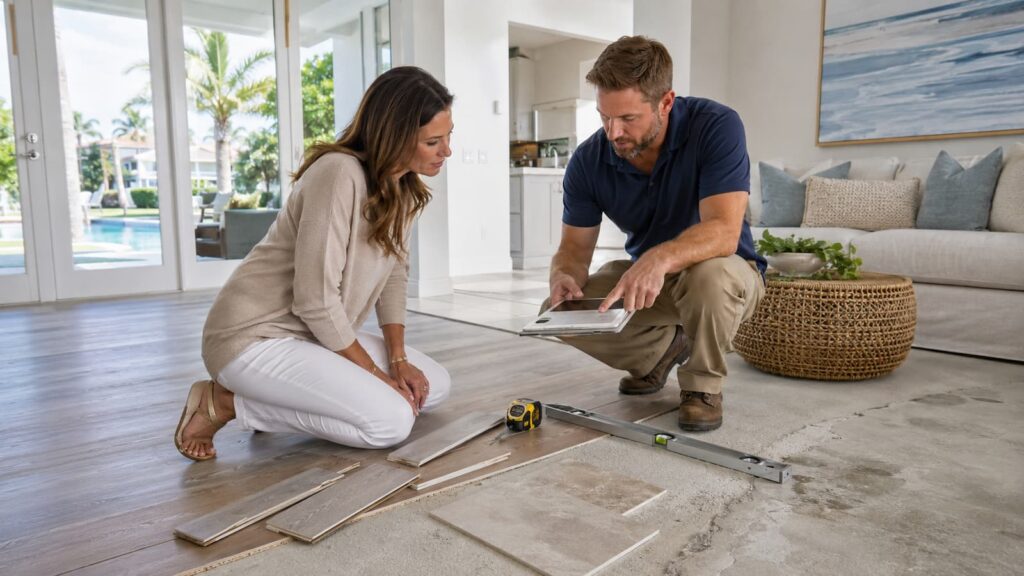
Hiring a flooring contractor is not just about finding someone who can install a new floor. It is about choosing the person or company that will evaluate the condition of your home, recommend the right material, prepare the surface correctly, handle unexpected issues, and leave you with a floor that looks good and performs well over time. A beautiful flooring product can still fail if it is installed poorly, placed over an uneven slab, or used in the wrong room.
For homeowners, the challenge is that many flooring problems are not obvious before the project begins. The old flooring may hide concrete slab dips, water damage, soft subfloor areas, old adhesive, cracks, moisture stains, or uneven room transitions. A contractor who only talks about square footage and material color may miss the conditions that actually determine how long the floor will last.
That is why asking the right questions before hiring a flooring contractor matters. Good questions help you understand what is included in the estimate, how the contractor handles preparation, whether the chosen material fits the room, what happens if hidden damage is found, and what kind of warranty or support you can expect after the project is complete.
This is especially important in Florida homes, where flooring often needs to deal with humidity, concrete slabs, sandy shoes, wet entries, pets, heavy traffic, and occasional leaks from appliances, plumbing, or storms. A flooring project in this environment should not be treated as a simple cosmetic update. It should be planned as a complete system: material, subfloor, moisture conditions, installation method, transitions, and finishing details.
This guide explains the most important questions to ask a flooring contractor before hiring one. It also explains what a strong answer should sound like, what warning signs to watch for, and how to compare estimates without choosing based only on the lowest price.
Why Asking Questions Before Hiring Matters
Flooring installation can seem straightforward from the outside. Remove the old floor, install the new one, clean up, and enjoy the finished space. In reality, many flooring projects involve important decisions before the first plank, tile, or board is installed. The contractor needs to evaluate the existing surface, confirm the material is appropriate, plan the layout, handle transitions, and prepare for hidden issues.
Asking questions helps you avoid misunderstandings. One estimate may include removal, disposal, minor prep, transitions, and baseboard work. Another estimate may only include basic installation over a ready surface. If you compare those two prices without understanding the scope, the cheaper quote may not actually be cheaper. It may simply leave out work that will be added later.
Good questions also help reveal how a contractor thinks. A professional contractor should be able to explain why floor flatness matters, what could happen if moisture is ignored, how material choice changes by room, and what steps are needed before installation. The best answers are specific, practical, and grounded in the actual conditions of your home.
Before hiring a flooring contractor, you are trying to understand several things:
- Does the contractor have experience with the flooring material you want?
- Will they inspect the slab or subfloor before installation?
- Is the estimate detailed enough to compare fairly?
- Do they understand moisture, leveling, and surface preparation?
- Will they explain what happens if hidden damage is found?
- Do they provide clear expectations for timeline, cleanup, and warranty?
- Are they recommending the right flooring for the room, not just the easiest product to sell?
The goal is not to interrogate the contractor. The goal is to make sure both sides understand the project clearly before work begins.
Question 1: What Types of Flooring Do You Install Most Often?
The first question should be simple: what types of flooring does the contractor install regularly? Flooring materials may look similar from a homeowner’s perspective, but they require different skills, tools, preparation, and installation methods. A contractor who mostly installs carpet may not be the best fit for large-format tile. A contractor who rarely installs floating LVP may not be familiar with the flatness requirements and expansion details that protect the locking system.
You want to know whether the contractor has real experience with the material you are considering. Luxury vinyl plank, tile, laminate, hardwood, and subfloor preparation all involve different details. A contractor does not need to specialize in only one product, but they should be comfortable explaining how that product should be installed and what conditions it requires.
For example, if you are planning vinyl plank flooring installation, the contractor should understand click-lock vs glue-down products, concrete slab preparation, expansion space, underlayment requirements, and moisture concerns. If you are planning tile, the contractor should understand substrate preparation, layout, mortar coverage, grout spacing, lippage, and wet-area details.
Good follow-up questions include:
- Do you install this type of flooring often?
- Have you installed this material in homes similar to mine?
- Do you prefer a specific installation method for this room?
- What problems do you usually see with this type of floor?
- What preparation does this material usually require?
A strong answer should be clear and specific. The contractor should be able to explain how the flooring material behaves, where it works best, and what could make it fail. Be cautious if the answer sounds vague, rushed, or overly casual, especially for projects involving tile, concrete slabs, moisture, or old flooring removal.
Question 2: Are You Licensed and Insured?
Before hiring any contractor, ask about licensing and insurance. Requirements can vary by location and scope of work, but the contractor should be able to explain their credentials and provide proof when appropriate. Insurance is especially important because flooring projects involve tools, demolition, dust, heavy materials, furniture movement, appliances, and work inside your home.
At minimum, homeowners should ask whether the contractor carries liability insurance and whether workers are covered appropriately. This protects both the homeowner and the contractor if something goes wrong. Accidents are rare with good professionals, but they can happen. A tool may damage a wall, furniture may be scratched, an appliance may be moved incorrectly, or a worker may be injured.
You do not need to make this conversation uncomfortable. A professional contractor should be used to the question. If a contractor becomes defensive or avoids answering, that is a warning sign.
Ask questions such as:
- Are you licensed for this type of work where required?
- Do you carry liability insurance?
- Are workers covered if someone is injured on the job?
- Can you provide proof of insurance if requested?
- Will the same company perform the work, or will it be subcontracted?
A trustworthy contractor should answer directly. The exact documentation may vary, but the contractor should not ask you to simply “trust me” when it comes to protection inside your home.
Question 3: Will You Inspect the Existing Floor, Subfloor, or Concrete Slab?
This is one of the most important questions you can ask. A flooring contractor should not only measure the room and discuss material. They should also evaluate the surface underneath the new flooring. The condition of the subfloor or concrete slab can determine whether the finished floor feels stable, looks clean, and lasts.
Many flooring problems start below the surface. A slab may have dips, high spots, old adhesive residue, cracks, moisture staining, or uneven transitions. A wood subfloor may have soft spots, movement, squeaks, water damage, or loose panels. If these problems are ignored, the new flooring can develop gaps, cracks, hollow sounds, movement, or premature wear.
A good contractor should be willing to inspect the floor and explain what they see. In some cases, a full inspection cannot happen until the old flooring is removed. That is normal. But the contractor should still discuss what hidden conditions may affect the project and how those issues would be handled if discovered.
Ask questions such as:
- Will you check the floor for flatness before installation?
- Will you inspect for soft spots or movement?
- Are there signs of moisture or previous water damage?
- Does the existing floor need to be removed before you can fully evaluate the surface?
- What happens if damage is discovered after removal?
If the contractor does not care about the surface underneath, be careful. A new floor is not only a finish layer. It is part of a system, and the system begins with the base.
Question 4: Does My Floor Need Leveling Before Installation?
Floor leveling is one of the most commonly misunderstood parts of a flooring project. Homeowners often assume the new floor will hide unevenness, but this is usually not true. LVP, tile, laminate, and hardwood all need a suitable surface. If the floor underneath has dips, humps, waves, or uneven transitions, the new floor may not perform correctly.
For LVP, uneven areas can cause flexing, clicking, broken locking edges, hollow sounds, or plank separation. For tile, uneven surfaces can cause lippage, cracked tile, loose tile, or cracked grout. For laminate, unevenness can create movement and gaps. For hardwood, the floor may feel unstable or develop squeaks.
When discussing floor leveling, it is also important to understand the difference between level and flat. The floor does not always need to be perfectly level from one side of the room to the other. It usually needs to be flat enough for the chosen flooring material. A slight slope may be acceptable if the surface is smooth and consistent. Sudden dips and high spots are the real problem.
Ask the contractor:
- Is the surface flat enough for this flooring product?
- How do you check for low spots and high spots?
- What level of floor variation is acceptable for this product?
- Would any areas need grinding, patching, or leveling compound?
- Is leveling included in the estimate or priced separately?
- What could happen if we skip leveling?
A strong contractor should explain this clearly. Be cautious if someone says “the new floor will cover it” without checking the surface. In many cases, the new floor will reveal the problem rather than hide it.
Question 5: What Happens If You Find Subfloor Damage?
Subfloor damage can change a flooring project. It may not be visible until old flooring is removed, especially if carpet, laminate, tile, or previous underlayment has been hiding the problem. Damage can appear as soft spots, water stains, loose panels, musty smells, rotten wood, crumbling patches, or unstable areas.
Before hiring a contractor, ask how they handle hidden subfloor damage. This question protects you from surprise and helps you understand whether the contractor has experience solving problems rather than simply installing over them.
Subfloor damage should not be ignored. LVP can move over soft spots. Tile can crack over unstable areas. Laminate can gap or swell if moisture remains underneath. Hardwood can squeak, cup, or shift. If the base is damaged, new flooring may fail even if the product is excellent.
If damage is present, repairing the subfloor may be necessary before installation continues. A professional contractor should be able to explain whether the issue is localized, how it would be repaired, and how it affects the schedule and cost.
Ask questions such as:
- What signs of subfloor damage do you look for?
- What happens if soft spots are found after old flooring removal?
- Will you show me the damaged area before doing extra work?
- How are repair costs handled if hidden damage is discovered?
- Can the project continue the same day, or would repairs change the timeline?
- How do you determine whether repair or replacement is needed?
The best answer is transparent. The contractor should not promise that hidden damage will never happen. They should explain how they handle it if it does.
Question 6: How Do You Handle Moisture or Water-Damaged Flooring?
Moisture is one of the biggest reasons flooring fails, especially in kitchens, bathrooms, laundry rooms, and homes with concrete slabs. Before hiring a flooring contractor, ask how they identify and handle water damage. This is especially important if your existing floor is swollen, lifting, musty, stained, soft, or separating.
Water damage can come from many sources: dishwasher leaks, refrigerator lines, washing machines, toilets, water heaters, AC condensate issues, exterior doors, storms, pet accidents, or old leaks that were never fully corrected. The visible flooring may be only part of the problem. Moisture can travel underneath and affect the slab, underlayment, subfloor, adhesive, baseboards, or walls.
A contractor should not simply cover water-damaged flooring with new material. The damaged material may need removal, the surface underneath may need inspection, and the moisture source must be fixed before replacement flooring is installed. If water damage has compromised the floor system, replacing water-damaged flooring should include preparation, not just a new finish layer.
Ask questions such as:
- Do you see any signs of water damage?
- Should the damaged flooring be removed before installing new material?
- How do you check whether moisture reached underneath?
- What happens if the slab or subfloor is still damp?
- Do I need to fix a leak before flooring work begins?
- Which flooring material makes the most sense if this room has future moisture risk?
A good contractor should take moisture seriously. Be cautious if someone says waterproof flooring will solve every water problem. Waterproof planks do not make the entire floor system waterproof.
Question 7: Which Flooring Material Do You Recommend for This Room, and Why?
A good flooring contractor should not recommend the same material for every room without asking how the space is used. Bathrooms, kitchens, laundry rooms, living areas, bedrooms, rentals, and pet-friendly homes all have different needs. The best material depends on moisture exposure, traffic, comfort, maintenance, budget, and the condition of the surface underneath.
This question helps you see whether the contractor is thinking practically. A contractor who understands flooring should be able to explain why LVP may be better in a living room, why tile may be safer in a full bathroom, why laminate should be used carefully around moisture, and why hardwood requires more caution in humid areas.
For example, tile may be the strongest choice for a bathroom because it handles splashes, steam, and wet cleaning well. LVP may be the better choice for living rooms and bedrooms because it feels more comfortable and creates a warm wood-look surface. Laminate may be reasonable in dry rooms but risky in laundry areas. Hardwood may be beautiful but more demanding in humid or high-traffic spaces.
Ask the contractor:
- What material would you recommend for this room?
- Why is that material better than the alternatives?
- Would you recommend a different material for a bathroom, kitchen, or living room?
- How does this material handle humidity and spills?
- Is this product suitable for pets, kids, or rental use?
- What are the long-term maintenance concerns?
The best answer should include pros and cons. A contractor who only praises one material without discussing limitations may not be giving you the full picture.
Question 8: What Exactly Is Included in the Estimate?
This question can prevent many misunderstandings. Flooring estimates are not always structured the same way. One contractor may include removal, disposal, minor prep, transitions, and basic trim work. Another may quote only installation labor. A third may include materials but not leveling or old flooring removal.
Before hiring a contractor, ask for a clear breakdown. You should understand whether the price includes material, labor, old flooring removal, disposal, underlayment, vapor barrier, floor prep, leveling, transitions, baseboard handling, quarter-round, furniture moving, appliance moving, stairs, and cleanup.
A detailed estimate does not need to be complicated, but it should be specific enough that you know what you are approving. Vague estimates can lead to frustration when additional work appears later. Some additional work is legitimate when hidden damage is discovered, but the process should be explained upfront.
Ask whether the estimate includes:
- Flooring materials
- Installation labor
- Old flooring removal
- Disposal and hauling
- Subfloor or slab preparation
- Floor leveling or patching
- Underlayment or vapor barrier
- Transition strips
- Baseboard or quarter-round work
- Furniture and appliance moving
- Stairs or special areas
- Final cleanup
When comparing estimates, compare scope, not just total price. A lower price that excludes necessary preparation may become more expensive later.
Question 9: What Could Change the Final Price?
Even a good estimate may change if hidden conditions are discovered. This is common in flooring because old materials can hide what is underneath. The important thing is not whether the price can ever change. The important thing is whether the contractor explains what could change it and how those changes will be approved.
For example, old carpet may hide slab cracks or pet stains. Old tile removal may reveal thinset ridges that need grinding. Laminate may hide moisture damage. A bathroom floor may look acceptable until the toilet is removed and soft areas are discovered. A concrete slab may need leveling once the old floor is gone.
Ask the contractor to explain possible change-order situations before work begins. A professional contractor should be able to describe what they can see now, what cannot be confirmed until demolition, and what would require additional approval.
Ask questions such as:
- What issues could increase the final cost?
- What hidden conditions do you commonly find?
- Will you stop and show me the issue before doing extra work?
- How are additional repairs priced?
- Will changes be documented before work continues?
- Are there any likely extra costs based on what you see now?
This conversation protects both sides. It helps the homeowner avoid surprise invoices and helps the contractor avoid pressure to install over problems that should be corrected.
Question 10: What Installation Method Will You Use?
Installation method matters because the same flooring category can be installed in different ways. LVP may be floating click-lock or glue-down. Tile may require different substrate preparation depending on the room and tile size. Hardwood may be nailed, glued, floated, or installed as engineered flooring depending on the product and surface. Laminate is usually floating but still has underlayment and expansion requirements.
You do not need to become an installation expert, but you should understand the basic plan. The contractor should be able to explain why that method fits your room, your subfloor, and your material. If the installation method is chosen only because it is fastest, that may not be the best long-term decision.
For example, floating LVP can work well in many residential spaces, but it needs a flat surface and correct expansion space. Glue-down LVP may be better in some situations, but it needs a smooth, clean, adhesive-compatible surface. Tile installation requires proper mortar coverage and surface stability. Hardwood needs moisture and movement considerations.
Ask questions such as:
- Will this floor be floating, glued down, nailed, or set in mortar?
- Why is that method best for this room?
- What surface preparation does this method require?
- Does the product manufacturer approve this method?
- How will expansion space be handled for floating floors?
- How will transitions be handled between rooms?
A strong contractor should explain the installation method in plain language. If they cannot explain why they are doing something, that is worth noting.
Question 11: How Will You Handle Transitions, Baseboards, and Trim?
Transitions and trim details have a major impact on how finished the project looks. A floor can be installed neatly in the middle of the room but look unfinished around doors, walls, thresholds, and adjoining rooms. These details should be discussed before installation begins.
Transitions matter when new flooring meets existing tile, carpet, hardwood, exterior doors, bathrooms, closets, or different flooring heights. If the new floor is thicker or thinner than the old floor, door clearance and transition pieces may need planning. In open layouts, poor transition planning can make a good floor look awkward.
Baseboards also need attention. Some projects involve removing and reinstalling baseboards. Others use quarter-round or shoe molding to cover expansion gaps. The best approach depends on the existing trim, budget, material, and desired finished look.
Ask questions such as:
- Will baseboards be removed and reinstalled?
- Will quarter-round or shoe molding be used?
- Are transitions included in the estimate?
- How will height differences between rooms be handled?
- Will doors need trimming?
- How will the floor finish around cabinets, closets, sliders, or exterior doors?
Do not leave these details until the end. Trim and transitions are not minor afterthoughts. They are part of the finished appearance and function of the floor.
Question 12: What Is the Project Timeline?
Flooring projects affect daily life. Furniture may need to be moved, rooms may be unavailable, pets may need to be kept away, appliances may be disconnected or shifted, and dust or noise may be part of the process. Before hiring a contractor, ask about the timeline and what could affect it.
A simple LVP project in a prepared room may move quickly. A tile project, whole-home installation, floor leveling project, or job involving demolition can take longer. If leveling compounds, adhesives, grout, or moisture-related repairs are involved, dry times and cure times may affect the schedule.
Ask for realistic expectations, not the fastest possible promise. A contractor who gives a slightly longer but more realistic timeline is often preferable to one who promises everything can be done immediately and then rushes preparation.
Ask questions such as:
- How long will the project take from start to finish?
- When can work begin?
- Will the project be completed in consecutive days?
- What could delay the project?
- Will leveling, adhesive, grout, or repairs require drying time?
- When can furniture and appliances be moved back?
- When can the floor be walked on normally?
The timeline should match the scope. If the project includes removal, prep, leveling, and installation, it should not be treated like a quick surface swap.
Question 13: Who Buys the Flooring Material?
Some homeowners buy flooring themselves. Others prefer the contractor to supply it. Both options can work, but the responsibilities should be clear. If the homeowner buys the material, they need to make sure the product is suitable for the room, compatible with the subfloor, and available in enough quantity. If the contractor supplies the material, the estimate should specify the product clearly.
One common problem is buying flooring based only on appearance or price. A product may look good but have limitations with concrete slabs, bathrooms, sunlight, underlayment, or installation method. A contractor should be able to review the product specifications and confirm whether the material fits the project.
Waste allowance is another detail. Flooring projects usually require extra material for cuts, closets, doorways, layout direction, damaged pieces, and future repairs. Buying exactly the measured square footage is usually not enough.
Ask questions such as:
- Do you supply flooring materials, or should I buy them?
- Is this product suitable for my room and subfloor?
- How much extra material should I order for waste?
- Should I keep extra planks or tiles for future repairs?
- What happens if the material arrives damaged or defective?
- Will you inspect the material before installation?
A good contractor should care about the product before installing it. Installing unsuitable material can create problems that neither the homeowner nor the contractor wants later.
Question 14: What Warranty or Workmanship Guarantee Do You Provide?
Flooring warranties can be confusing because there may be two different types: the manufacturer’s product warranty and the contractor’s workmanship warranty. The manufacturer’s warranty covers certain product defects under specific conditions. The contractor’s warranty or guarantee covers installation work, usually within defined limits.
Before hiring a contractor, ask what is covered and what is not. A workmanship warranty may not cover damage from leaks, improper cleaning, moving appliances, pet damage, flooding, product defects, or homeowner-supplied material problems. That is normal, but it should be explained clearly.
The contractor should also explain that manufacturer warranties often depend on proper installation. If the subfloor is not prepared according to the product requirements, or if the wrong underlayment is used, the product warranty may be affected. This is another reason proper preparation matters.
Ask questions such as:
- Do you provide a workmanship warranty?
- What does it cover?
- What is excluded?
- How long does the coverage last?
- Does the manufacturer’s warranty require specific installation steps?
- What should I do if I notice a problem after installation?
A strong contractor should be clear and realistic. Be cautious of vague lifetime promises that do not explain what is actually covered.
Question 15: How Should I Prepare My Home Before Installation?
Home preparation affects how smoothly the flooring project goes. Before installation day, homeowners should know what needs to be moved, protected, disconnected, or cleared. This includes furniture, small items, appliances, closet contents, pets, children, electronics, curtains, and fragile decor.
Some contractors include furniture moving. Others expect the homeowner to clear the rooms. Appliance movement may be included, excluded, or limited depending on the project. Heavy furniture, pianos, pool tables, built-ins, and large appliances may require special planning.
You should also ask about dust, noise, parking, material storage, and access. Tile removal, slab grinding, floor leveling, and demolition can create more disruption than a simple installation over a prepared surface.
Ask questions such as:
- What should I move before the crew arrives?
- Do you move furniture?
- Do you move appliances?
- Should closets be emptied?
- How should pets be handled during the project?
- Will there be dust or strong odors?
- Where will materials be stored?
- Will I need to be home during the installation?
Clear preparation instructions help reduce delays and protect your belongings. They also help the contractor work more efficiently.
Question 16: How Will Cleanup and Disposal Be Handled?
Cleanup is part of the project experience. Flooring work can generate debris, packaging, old flooring, dust, cut pieces, adhesive residue, thinset, trim scraps, and general construction mess. Before hiring a contractor, ask what cleanup includes and who handles disposal.
Old flooring removal can create a lot of material. Carpet, padding, tack strips, tile, laminate, old vinyl, underlayment, and baseboard scraps may all need disposal. Tile removal in particular can create heavy debris. If disposal is not included, the homeowner may be responsible for hauling or arranging pickup.
Ask questions such as:
- Is old flooring disposal included?
- Will the crew remove all debris from the home?
- How much cleanup is included after installation?
- Will there be dust control during demolition or grinding?
- Will leftover materials be saved or discarded?
- Will the finished floor be cleaned before the project is complete?
A good contractor should leave the space reasonably clean and ready for normal use, though homeowners may still choose to do a final detailed cleaning after construction work.
Question 17: Can You Show Examples of Similar Projects?
Before hiring a flooring contractor, ask to see examples of similar work. The most useful examples are not just beautiful finished floors, but projects similar to yours. If you are installing LVP over concrete, ask about similar slab projects. If you are replacing tile in a bathroom, ask about tile installations in wet areas. If your floor needs leveling or repair, ask whether the contractor has handled that kind of preparation.
Photos can help, but they do not tell the whole story. A contractor should also be able to describe what the project involved. Did they remove old flooring? Was the slab uneven? Were transitions difficult? Was moisture present? Did they have to repair the subfloor? These details reveal more than a simple after photo.
Ask questions such as:
- Do you have photos of similar projects?
- Have you worked on homes with concrete slabs like mine?
- Have you handled flooring replacement after water damage?
- Can you show examples of transitions and finished edges?
- Can you explain what preparation was done before installation?
A strong portfolio should show clean installation, thoughtful transitions, and attention to detail. But the conversation behind the photos matters too. The best contractor can explain the work, not just show the result.
Question 18: How Do You Handle Communication During the Project?
Good communication can make a flooring project much less stressful. Before hiring a contractor, ask how updates, questions, and unexpected issues will be handled. This matters especially for larger projects, occupied homes, rental properties, and jobs where old flooring removal may reveal hidden damage.
You should know who your main point of contact is, when the crew will arrive, how changes will be approved, and how questions will be answered. If you are not home during the work, communication becomes even more important. Photos, messages, or quick calls can help avoid misunderstandings.
Ask questions such as:
- Who will be my main contact during the project?
- How will you update me if something changes?
- Will you contact me before doing extra work?
- How should I reach you if I have a question?
- Will I receive progress updates during multi-day projects?
- How do you handle final walkthroughs or punch-list items?
A contractor who communicates clearly before the job is more likely to communicate clearly during the job. Pay attention to how questions are answered during the estimate stage. That is often a preview of the project experience.
Question 19: What Are the Biggest Risks With My Project?
This is one of the best questions to ask because it encourages honesty. Every flooring project has some risk. A contractor who is willing to explain potential issues is usually more trustworthy than one who promises everything will be perfect without looking closely.
Risk does not always mean something is wrong. It may simply mean there are variables. Old tile removal may reveal slab damage. A bathroom floor may hide water damage. A long hallway may require careful layout. A floating LVP floor may need leveling. A concrete slab may need moisture evaluation. A transition to existing flooring may require a special reducer or threshold.
Ask directly:
- What concerns do you see with this project?
- What could make this installation more difficult?
- What would you want to check before starting?
- Are there any rooms where you would recommend a different material?
- What mistakes should I avoid as the homeowner?
A good contractor may mention surface flatness, moisture, material quality, transitions, old flooring removal, or room-specific issues. That is a positive sign. It means they are thinking about performance, not just the sale.
Question 20: What Should I Expect After Installation?
The flooring project does not end the moment the last plank or tile is installed. Homeowners should know when the floor can be walked on, when furniture can be moved back, how to clean it, what products to avoid, and what early signs of problems to watch for.
Different flooring materials have different aftercare needs. Tile grout may need time before heavy cleaning. Glue-down flooring may have adhesive cure requirements. Floating floors may need proper furniture pads and controlled cleaning. Hardwood may require specific humidity and cleaning practices. LVP and laminate may have restrictions on steam mops or harsh chemicals.
Ask questions such as:
- When can we walk on the floor?
- When can furniture go back?
- Are there cleaners we should avoid?
- Do we need furniture pads?
- How should spills be handled?
- What maintenance does this material need?
- What should we do if we notice movement, gaps, cracks, or noise?
Good aftercare protects the installation. It also helps you avoid accidentally damaging the floor or voiding product warranty requirements.
Red Flags When Hiring a Flooring Contractor
Asking good questions is useful, but you should also pay attention to warning signs. A contractor does not need to be perfect in presentation, but they should be clear, professional, and willing to discuss the project in detail. Flooring is too important to leave to vague promises.
One red flag is a quote that is extremely low but does not explain what is included. Another is a contractor who says no preparation is needed without inspecting the floor. Be cautious if someone dismisses moisture, refuses to discuss subfloor conditions, or says leveling is never necessary.
Other red flags include:
- No clear written estimate
- Vague answers about insurance or credentials
- No discussion of subfloor or slab condition
- Pressure to decide immediately
- Unclear payment terms
- No explanation of what could change the price
- Ignoring visible water damage or soft spots
- Recommending the same material for every room without explanation
- No clear timeline or communication plan
- Reluctance to provide examples of past work
A good contractor should make the project feel clearer, not more confusing. If the answers leave you uncertain, it may be worth getting another estimate.
How to Compare Flooring Estimates Fairly
Comparing flooring estimates by total price alone can be misleading. The lowest estimate may not include old flooring removal, disposal, floor prep, leveling, transitions, trim, or repairs. The higher estimate may be more complete. To compare fairly, look at the scope of work.
Start by comparing what each contractor includes. Then compare the material quality, installation method, preparation plan, timeline, warranty, and communication. If one estimate mentions subfloor inspection and leveling while another ignores it, those are not equal estimates.
A fair comparison should consider:
- Material type and quality
- Labor scope
- Old flooring removal and disposal
- Subfloor or slab preparation
- Leveling, patching, or repairs
- Transitions and trim details
- Furniture or appliance handling
- Project timeline
- Warranty or workmanship coverage
- Professionalism and communication
The best value is not always the lowest price. The best value is the contractor who understands the project, prepares the surface correctly, installs the material properly, and communicates clearly before problems happen.
Final Checklist: Questions to Ask Before Hiring a Flooring Contractor
Before choosing a contractor, use this checklist to make sure the important topics have been covered. You do not need to ask every question word for word, but you should feel confident that you understand the answers.
- What types of flooring do you install most often?
- Are you licensed and insured where required?
- Will you inspect the existing floor, subfloor, or slab?
- Does my floor need leveling before installation?
- What happens if you find subfloor damage?
- How do you handle moisture or water-damaged flooring?
- Which flooring material do you recommend for this room, and why?
- What exactly is included in the estimate?
- What could change the final price?
- What installation method will you use?
- How will transitions, baseboards, and trim be handled?
- What is the project timeline?
- Who buys the flooring material?
- What warranty or workmanship guarantee do you provide?
- How should I prepare my home?
- How will cleanup and disposal be handled?
- Can you show examples of similar projects?
- How will communication work during the project?
- What are the biggest risks with my project?
- What should I expect after installation?
If a contractor answers these questions clearly, you will have a much better sense of whether they are the right fit for your home.
Final Thoughts: The Right Contractor Protects the Whole Flooring Project
Hiring a flooring contractor is not only about installation. It is about judgment, preparation, communication, and accountability. The right contractor helps you choose a material that fits the room, checks the surface underneath, explains what is included, identifies possible problems, and installs the floor in a way that supports long-term performance.
The most important questions are often the ones that go beyond the visible flooring. Is the slab flat enough? Is there moisture damage? Does the subfloor need repair? Is the selected material right for the room? Are transitions included? What happens if hidden damage is found? These details determine whether the finished floor simply looks good on day one or continues to perform well over time.
For homeowners in Florida, these questions matter even more because humidity, concrete slabs, water exposure, sandy traffic, pets, and indoor-outdoor living can all affect flooring performance. A strong installation starts before the first plank or tile is placed.
If you are planning a flooring project, working with an experienced flooring contractor can help you avoid common mistakes and make better decisions from the beginning. A good contractor should not make the process feel rushed or confusing. They should help you understand the project clearly, prepare the surface properly, and choose flooring that makes sense for your home.